Apollonius of Perga · 佩尔加的阿波罗尼奥斯
Conics · 圆锥曲线论
A Study of the Synonymity between Hyperbola and Ellipse in Proposition 21, Book I
Paper / 论文
To answer why an hyperbola can sometimes be treated synonymously with an ellipse, my hypothesis is that the commonalities shared by the two figures are revealed by Proposition 12 and 13 in Book I. For it is in these propositions that the definition of an hyperbola and that of an ellipse are first laid out. The essential difference and similarity between the two figures, therefore, can only be most originarily determined through an understanding of these two propositions.
The definition of an hyperbola as formulated in Proposition 12, and here summarized by me, determines that an hyperbola is a conic section the square on the ordinate of which is equal to the rectangle contained by the abscissa corresponding to the ordinate and the upright side plus a figure projected beyond it, a figure that is ‘similar and similarly situated to the rectangle contained by the straight line subtending the exterior angle of the [vertex of the axial] triangle and by the parameter’. The parameter is what is later known as the upright side, and ‘the straight line subtending the exterior angle of the [vertex of the axial] triangle’ is nothing other than the transverse side.
If we read Proposition 13, we find that the definition of an ellipse is structurally the same. I summarize the definition to the following: an ellipse is such a conic section the square on the ordinate of which is equal to the rectangle contained by the abscissa corresponding to the ordinate and the upright side minus a figure projected within it, a figure that is similar and similarly situated to the rectangle contained by the transverse side and the upright side. And if we be more careful, and see if the upright side in an ellipse is determined in a similar way as it is determined in an hyperbola, we find that it is indeed the case. For the upright side in both cases is constructed according to a proportion between the same terms in the same order, namely the transverse side to the upright side should be the same as the square (on the line which is parallel to the cutting plane and is produced from the vertex of the cone to its base) to the rectangle (contained by the line connecting one end of the base of the axial triangle to the intersection point between the base and the aforesaid line which is parallel to the cutting plane, and by the line connecting the other end of the base of the axial triangle to the same intersection point). And the transverse side of an hyperbola seems not essentially different from that of an ellipse, for each signifies the distance between the two cuts the cutting plane makes on the section along the same diameter. Moreover, the diameter is defined in First Definitions as that straight line which, ‘drawn from the curved line, bisects all straight lines drawn to this curved line parallel to some straight line’. The diameters of all sections, including those of parabolas, share the same definition. But parabolas do not have a transverse side, for its diameter does not cut the conic section at two places, hence not prescribing the definite distance between two cuts which is the transverse. Therefore, it is reasonable to conclude backwards that, since an hyperbola and an ellipse share the same definition of a diameter, and unlike a parabola, they both have a transverse side on their diameter, the determination of their respective transverse sides being essentially one, other terms of the determining proportion being also equivalent, their determination of the upright side should essentially be one. Since both definitions of the two figures are dependent upon the determination of the upright side, other things being the same, their definitions should belong together. The difference between the two propositions is therefore one of expression, not one of essence.
To test my hypothesis, I now turn to Proposition 21 where the hyperbola and the ellipse are treated synonymously. This proposition aims at proving that within a non-parabola section, the square on its ordinate is to the rectangle contained by ‘the straight lines cut off by [the ordinate] beginning from the ends of the transverse side of the figure as the upright side of the figure is to the transverse’. In an hyperbola, one end of the transverse is the vertex of the section, while the other end of the transverse is outside the section, being the vertex of the opposite section. In an ellipse, however, both ends of the transverse are on the closed figure. While ‘the straight lines cut off by the ordinate’, later named as the ‘abscissae’, share one same definition of a distance between the vertex and the cutting points on the diameter in both cases, there remains the difference that, in an hyperbola, one of the abscissae is expressed as the transverse plus the other abscissa, whereas in an ellipse, one abscissa is expressed as the transverse minus the other abscissa. However, this difference is not crucial for the first step of Proposition 21, which consists of the establishment of a proportion between the similar triangles. Proportion alone matters here. And since the difference does not alter the fact that similar triangles can be formed based on a projection from the transverse over the upright side, through the ‘determining’ line, this difference is of no importance. In Taliaferro’s figure, the two similar triangles thus formed are Triangle ABC and Triangle GBK. We can see that depending upon whether the transverse is on the outside or the inside of the section, the triangle similar and similarly situated to the triangle formed between the transverse and upright side either exceeds or falls short of the triangle formed between the transverse and upright side. But what matters in this step is simply the proportion that obtains between these two similar triangles, as was said above. Hence regardless of whether the projected triangle exceeds or falls short of the triangle formed between the transverse and upright side, as long as the triangles are similar triangles, the proportion holds. Thus here, so long as both an hyperbola and an ellipse have both the transverse and the upright side, similar triangles can be formed, and the relationship still obtains.
The other condition required of the proof is more specified. For in order to achieve the final substitution of the square on the ordinate by the rectangle contained by the abscissa and by the line drawn parallel (a line thus drawn amounts to Line GK in Taliaferro’s figure) to the upright side through the intersection between the ordinate and the diameter stopping at the ‘determining line’, which is a line connecting the other end of the transverse to the other end of the upright side produced indefinitely, one has to, applying Proposition 12 and 13, first confirm that the said rectangle is identical to the rectangle, in the case of an hyperbola, contained by the corresponding abscissa and the upright side plus a figure projected beyond it, and in the case of an ellipse, to the rectangle contained by the corresponding abscissa and the upright side minus a figure projected within it, whereas in both cases the said projected figure is similar and similarly situated to the rectangle contained by the transverse and upright side.
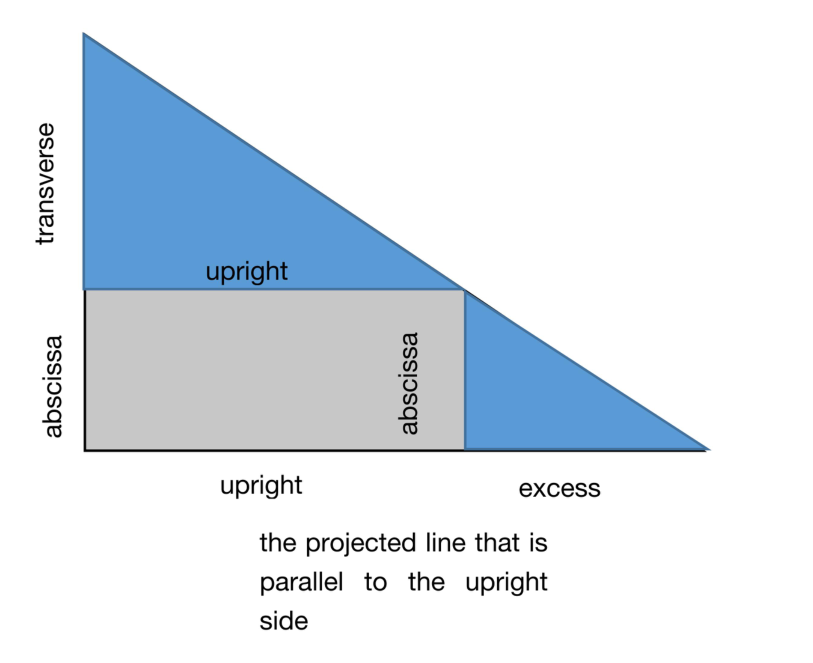
This identity is confirmed when we see how the figure is ‘determined’. Since similar triangles are constructed along that ‘determining [διορίζουσα] line’, in an hyperbola, the base that corresponds to the upright side of the section in the constructed triangle exceeds the upright side, while in an ellipse, the same base falls short of the upright side. Therefore, in an hyperbola, the rectangle contained by the abscissa and this line ‘drawn parallel to’ the upright side (these formulations on how this line should be drawn I from now on shorten into the term ‘projection’, and the line thus drawn that is the base corresponding to the upright side of the section in the constructed triangle I from now on will call ‘the projected line that is parallel to the upright side’) shall be equal to that area which is the rectangle contained by the abscissa and the upright side plus the projected rectangle, similar and similarly situated to the rectangle contained by the transverse and upright side. For since the triangles constructed in Proposition 21 are similar triangles, the ratio between the excess the projected line that is parallel to the upright side has to the upright side and the abscissa should be equal to the ratio between the upright and the transverse side, as is displayed in the first diagram below (see the diagrams below).
When the abscissa is taken as the common height, the rectangle contained by the projected line that is parallel to the upright side and the abscissa should exceed the rectangle contained by the upright side and the abscissa by a rectangle contained by the excess length and the abscissa, which is equivalent to the figure projected beyond, similar and similarly situated to the rectangle contained by the transverse and upright side. Thus, we see the equivalence between that rectangle contained by the projected line that is parallel to the upright side and the abscissa, and that rectangle contained by the upright side and abscissa plus a rectangle projected beyond, in the case of an hyperbola.
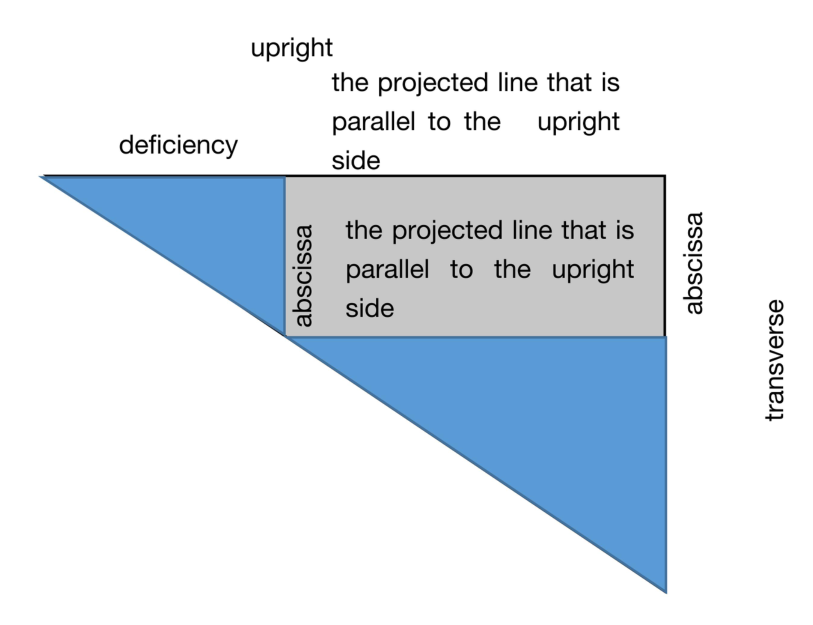
This formulation of a rectangle contained by the projected line that is parallel to the upright side and the abscissa also includes the case of an ellipse. For in an ellipse, the figure is depicted like the second diagram below (see the diagrams below).
Likewise, in the case of an ellipse, the rectangle contained by the projected line that is parallel to the upright side and the abscissa is essentially identical to the area of a rectangle contained by the upright side and the abscissa deficient of a rectangle projected within the figure similar and similarly situated to the rectangle contained by the transverse and upright side. Since this formulation of ‘a projected line that is parallel to the upright side’ is consistent to the scenarios depicted in both cases, it is legitimate to establish the synonymity between the hyperbola and the ellipse in this proposition.
So far, it is implied that because of the multiple commonalities shared between the hyperbola and the ellipse, there are also multiple occasions by which the two figures can be treated in a synonymous way. Depending on the particular end the proposition aims at achieving, the commonality actually used in the proposition might differ in its level of specification. For instance, one commonality might simply be that only the hyperbola and the ellipse have both the upright and transverse side. It could also be like in Proposition 21, where the commonality is further specified as a certain relationship that abscissa holds to the corresponding ordinate, through the mediation of the upright and transverse side. In Proposition 21 we see both at work, for the establishment of the relationship between the similar triangles is only contingent upon the existence of a transverse side. So when both the hyperbola and the ellipse have the transverse side, the synonymity is evident. But with the later determination of the rectangle contained by the projected line that is parallel to the upright side and the abscissa in relation to the square on the ordinate, a further specification of this synonymity needs be clarified. Therefore, what is required is to establish that both the species of ‘the area that is a rectangle contained by the upright side and by the abscissa plus a rectangle that is projected beyond, similar and similarly situated to the rectangle contained by the transverse and upright side’, and the species of ‘the area that is a rectangle contained by the upright side and by the abscissa minus a rectangle that is projected within, similar and similarly situated to the rectangle contained by the transverse and upright side’, belong to the genus of ‘a rectangle contained by the abscissa and the projected line that is parallel to the upright side’. This figure of a higher generality is what the proposition is interested in (to effect the crucial step of the substitution of the square on the ordinate by this figure), and it is this more general figure that becomes the ideated object for this proposition, thus the differences can be overlooked. How such a figure of higher generality can be treated as one object, however, is a much more complex question that has grave philosophical implications.
本文由 AI 从英文原文翻译。请以原文为准。
为回答为什么双曲线有时可以与椭圆同义地处理,我的假设是:第一卷的命题12与命题13揭示了这两个图形共有的性质。因为正是在这两个命题中,双曲线与椭圆的定义首次被提出。因此,只有通过理解这两个命题,才能最原初地确定这两个图形之间本质的差异与相似。
命题12所表述的双曲线定义,在此由我概括如下:双曲线是一种圆锥曲线,其纵线(ordinate)上的正方形,等于与该纵线对应的横截线(abscissa)和直边(upright side)所围成的矩形,加上一个向外投出的图形;这个图形“与[轴]三角形[顶角]外角的对边和参数所围成的矩形相似且位置相似”。参数就是后来所谓的直边,而“[轴]三角形[顶角]外角的对边”不是别的,正是横边(transverse side)。
如果我们阅读命题13,就会发现椭圆的定义在结构上与之相同。我将其定义概括如下:椭圆是一种圆锥曲线,其纵线上的正方形,等于与该纵线对应的横截线和直边所围成的矩形,减去一个向内投出的图形;这个图形与横边和直边所围成的矩形相似且位置相似。若再仔细一些,考察椭圆中直边的确定方式是否与双曲线中相同,我们就会发现,确实如此。因为在两种情形下,直边都是根据相同的项以相同次序构成的比例来作出的,即横边与直边的比,应当等于一个正方形与一个矩形的比:该正方形作在那条平行于截平面、从圆锥顶点引到底面的直线上;该矩形则由两条线围成,一条连接轴三角形底边的一端与该底边和前述平行于截平面的直线的交点,另一条连接轴三角形底边的另一端与同一个交点。而且,双曲线的横边与椭圆的横边似乎也没有本质差别,因为两者都表示截平面沿同一直径与曲线相截的两点之间的距离。此外,“最初的定义”把直径定义为这样一条直线:“从曲线上引出,平分所有按某一直线方向平行地引至该曲线的直线。”所有截线的直径,包括抛物线的直径,都具有相同定义。但是抛物线没有横边,因为它的直径不在两处与圆锥曲线相交,因而不规定两交点之间作为横边的那段确定距离。因此,我们可以合理地反推:既然双曲线与椭圆共享直径的同一定义,又与抛物线不同,都在直径上具有横边,而各自横边的确定方式在本质上是同一种,确定比例中的其他各项也相等,那么它们对直边的确定在本质上就应当是同一种。既然这两种图形的定义都依赖于直边的确定,在其他条件相同的情况下,它们的定义就应当归属于一起。因此,两命题之间的差别是表达上的差别,而非本质上的差别。
为了检验这一假设,我现在转向将双曲线与椭圆同义地处理的命题21。这个命题旨在证明:在一个非抛物线的截线中,纵线上的正方形与“从图形横边两端起、由[纵线]截出的直线”所围成的矩形之比,等于图形的直边与横边之比。在双曲线中,横边的一端是截线的顶点,另一端则位于该截线之外,是相对截线的顶点。然而,在椭圆中,横边的两端都位于这一闭合图形上。虽然“由纵线截出的直线”——后来被称为“横截线”——在两种情形下都共享同一定义,即顶点与直径上的截点之间的距离,但仍有一个差异:在双曲线中,一条横截线被表示为横边加上另一条横截线,而在椭圆中,一条横截线被表示为横边减去另一条横截线。然而,这一差异对于命题21的第一步并不关键,因为这一步在于确立相似三角形之间的比例。在这里,唯有比例重要。既然这一差异并不改变如下事实,即借助从横边经直边、穿过“确定线”的投射可以形成相似三角形,那么这一差异就无关紧要。在塔利亚费罗的图中,如此形成的两个相似三角形是三角形ABC和三角形GBK。我们可以看到,取决于横边位于截线外部还是内部,那个与横边和直边构成的三角形相似且位置相似的三角形,或是超出,或是不及横边与直边所构成的三角形。但如上所述,这一步重要的仅仅是这两个相似三角形之间成立的比例。因此,无论投出的三角形超出还是不及横边与直边所构成的三角形,只要三角形相似,比例就成立。所以在这里,只要双曲线与椭圆都同时具有横边与直边,就能够形成相似三角形,而该关系也依然成立。
证明所要求的另一个条件更为具体。因为为了最终以一个矩形替换纵线上的正方形,这个矩形由横截线与另一条线围成,后者经过纵线与直径的交点,平行于直边作出,终止于“确定线”(如此作出的直线在塔利亚费罗的图中相当于GK线);而“确定线”则是连接横边另一端与直边另一端并无限延长的直线。为完成这一替换,必须运用命题12和13,首先确认上述矩形与如下图形相同:在双曲线的情形下,是对应横截线与直边所围成的矩形加上一个向外投出的图形;在椭圆的情形下,则是对应横截线与直边所围成的矩形减去一个向内投出的图形。在两种情形中,所说的投出图形都与横边和直边所围成的矩形相似且位置相似。
当我们看到图形如何被“确定”时,这一同一性便得到确认。既然相似三角形沿那条“确定[διορίζουσα]线”构成,那么在双曲线中,所作三角形中对应截线直边的底边,就长于直边;而在椭圆中,同一底边则短于直边。因此,在双曲线中,横截线与这条“平行于”直边“作出”的线所围成的矩形,应当等于横截线与直边所围成的矩形加上那个投出的矩形的面积;后者与横边和直边所围成的矩形相似且位置相似。(从现在起,我将关于这条线应当如何作出的这些表述简写为“投射”,并把如此作出的线——也就是所作三角形中对应截线直边的底边——称为“平行于直边的投射线”。)因为命题21中所作的三角形相似,所以平行于直边的投射线超出直边的部分与横截线之比,应当等于直边与横边之比,如下面第一幅图所示(见下方图示)。
把横截线作为共同的高,平行于直边的投射线与横截线所围成的矩形,就应当比直边与横截线所围成的矩形多出一个矩形,这个矩形由超出的长度与横截线围成,等同于那个向外投出的、与横边和直边所围成的矩形相似且位置相似的图形。这样,在双曲线的情形下,我们就看到了两者的等同:一个是平行于直边的投射线与横截线所围成的矩形,另一个是直边与横截线所围成的矩形加上一个向外投出的矩形。
以平行于直边的投射线与横截线所围成的矩形作出的这一表述,也包含椭圆的情形。因为在椭圆中,图形如下面第二幅图所示(见下方图示)。
同样,在椭圆的情形下,平行于直边的投射线与横截线所围成的矩形,在本质上等同于直边与横截线所围成的矩形的面积,减去一个向图形内部投出的矩形;后者与横边和直边所围成的矩形相似且位置相似。既然“平行于直边的投射线”这一表述与两种情形所描绘的情况都一致,就有理由在这个命题中确立双曲线与椭圆的同义性。
到目前为止,已经隐含地表明:由于双曲线与椭圆共享多重共同性质,也就存在多个可以将这两种图形同义地处理的场合。取决于命题意欲达成的特殊目的,命题实际使用的共同性,在具体程度上可能有所不同。例如,一种共同性可能仅仅是,只有双曲线与椭圆同时具有直边和横边。也可能像命题21那样,共同性被进一步具体规定为:通过直边与横边的中介,横截线与对应纵线之间成立的某种关系。在命题21中,我们看到这两种共同性都在起作用,因为相似三角形之间关系的确立,仅仅依赖于横边的存在。因此,当双曲线与椭圆都具有横边时,其同义性就显而易见。但在后来确定平行于直边的投射线与横截线所围成的矩形和纵线上正方形之间的关系时,就需要进一步澄清这一同义性的具体规定。因此,我们必须确立这样一点:一类是“直边与横截线所围成的矩形,加上一个向外投出的、与横边和直边所围成的矩形相似且位置相似的矩形的面积”;另一类是“直边与横截线所围成的矩形,减去一个向内投出的、与横边和直边所围成的矩形相似且位置相似的矩形的面积”。这两个种都属于同一个属,即“由横截线与平行于直边的投射线所围成的矩形”。这一具有更高普遍性的图形,正是该命题所关心的(以实现那一关键步骤,即用这个图形替换纵线上的正方形);而也正是这一更普遍的图形,成为此命题的理念化对象,差异因此可以被略去。然而,这样一个具有更高普遍性的图形如何能够被当作一个对象,则是一个复杂得多、并具有重大哲学含义的问题。