Edmund Husserl · 埃德蒙德·胡塞尔
Ontology and phenomenology · 本体论与现象学
24年Majo论胡塞尔笔记
Douban · Bidasari
Source revised / 来源修订: 27 June 2026
Reading / 研读:Claudio Majolino / 克劳迪奥·马约利诺 · The Invention of Infinity: Essays on Husserl and the History of Philosophy 无限的发明:胡塞尔与哲学史论集
In this note / 篇目
Majo论胡叟的本体论思路
Majo的无头本体论写得很清楚,其基本思路大概分为几个步骤。首先,给出tode ti与Wesen的不可分割性;任何一个“此物”都必然聚集了诸本质;这样的双重运动就是亚的“物性”的双重运动。
然后,eide与“此物”之间也有相互转换的运动。“此物”可以上升到eide,而eide也可以下降到“此物”。当这双重运动的可能性(尽管仍然是非对称的)被给出后,本质就可以在上升-下降的纵轴上被联系为一个整体把握。
接下来,Majo指出,诸本质结构除了有纵向的genera-species关系,还有横向的互补关系。也就是,诸本质结构“之-间”可能相互独立或相互补充;如果一个本质结构的整体是独立的,那它就是具体的;如果这个本质结构需要其它本质结构的补充,那它就是抽象的,而当补充完成于一个结合这些本质结构的新区域的诞生时,这个新区域相对于之前的抽象结构就可以被视作具体的。而胡叟意义上的个体individuum就是具体的本质结构。
而具体和抽象的诸本质结构需要被统握在同一个区域当中,这一区域就是存在区域。然而这一个新的绝对的区域并非是传统意义上的“最高属”,因着最高属无力刻画诸本质结构之间的交互关系(作为最高属的“存在”只意味着一切事物都分有存在,然而各自以什么方式占据对存在的分有却无法被具体刻画)。这一区域被胡叟刻画为是pros hen,并最终被归于先验的而非本体论的,因此被称为无头本体论。建立一个本体论意义上的最高区域的主要困难似乎是,如果有这样的pros hen的区域,那似乎说明了本来被视作具体的本质区域也变成需要其它本质区域补充的抽象区域了。
补充两点,一个是tode ti并非是“此在(Dasein/Existenz)”,因为tode ti本身也是一个是接受其它的本质范畴作为其谓语的本质范畴,而“此在”则是尚未被把握或者无法被把握为理智范畴(intellectual category)的直接性(比如仅仅在物理经验上有意义的感知材料),换句话说,tode ti是属于一个个体关联于其它本质的“此性(thisness)”,这个“此性”在对个体的本质判断中被完全决定(fully determined by essences),所以可以说“此红”;另一个是,在判断“这是红的”中,个体的tode ti被归化(subsume)于范畴,而范畴同时下降于个体而实例化(exemplification),但在判断“红是一种颜色”中,一个范畴(作为eidos)被归附(subordinate)于另一个更高的eidos,而更高的eidos同时下降于较低级别的eidos而特殊化(speciation)。
Majo论胡赛尔的Mannigfaltigkeit(manifold):
1. 「Mannigfaltigkeit(manifold)」作为一个关键的概念,有三种不同的含义,其一是纯粹的「多性(multiplicity)」,其二是康托尔所定义的「以确定/可直观的秩序所规定的一-多综合」,其三是黎曼所定义的「以某种秩序被连续构造出的一-多综合」。像感知物就是以第三种方式构造出来的。
2. 不同的存在区域具有不同的「一-多结构」,这也是我康德论的中心。完整的存在是多种「一-多结构」的综合。这是反海德格尔的,因为海德格尔将「存在-存在者」的问题视作根本问题,其所强调的本体论差异因此至多只能是一种抽象,而无法达成对其具体结构和区域的刻画。
3. 诸manifold间有一个很重要的区分,就是「自造」与「它造」的区分。「自造」者一旦将其统摄的结构性元素取消任何一个,其整体就失去了意义;换句话说,「自造」者的每一个结构性元素都是相对的,所以失去了「原初印象(primal impression)」的「前摄」是完全没有意义的,失去了「左」的「具身空间」也是没有意义的。而「它造」者则相反,对其某个结构元素的取消仅仅意味着这个整体本身被转化成了新的结构,比如如果取消了所有的「侧显」,感知物就只是被转化成了图像,但其作为图像依然具有自己的意义和一多结构。对「它造」者来说,每一个元素都是自在独立的元素。
4. 正是因为「自造者」的这一特性,意识才得以被称作是绝对的,因为绝对意识正是那一「活的当下」,而对这一根本活性的任何结构上的变更都是不可想象的。同时,也可以理解为什么「超越性」与「超越构造/未构造性」是完全不同的概念。「超越性」恰恰是在活动中被构造出来的,而那「超越构造」的东西无非是在上一个活动中被构造出来又被被动接受的产物罢了,其接受本身强调的是沉淀的「被动性」或者「他者活动/另一个活动」的超越性,而这一「超越性」仅仅是相对的、总可以再次被激活为活动本身的内在超越的。
5. 所以Majo对胡赛尔的理解是非常德勒兹化的。重要的并非是「一」相对于「多」,而是「一-多互摄」的诸结构。德里达对柏拉图主义的的批评因此是无效的。胡赛尔真正的柏拉图主义在于对那种「自造者」的探究;因为「自造者」与「无意义」接壤,对它的探究自然就成为了对「意义」本身根源的探究。但是这一对意义根源的探究触及了变更与还原的最底部:如果这些根源亦一同消失了呢?世界终结的可能性依然还是一个问题。
Majo论胡赛尔的「态度(attitude)」概念:
1. 「态度」指的是一个活的经验与其它活的经验不以「奠基(founding)」的方式被综合成一个整体,而是以「跃出(saliency)」的方式,某一个活的经验获得了更强的活性,而作为构成一个整体的某个部分成为了这一整个整体的「符号」。比如说,语言中「发声」的经验奠基了「传义」的经验,可「传义」的经验,作为语言整体经验的一个部分,相比起「发声」的经验获得了更高的权重。这一种「跃出」因此强调的并非是意义在本体论上的结构,而是意义相对于主体之关注的结构(what matters)。
2. 「跃出性的统一(unity of saliency)」有三法则,其一,其指向的并非一般存在,而是那使朝向它的主体活动更具有活性的存在(what matters);其二,任何此类统一都是有条件的、偶然的;其三,这一统一是力与力、强度与强度、活性与活性之间的对抗和动态均衡。
3. 最宽泛的三种「跃出性」的结构是,「存在-意见」,「目的-意志」和「价值-情动」。任何跃出性都可以被这样归类,一个东西在视野中跃出,无非是因为它正作为存在被认识,或作为目标被意愿,或作为价值带来感触。任何暂时的或者偶然的跃出性统一都是广义上的「态度」;而有些「态度」不仅持久,甚至还可以作为某种惯习(habitus)主体间继承。
4. 有一种态度并非是作为制造出的惯习被继承下来的,而是一种必然的、自然的态度,这就是「自然态度」。「自然态度」是一切「态度」的根基,因为一切态度都是建立在「世界信念」之上的,「世界」作为存在者和理论认识的全体,作为目的和实践行动的全体,以及作为价值和精神活动的全体。
5. 「态度」因此有几个层面:a. 如果有着朝向,这一态度永远间接指向「实存的、事实的世界」,因此是自然的;b. 各种态度本身也在交互主体性构成的内在意义网络中,因此是共构成的,这种「共构成」的态度可以是自然态度也可以不是,同时诸自然态度可以是被共构成的也可以是被人工取消了其构成性维度的自然主义态度;c. 一种态度可以朝向对象,也可以朝向活动着的意识本身,而这种「自反」也完全可以是对意识活动的对象化;d. 当态度直接地指向「世界」作为全体的时候,其对应的态度也获得了「世界性」,比如理论态度就此成为了存在者全体的科学,实践态度就此成为了对绝对者的政治决断,而估价态度则成为了诠释启示的宗教。
6. 如果一个态度只是朝向有限者,那它就仍然没有达到真正的无限理念。但如果一个态度达到了无限的理念,却将其不加批判或还原地视作一个客观给予的事实,也就是,不将「自反性」完整地、踏实地实现出来,而是抽象出某个孤立于完整生命的片面活动(类比于斯宾诺莎处抵达了无限的「质性(attributes)」却没有将这些「质性」综合成完整的大全),那即使「主体」被划定为此理念的构造源泉,这个主体依然是抽象的对象。无论是否表面上有自反,根底里这都是“对象化”,而并非真正的绝对者的辩证统一。这样的态度也因此依然停留在自然态度中,即使它是无限的自然态度。
7. 这些无限但抽象的「自然态度」包括:实践上的浪漫主义,理论上的自然主义,和价值上的神秘主义。对这些态度的克服就在于,首先,引入更多这些态度所缺失的面向,使主体获得精神上的整全性;而这一整全性允许了主体进行不同态度的彻底变更,因为诸「跃出性」在一个整全的主体内部获得了最稳定的均衡,所以任一「跃出」都无法彻底压倒其它的「跃出」,而此时想象力对「跃出」的自由变更就成为了可能;正因为「世界」不再仅仅是存在者全体,而同时还是全部价值和实践的场所,「世界」的存在因此在向其它的无限的自然态度过渡时被悬置了;尽管「世界」对任意一个态度而言都依然是一个信念,但对已经具有了整全性的态度而言,「世界」成为了“可以”存在中立、价值中立、目的中立的「世界」,我们需要的只是想象力变更对这个世界实际上的「中立化(neutralization)」;或者说,彻底的想象力变更恰恰是态度之整全性的根本内容。对理论上的自然态度的变更就是现象学还原,「现象学态度」就是整全的理论态度;类似的,重估一切价值的「超人」的态度就是整全的审美态度;实现了社会生产与自我技术统一的「辩证唯物主义」的态度就是整全的实践态度。
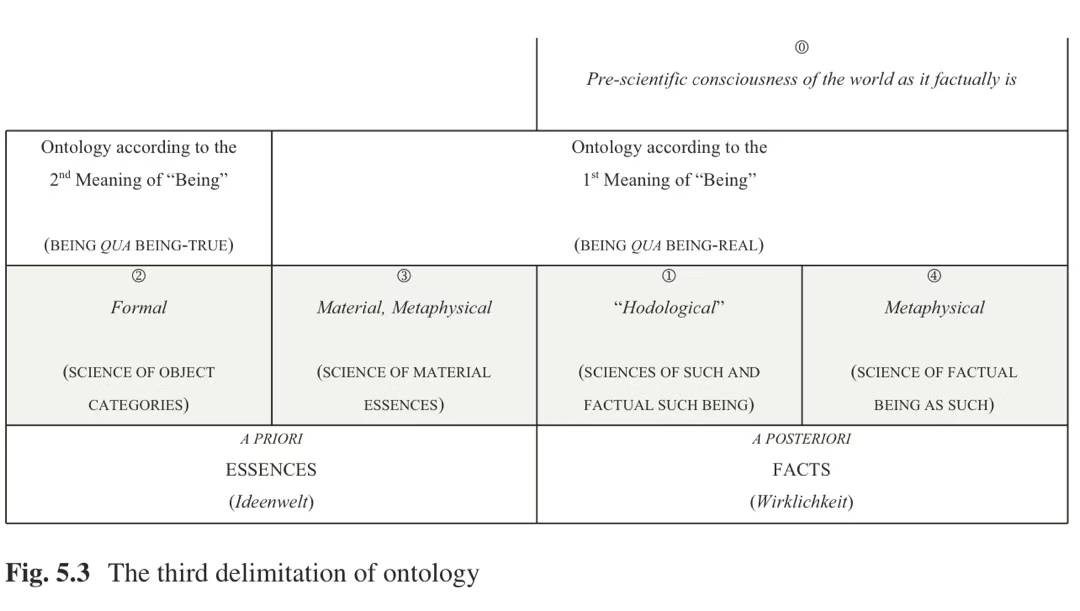
Majo绘制的胡赛尔本体论地图:
1. 从「前科学的生活世界」到「诸经验科学」的上升所依赖的意识成就是「理念化(idealization)」,这也是最初的「无限」,即将「存在之类型(type of being)」把握为「存在之理念(eidos of being)」并对这一理念对象之结构和构成本身进行澄清,再让这一理念结构重新沉降回「实在(reality)」。这一个「图像-原型」的关系就是希腊科学最本源的关系。
2. 在「诸经验科学」之上统御着一切科学的正是「形而上学」。「形而上学」的对象是那最高的理念,即「实在本身(being as such per realiter)」的理念。但是这一「实在本身」如果要获得完全的、一般性的界定,意识必须进行另一种构造,即对「形式对象」的构造。这就牵扯到意识的第二个成就,也是对更高级的「无限」的成就,也就是现代科学所达成的「符号化」。「符号化」带来的因此并非「作为一般实在的存在(being as general reality)」,而是「作为一般真理的实在(being as general truth)」,或者说,其对象是「一般世界(world in general)」,纯粹形式意义上的「合规则性(regulativeness)」。
3. 「形而上学」占据着在「符号化」和「理念化」之间的过渡位置。一方面,它并不是无视直观奠基之秩序的纯粹可能性的平面,另一方面,它也不是无限攀升的理念阶梯上的任意一个点。意识需要「符号化」去将「形而上学」从「有限的经验科学」或者「区域本体论」中解放出来,成为纯粹先验的科学;但这并不意味着「形而上学」就是「形式逻辑」。相反,「形而上学」需要「理念化」将形式符号重新奠基为「此世之一般实在」,也就是要成为那使经验可能的「实在之根」;这就是康德那里先验唯心主义的意义,就是指占据了绝对的先验位置后对经验对象的朝向。「符号化」就是对先验位置的占据,「理念化」则是对经验的朝向。这一朝向是两方面的,一方面,「形式逻辑」要获得自己的形而上学起源并作为意识在「我们所拥有的这唯一一个世界」中的成就被奠基,另一方面,「形式逻辑」要划定出自身内容中属于「实在」的、可激活的部分,并重新取得对「实在」的(先验)直观。
4. 如果缺失了「形而上学」对「实在之纯粹可能性」的先验奠基,那最终我们的科学就只能得到一种抽象的「验证关系(verificatory relatedness)」,即,科学的组成元素将局限于孤立的「假设」与「验证」,局限于事实性的有与无,而非实在与潜能的交互奠基:并不讨论假设是如何在经验中被构造出来,也不讨论验证实验是如何在理论态度中获得奠基,而仅仅将两者视作各自关闭的本体论区域,而无视其区域之间连续的构造关系。这就是欧洲科学的危机。
5. 最终的科学就是由导向先验的形式本体论与导向后验的诸经验科学共同奠基的形而上学,一种获得了先验实在与事实实在本质关联的绝对的形而上学。
Majo论胡赛尔「绝对意识」:
1. 「绝对性」有三个含义,一个是说这一存在者本身的构成方式是无条件的,或者说,组成其存在的任意部分都必然要求其它所有组成部分才能获得意义,「绝对意识」在此处就是指自构成的内时间意识;一个是说一个东西作为「个体」并非是抽象的,而是「独立于任何其它个体」的个体,并因此是无需依靠其它类似的「个体」也足以获得意义的,尽管它并非是自构成,而是依赖于其它抽象范畴,「绝对意识」在这个意义上就是具体的第一人称的「自我」;最后一个则是说,一个区域有着构成其区域本质的先验法则,而这一区域所包含的任何个体都是对这一区域之法则的实例化,这个意义上的「绝对意识」因此就是「构成了一般意识的根本先验法则」。
2. 那么当胡赛尔说「世界可以毁灭,可绝对意识必须持存」时,他是在说哪个绝对意识呢?很明显,只有对第一个绝对意识,即那世界毁灭后依旧绝对实存着的意识,下这个判断才有意义。一方面,如果绝对意识指的仅仅是独立的「我」,那任何独立具有意义的事物都可以说是绝对的。另一方面,如果绝对意识指的是意识区域,那世界作为一个区域当然也不会是相对的。所以,如果我们要理解意识相对于世界的绝对性,我们必须要把握住意识的自造性,同时,也要把握住世界相对于意识的它造性。
3. 通过「本质变更(eidetic variation)」,意识足以达成两种成就。一种是达到「本质直观(categorial intuition)」并由此获得从「此性」里剥离的作为对象的「理念(eidos)」,一种是通过变更,明确某个理念所统摄的领域的外延范围和内在法则。一本书在何种情况下不再能被合适地称作一本书,一个人何种情况下不再能被合适地称作一个人,以及一个世界何种情况下不再能被合适地称作世界。
4. 在剥离了与「意识」的关系后,「世界」足以失去其意义而坍塌成「非世界」。这一方面说明,形式上,「世界」是「它造」的,所以在失去一个结构元素后,它并没有失去意义,而是转变成了新的东西;另一方面,内容上,「意识」与其有本质上的关联。但剥离了「世界」,「意识」依然有其构造出的对象,即「非世界」,因为意识一方面具有「自造」的本质结构,而这一「自造」者是不依赖于「世界」的。
5. 这也可以体现胡赛尔哲学的激进性。「形式本体论」的对象无非是「一般合宜世界」或者「世界性」本身,而「质料本体论(形而上学)」的对象则是构成了此世的「一般实在」;但它们作为本体论却都无力刻画那超出了「世界」或「世界性」的「纯粹质料」或者「非-在之深渊」。而胡赛尔的先验现象学,通过对意识构成活动而非对存在的描述,依然能做到对「非世界」之意义的探究。胡赛尔的先验现象学因此处于诸本体论的外部,并具有比海德格尔对存在问题的关注更为激进的理论疆域和理论深度;或者哪怕海德格尔的存在问题同样试图超越形而上学,他对胡赛尔依旧停留在形而上学传统内的批评是不公允的。
Majo论「想象力」:
1. 在沃尔夫处,「生产官能(prodictive faculty)」是类,「想象力(facultas imaginandi)」是对「图像」的一种不依赖于当下感知的生产(记忆作为再生产官能则可以察觉这一生产出的图像对经验内容的依赖性),「虚构力(facultas fingendi)」则是对生产出的图像进行随意变更与实验直至其创造的图像得以独立于过往经验甚至一切可能经验的官能。
2. 康德对沃尔夫的概念进行了改造。在沃尔夫那里,「想象力」的生产与「记忆」和「预见」的再生产是分开的。但是康德将记忆之再生产的源头划给了想象力的生产:一切再生产都依赖于想象力在当下更为原初的生产,记忆和预见都是一种想象。同时,想象力不仅有着经验上与「当下感知」区别开来的意义,还有着先验上进行「纯粹直观」的功能。想象力因其经验上进行图像生产自由性得以通达先验意义上对一切直观的奠基,尽管在康德这里,先验想象力并不具备经验想象力的「创造性」。
3. 海德格尔和利科继承了康德的洞见,并将康德处想象力的「经验的-先验的」重新解释为「存在者的-存在的」。这样,艺术或诗歌的想象力就成为了对真理的「去蔽」,并作为更原初的存在决断奠基了、丰富了对「世界」和「存在者全体」的解释。
4. 胡赛尔对「想象力」概念的改造是两方面的。首先,他将「先验想象」转化为「被动综合」。由此,「想象力」不再是一个对「世界」进行整全创造的力量;相反,「世界」是在经验中才能被确证的先验结构,「世界」与「被动综合」是交互着构成的。然后,他从「想象力」的经验心理范畴中还原出了「想象力」的本质结构:「想象力」就是那朝向了以「随机(arbitrary)」方式组合成一个整体之对象的意向性。这里的「随机」可以是弱的,也就是如历史学所追求的对诸材料的和谐的整理,「随机」在这里仅仅意味着一个精确法则的缺位而已;也可以是强的,即诗性的「自由」,这里意向达成的对象是审美态度里的价值的冲突统一,而非理论态度里的存在的冲突统一。同时,诗性自由需要与幻想的自由区分开来,因为诗性自由并非是没有规律的,而是这个规律与「存在」无涉,而仅仅是「表象」的规定。
5. 如果说海德格尔理解的想象力意图将诗引入对「世界」的重新解释,那么胡赛尔理解的想象力则允许了对「非世界」(一个不在理论态度内获得其统一性的视域)的意向。海德格尔认为诗歌能让此在通过“它世”重新认识“此世”,而胡赛尔则认为主体得以通过“非世界”达成对“世界性”的认识。胡赛尔的想象力因此具有比一般解读中更加激进的面向:一种毁灭世界的想象力。
Majo论「合宜」:
1. 布伦塔诺在他的本体论和心理学研究中都利用了「合宜/不合宜(proper/improper)」的划分。在本体论层面,布伦塔诺将亚里士多德所说的「存在的多义性」还原为「存在的四种意涵」,再将这四种中的三种视作「不合宜的」,而仅保留了「范畴意义上的存在」;接着,又将「本体」这一范畴视作唯一合宜的存在的意义。心理学上,布伦塔诺将「心理行动(psychic act)」视作合宜的存在,而将与行动相关联的「内在意向对象(immanent intentional object)」视作不合宜的。
2. 海德格尔认为自己继承了布伦塔诺的亚里士多德式本体论,而胡赛尔继承了布伦塔诺的意向性心理学。但实际上,海德格尔真正继承的是对存在的「合宜」的问题,也就是,什么是对「存在」最原初的、合宜的理解。
3. 早在「算数哲学」阶段,胡赛尔就已经意识到「合宜/非合宜」这一组对立的局限性了。因为「数」并不是直接建立在对「诸多(multitude)」的经验直观中的概念;相反,「数」反而是根据形式规则进行运算的一种符号算法所需要的元素。这也是为什么「负数」、「无理数」、「虚数」等等不能粗暴地被视作是对“合宜”的「自然数」的概念非合宜的扩张。这里不再是「合宜」对「非合宜」的“起源(origination)”,而是「简单对象」对「复杂对象」的“奠基(foundation)”。简单来说,「自然数」奠基了符号数学的先验可能性,并与符号数学“分享”某种最普遍的形式法则,但这并不意味着「自然数」本身所具有的特殊的法则因此就是“更原初”“更本真”的。要理解数学我们自然需要理解自然数,但这不是因为其它的数学都可以追溯回对自然数的直观与计算,而是因为内在于任何数学聚落(manifold)的具体结构都是从对自然数聚落的结构的超越和更改中发展出来的。
4. 因此,当谈及「存在问题」时,胡赛尔将「存在」放到「范畴直观」这个区域探讨。「范畴直观」并不与「经验直观」共享一样的结构。相反的,「范畴直观」指的是,经验对象在语言中获得「意义关系(signitive relatedness)」,并作为意义的复杂对象被直观。如果说「经验直观」构造的是作为“一个”感知物的简单对象的话,那「范畴直观」指的就是对这一感知物与其它感知物之间关系的判断。「存在」因此并不是作为被单拎出来的一个大写名词而是作为语句中的具体构成元素成为问题的。「存在」是一种关系,而不是一个名词化了的对象,而对「存在」的名词化最多只能是一个特殊的结构。作为一种意义关系,「存在(is/being)」与「与(and/collectivity)」与「或者(or/disjunctivity)」等等是同等地位的,甚至我们可以说「存在」无非是与「与」这一结构相似的一个特殊结构。「一-多」问题并不比「存在」问题更浅显。如果说形式本体论是对「一-多」问题在「世界性」这一个框架下的探究,那先验现象学就可以说是对「一-多」问题,即对一切「一-多」构成的演绎描述,在任何框架下都可以进行探究的最高的科学。
5. 所以,如果说海德格尔的「探源」过度依赖于词源学的话,那么胡赛尔就把握住了词源学的不可靠,因为语词之间的意义结构总是偏移的、差异化的。胡赛尔的「探源」或者「历史探问」恰恰是对过去之视域的激活,其历史目的论是以可能性与开放性为“中心”的目的论,是对每一代主体成就的探问,而非依赖于对「存在」的某种“原初解读”去“毁灭”过去的历史与传统。哪怕欧洲科学的危机源自对生活世界的遗忘,这也不意味着生活世界就是相比之科学“更原初”的,而仅仅是因为生活世界需要为科学奠基,才能让科学实现自身的愿景。生活世界并不是来摧毁伽利略的,而是去通过对伽利略的批判,获得对伽利略本人成就之意义的真正充实。历史并非是「存在之遗忘」的历史,而是过去与未来彼此联系彼此成就的「交互主体」的历史。
6. 唯一一个依然可以使用「合宜/非合宜」的场合就是在每个聚落(manifold)内部自有的意向性充实(fulfillment)标准,所以数学并不要求自然直观而是要求范畴直观的充实;而正如理性有自己的「合宜」,非理性亦有自己的「合宜」,关键是这些「合宜」在世界内彼此和谐的构成结构(前定和谐),而不是一个合宜对另一个合宜的统治。
Majo论lekton与noema:
1. 萨特在讨论「否定」时引入了斯多葛学派的「lekton」和胡赛尔的「noema」作为参照。对萨特来说,「lekton」和「noema」作为「意义」并非是对象,而是意识所朝向的对象;此外,它也并非是「定在着的意识行动(the conscious act that positively is)」本身,而是在本体论上“依赖”于意识行动并“内在”于意识行动的一个对象。在这个意义上,无论是lekton还是noema都无法如「否定/非在」一样成为对现实本身进行构建的「强结构元素(a robust structural element)」。
2. 但是萨特对lekton和noema的解读是错误的。noema并不是内在于noesis的内容对象,lekton也不是内在于表达行动的表征内容。这一点德勒兹比萨特看得透彻。德勒兹准确地区分出了lekton的特殊性:作为「意义(sense)」,它既不是作为语词组合的「表达」本身,因为它是那被表达的;也不是任意语词组合所指称(designate)的物或事态,因为它关联于意识而并非独立于意识;也不是被显露(manifest)出来的意识行动及其内在的关联内容,因为它是意识所指向的对象,而并非行动本身;也不是被意谓(signify)的概念关系,因为哪怕是取消了概念之间基本范畴关系的诗歌,比如策兰「手臂被群天环兀鹫着/灵被土星着环绕(von Himmeln umgeiert die Arme, die Seelen saturnisch beringt)」,依旧具有「意义(sense)」,即使这「意义」并非是「意涵(meaning)」。相反的,这个「意义」并非是试图将表达还原为概念之间的主谓从属关系,仿佛这个意义是某个概念的一个「属性(property)」,也不是要这些概念遵照某个固定的「构象(configuration)」,仿佛这些概念有某些「内在的倾向」去以特定的方式结合在一起;毋宁说,「意义」是在概念之间“发生了”的事件,因此是绝对的生成。
3. 由此,lekton并非概念,而是对概念的构象(configuration)。用胡赛尔的话说,lekton即判断所朝向的「复杂对象」,是诸简单对象在逻辑上被综合起来构成的事态或事件,或者说就是那形式逻辑所朝向的意义对象,而其直观上的对应就是范畴直观所构造的形式本体论。胡赛尔的现象学因此达成了德勒兹所赞赏的「斯多葛运动」,它的形式主义一方面完成了对亚里士多德的「存在/实在」问题的反叛,从存在的阶梯和本体论差异转向了「任何东西」的多元平面;另一方面,它的先验立场又是反柏拉图理念实在论的,因为诸理念并非是实体(real entity),而是先验还原后被悬置了存在并在经验中被奠基的作为主体成就的对象(object)。这里必须要先验还原,仅仅是形式主义不足以取消柏拉图主义实在论会设定的形式本身的因果效力,毕竟形式主义只是将形式不加澄清地视作「法则」或者「规定」,仿佛它们确实对「实在」有因果上的规定性一样。然而,尽管德勒兹认识到胡赛尔与他自己的相似之处,他最终只停留在了胡赛尔的形式主义,而拒绝接受先验现象学和先验还原,因为他认为胡赛尔的noema最后还是将lekton转化成了主词的谓词(莱布尼茨式的单子论,作为谓词的事件)。当然,「意义」或者lekton是无需先验还原也可以在形式逻辑和形式本体论里面去讨论的,但noema在最根本是先验还原过后得到的noesis的对应内容。因此德勒兹可以全盘接受胡赛尔的形式主义以及其反亚里士多德的面向,却批评他的先验现象学对柏拉图主义的批评不彻底,没有克服「主语」「谓语」「主体」「对象」这些范畴,而保留了某种“常识上的柏拉图主义”,即依旧把「数」「判断」「关系」这些都视作「东西」,而非「事件」。
Majo论高尔吉亚和柏拉图:
1. 先验现象学之前的哲学有三次开端,因此也带来了三次危机。第一次开端是索伦和泰勒斯。索伦第一次真正建立了「游历,为了智慧」的主题,而这一主题在亚里士多德那里成为了哲学最早的正当性来源,即「所有人在天性上就渴求知识,对此的证明就是我们对感官的喜爱」,而索伦第一次将这一潜能实现为「对世界诸事实的知道和比较」。泰勒斯则将索伦的行动转化为了一种惯习和生活态度,这同时意味着泰勒斯将其整个世界都化作了理论的对象。索伦的生活世界仅有部分是属于理论的,但泰勒斯的整个生活世界就是知识的对象。在泰勒斯之后,前苏格拉底时代的哲学家都继承了他的哲学生活态度,以整个世界作为思考的对象。
2. 但这导致了哲学的第一次危机,也就是智术师的崛起。智术师的态度并非是纯粹理论的,但也不是纯粹无关理论的;智术师真正的态度是对理论的嘲弄和玩笑,是「反-哲学」。因为前苏格拉底哲学家都以某种总体化的灵感为媒介,以整个世界为对象进行一蹴而就的理论化,并因为他们面对的「世界」与构造的「世界本源」的不可通约(比如毕达哥拉斯的「数」,赫拉克利特的「火」,德谟克利特的「原子」,等等),设立了学派与学派之间的壁垒;这导致他们无法有效对抗智术师的批评。这就是哲学的第一次危机。
3. 面对这一危机,柏拉图第二次开启了哲学。一方面,他将哲学的对象改造成了一个具体的「世界」,一个普遍性和特殊性交相辉映的「大全」;另一方面,他将哲学本身纳入哲学思考的范畴,把哲学方法改造成了并非全然依赖直觉或灵感,而是理论和理论之间互相证实的逻辑。这让他足以面对普罗泰戈拉基于「意见(doxa)」的立场对「科学(episteme)」的质疑,但却无法回应高尔吉亚对「与知识相关联的存在之超越性」和「知识本身的明见性对超越性存在的通达」的质疑。
4. 高尔吉亚成为了第二次危机的种子,并最终被更纯粹的怀疑论继承。这导致了哲学的第三次开端,也就是笛卡尔。但笛卡尔虽然触及了主体对外部知识的奠基问题,也就是触及了超越性的问题,却依旧没有达成真正的「哲学」,即「超越论现象学」,因为他虽然讨论了世界的超越性,却忽视了我思主体本身也是被先验自我构成的一个超越性的心理学对象,也因此没有触及真正重要的意向性构成问题。这就是如休谟等经验主义怀疑论者带来的第三次危机——所谓的欧洲科学危机——而这次危机则将真正处理「高尔吉亚-柏拉图」的问题,将彻底的对超越性的怀疑与客观科学理念结合起来,成为那去探究「内在构成着超越性与客观性之主体」的理念科学。
补充3. 柏拉图那里的灵魂预先已经被视作是通达了理念之客观存在(哪怕是晚期柏拉图那颇可疑的理念“生成论”依旧预设了理念的客观被给予性)的中介了,需要的仅仅是通过辩证法抵达理念之客观存在(无论是静态的还是动态的)的网络;但是高尔吉亚怀疑的恰恰是灵魂这一“通达”的可能性。由此,高尔吉亚已经提出了主体与超越性之关联问题。
Majo的无限学园:
1. 胡赛尔将整个哲学史视作以柏拉图的科学的无限理念为中心所构造出的无限的学园社群,因为在柏拉图那里,「大全」第一次获得清晰的把握。这当中,贤者、前苏哲学、智术师和苏格拉底皆有贡献。尤其是苏格拉底是第一个生发了先验主题的思者。胡赛尔再接着综合了亚里士多德的实在本体论(质料本体论)与发轫于斯多葛派的形式本体论。在亚里士多德那里,存在之理念(being as such)被提出,因此他超出了事实形而上学(being of all beings),但要对这一理念进行真正的把握,形式本体论是不可或缺的。而这一切最终汇流于笛卡尔。
2. 胡赛尔对哲学史,尤其是对亚里士多德对柏拉图的继承关系的讨论与中期柏拉图主义很相似。通过这一与中期柏拉图主义的比较,我们可以看到隐藏在对「柏拉图-亚里士多德」这种继承关系的理解底下的并非是简单的两者「教条事实(doctrinal facts)」的重合,而是一种更深刻的连续性。形式本体论和质料本体论和诸经验科学所构成的「理念系统(eidetics)」本身并非是「起源(arche)」,并非是「万物之根」。而通过对哲学史的整全理解,胡赛尔抵达了对哲学内在目的的澄清:亚里士多德是柏拉图最好的学生,恰恰是因为他对科学这一理念的继承,也就是对「万物之根」的问题的继承。「万物之根」的问题不是教条,而是哲学最根本的问题领域,只有抵达这一步,才可以说进入了学园的门。
3. 为什么对「根」的问题的探究必须要历史?哲学史对哲学为什么是必要的?因为历史本就是「根」的无限生成。对「根」的追索以及从「根」出发对万物的演绎要求了对历史的意义的澄清与探问。这就是柏拉图的「蒂迈欧篇」最「根性(radical:to the roots)」的意义,「人是属天的植物」。在胡赛尔这里,「根」或者「一-多」被转移进了先验主体性。先验构成的主体性因此是先于本体论理念系统的「根」,尽管诸领域都生发于它。
4. 海德格尔虽然有对「根」的探问,但他一方面轻视特殊的经验科学,并不具体刻画这些区域;一方面缺少清晰的形式本体论,所以他无法把握「本质实在」的具体结构,只能纠结「存在」与「存在者」在「世界」中的关系,而不曾进入那使「世界」成为可能的、不仅包括了「它界」还包括了「非世界」的绝对的「根」。
5. 胡赛尔的历史探问必须是分为两部分的:一方面,思者从当下出发,回溯性重构出属于思者自己的柏拉图,这是因为在活的当下,思者必然在自己的思中朝向过去沉淀的意义;另一方面,这一回溯性重构需要被再次以柏拉图的视角构成,这是因为,要彻底达成自我理解,过去的沉淀需要被激活为可能性的视域;而这一视域的激活又再次展现了一个新的可能的柏拉图,并在当下的活性中展开;但这一个新的柏拉图又恰恰是柏拉图在历史中所预见的、被他的无限科学理念与对「万物之根」的探究所意向的。这就是思想的「自我丰富化(self-enrichment)」。而这一种思想的无限性最开始就是在柏拉图的思中展开并成为一项「事业(task)」的。真正的柏拉图主义者因此并不是指支持柏拉图的某些具体教条的人,而是继承了柏拉图最先看到的科学理念的无限性与其事业的人。一个人可以继承柏拉图的所有教条,却无法看到科学理念所内在要求的无限的批判继承关系,那这个人最多还只是一个教条主义学者,而不能称作思者。
AI translation from the Chinese original. The original is the authoritative text.
In this note / 篇目
- Majo on Husserl’s Ontological Approach
- Majo on Husserl’s Mannigfaltigkeit (Manifold)
- Majo on Husserl’s Concept of Attitude
- Majo’s Map of Husserlian Ontology
- Majo on Husserl’s Absolute Consciousness
- Majo on Imagination
- Majo on the Proper
- Majo on Lekton and Noema
- Majo on Gorgias and Plato
- Majo’s Infinite Academy
Majo on Husserl’s Ontological Approach
Majo’s account of a headless ontology is very clear. Its basic approach proceeds through several steps. First, it establishes the inseparability of tode ti and Wesen: every “this thing” necessarily gathers together essences. This double movement is Aristotle’s double movement of “thinghood.”
Next, there is also a reciprocal movement of transformation between eide and “this thing.” “This thing” can ascend to eide, and eide can descend to “this thing.” Once the possibility of this double movement is given, even though it remains asymmetrical, essences can be connected and grasped as a whole along the vertical axis of ascent and descent.
Majo then points out that essential structures have not only vertical relations of genera and species but also horizontal relations of supplementation. Essential structures can be independent of, or complementary to, one another. If an essential structure is independent as a whole, it is concrete; if it requires supplementation by other essential structures, it is abstract. When supplementation is completed in the birth of a new region combining these essential structures, this new region can be considered concrete relative to the preceding abstract structures. An individual, individuum, in Husserl’s sense is precisely a concrete essential structure.
Concrete and abstract essential structures need to be comprehended within one and the same region: the region of being. Yet this new, absolute region is not a “highest genus” in the traditional sense, since a highest genus cannot characterize the interactions among essential structures. “Being” as the highest genus only means that all things participate in being; it cannot concretely describe the respective ways in which they occupy their participation. Husserl characterizes this region as pros hen and ultimately assigns it to the transcendental rather than the ontological, hence the name “headless ontology.” The principal difficulty in establishing an ontological highest region seems to be that, if there were such a pros hen region, essential regions previously considered concrete would apparently become abstract regions requiring supplementation by other essential regions.
Two supplementary points. First, tode ti is not “Dasein/Existenz,” because tode ti is itself an essential category that receives other essential categories as its predicates, whereas “Dasein” is an immediacy not yet grasped, or incapable of being grasped, as an intellectual category—for example, perceptual material meaningful only in physical experience. In other words, tode ti is the “thisness” belonging to an individual in relation to other essences. This “thisness” is fully determined by essences in essential judgments about the individual, so that one can say “this red.” Second, in the judgment “this is red,” the individual’s tode ti is subsumed under a category, while the category simultaneously descends to the individual in exemplification. In the judgment “red is a color,” however, a category as an eidos is subordinated to another, higher eidos, while the higher eidos simultaneously descends to the lower eidos in speciation.
Majo on Husserl’s Mannigfaltigkeit (Manifold)
1. As a key concept, “Mannigfaltigkeit” or “manifold” has three different meanings: first, pure multiplicity; second, in Cantor’s definition, a one–many synthesis determined by a definite or intuitable order; third, in Riemann’s definition, a one–many synthesis continuously constituted according to an order. A perceived thing, for instance, is constituted in the third way.
2. Different regions of being have different one–many structures. This is also the central point of my Kant essay. Complete being is a synthesis of multiple one–many structures. This is anti-Heideggerian: Heidegger treats the question of “being and beings” as fundamental, but the ontological difference he emphasizes can at most be an abstraction and cannot characterize its concrete structures and regions.
3. An important distinction among manifolds is that between the “self-constituted” and the “other-constituted.” If any structural element encompassed by something self-constituted is removed, the whole loses its meaning. In other words, each structural element of something self-constituted is relative to the others. Protention without primal impression is completely meaningless, as is embodied space without “left.” With something other-constituted, the reverse holds: removing a structural element merely transforms the whole into a new structure. If all adumbrations are removed, for example, a perceived thing is simply transformed into an image, yet as an image it still has its own meaning and one–many structure. For something other-constituted, every element is independent in itself.
4. It is precisely this characteristic of the self-constituted that allows consciousness to be called absolute. Absolute consciousness is the living present, and any structural alteration of this fundamental activity is inconceivable. This also helps us understand why “transcendence” and “transcending constitution/being unconstituted” are completely different concepts. Transcendence is precisely what is constituted in activity. What “transcends constitution” is merely something constituted in a preceding activity and then passively received. Its reception emphasizes the passivity of sedimentation, or the transcendence of another’s activity or another activity. This transcendence is only relative and can always be reactivated as the immanent transcendence of activity itself.
5. Majo’s understanding of Husserl is therefore thoroughly Deleuzian. What matters is not the One as opposed to the Many, but the various structures of their reciprocal implication. Derrida’s critique of Platonism is thus ineffective. Husserl’s true Platonism lies in his investigation of the self-constituted. Because the self-constituted borders on meaninglessness, investigating it naturally becomes an investigation of the roots of meaning itself. Yet this investigation touches the very bottom of variation and reduction: what if these roots also disappeared? The possibility of the end of the world remains a question.
Majo on Husserl’s Concept of Attitude
1. “Attitude” means that one lived experience is synthesized with other lived experiences into a whole through saliency rather than founding. A particular lived experience acquires greater vivacity and, as a constituent part of a whole, becomes the “sign” of that entire whole. In language, for instance, the experience of vocalization founds the experience of conveying meaning, yet conveying meaning, as part of the whole experience of language, receives greater weight than vocalization. This saliency therefore emphasizes not the ontological structure of meaning, but the structure of meaning relative to the subject’s attention—what matters.
2. A unity of saliency has three laws. First, it is directed not toward being in general, but toward the being that gives greater vivacity to the subjective activity directed toward it—what matters. Second, every such unity is conditional and contingent. Third, this unity is an opposition and dynamic equilibrium among forces, intensities, and vivacities.
3. The three broadest structures of saliency are “being–opinion,” “end–will,” and “value–affect.” Any saliency can be classified in this way. Something stands out in the field of view only because it is known as a being, willed as an end, or felt as a value. Any temporary or contingent unity of saliency is an attitude in the broad sense. Some attitudes not only endure but can even be inherited intersubjectively as a habitus.
4. One attitude is not inherited as a produced habitus but is a necessary, natural attitude: the natural attitude. The natural attitude is the foundation of every attitude, because all attitudes rest on belief in the world: the world as the totality of beings and theoretical cognition, as the totality of ends and practical actions, and as the totality of values and spiritual activities.
5. Attitude thus has several levels: a. If it is directed toward something, an attitude always indirectly points toward the actually existing, factual world and is therefore natural; b. Attitudes themselves also belong to the immanent network of meanings constituted in intersubjectivity and are therefore co-constituted. Such co-constituted attitudes may or may not be natural attitudes, while natural attitudes may be co-constituted or may be naturalistic attitudes whose constitutive dimension has been artificially canceled; c. An attitude may be directed toward objects or toward active consciousness itself, and this reflexivity may perfectly well be an objectification of conscious activity; d. When an attitude directly addresses the world as a totality, it acquires a corresponding world-character. Thus the theoretical attitude becomes the science of the totality of beings, the practical attitude becomes a political decision concerning the absolute, and the evaluative attitude becomes a religion interpreting revelation.
6. If an attitude addresses only the finite, it has not yet attained a genuinely infinite idea. But if an attitude attains an infinite idea while treating it uncritically and without reduction as an objectively given fact—if it fails to realize reflexivity fully and concretely, abstracting instead a partial activity isolated from complete life, analogous to reaching infinite attributes in Spinoza without synthesizing those attributes into a complete totality—then even if the subject is designated as the constitutive source of this idea, that subject remains an abstract object. Whether or not reflexivity appears on the surface, this is fundamentally objectification rather than the genuine dialectical unity of the absolute. Such an attitude therefore remains within the natural attitude, even if it is an infinite natural attitude.
7. These infinite but abstract natural attitudes include practical Romanticism, theoretical naturalism, and evaluative mysticism. Overcoming them first requires introducing more of the dimensions they lack, so that the subject acquires spiritual wholeness. This wholeness permits thoroughgoing variation among different attitudes, because salient elements attain their most stable equilibrium within a whole subject: no single saliency can completely overwhelm the others, and the imagination can now freely vary them. Because the world is no longer merely the totality of beings but also the place of all values and practices, its existence is suspended in the transition to other infinite natural attitudes. Although the world remains a belief for any particular attitude, for an attitude that has acquired wholeness it becomes a world that can be neutral with respect to existence, value, and ends. All we need is imaginative variation actually to neutralize this world. Or rather, thoroughgoing imaginative variation is precisely the fundamental content of an attitude’s wholeness. Variation of the theoretical natural attitude is phenomenological reduction; the phenomenological attitude is the whole theoretical attitude. Similarly, the attitude of the overman who revalues all values is the whole aesthetic attitude, while the attitude of dialectical materialism that achieves the unity of social production and technologies of the self is the whole practical attitude.
Majo’s Map of Husserlian Ontology
1. The accomplishment of consciousness underlying the ascent from the prescientific lifeworld to the empirical sciences is idealization. This is also the first infinity: grasping a type of being as an eidos of being, clarifying the structure and constitution of this ideal object itself, and then letting this ideal structure sediment back into reality. This relation between image and archetype is the most originary relation of Greek science.
2. What governs all sciences above the empirical sciences is metaphysics. Its object is the highest idea, the idea of being as such per realiter. Yet if this being as such is to receive a complete, general definition, consciousness must undertake another constitution: the constitution of formal objects. This involves a second accomplishment of consciousness and an accomplishment of a higher infinity: the symbolization achieved by modern science. What symbolization brings is thus not being as general reality but being as general truth. Its object, in other words, is the world in general, regulativeness in a purely formal sense.
3. Metaphysics occupies the transitional position between symbolization and idealization. On the one hand, it is not a plane of pure possibility that disregards the order of intuitive founding; on the other, it is not just any point on an infinitely ascending ladder of ideas. Consciousness needs symbolization to liberate metaphysics from finite empirical science or regional ontology and make it a purely transcendental science. Yet this does not mean that metaphysics is formal logic. On the contrary, metaphysics needs idealization to refound formal symbols as the general reality of this world, becoming the root of reality that makes experience possible. This is the meaning of transcendental idealism in Kant: the orientation toward empirical objects after occupying the absolute transcendental position. Symbolization occupies the transcendental position; idealization turns toward experience. This orientation has two sides. Formal logic must acquire its own metaphysical origin and be founded as an accomplishment of consciousness within this one and only world that we possess; it must also delimit the part of its content that belongs to reality and can be activated, thereby regaining a transcendental intuition of reality.
4. Without the transcendental founding of the pure possibility of reality by metaphysics, our science can ultimately obtain only an abstract verificatory relatedness. Its constituent elements will be confined to isolated hypotheses and verifications, to factual presence and absence rather than the reciprocal founding of actuality and potentiality. It will discuss neither how hypotheses are constituted in experience nor how verifying experiments are founded in the theoretical attitude. Instead, it treats the two as separately closed ontological regions, disregarding the continuous constitutive relations between them. This is the crisis of European sciences.
5. The ultimate science is a metaphysics jointly founded by formal ontology directed toward the transcendental and empirical sciences directed toward the a posteriori: an absolute metaphysics that has acquired the essential relation between transcendental reality and factual reality.
Majo on Husserl’s Absolute Consciousness
1. Absoluteness has three meanings. First, a being’s own mode of constitution is unconditional: any part composing its being necessarily requires all the other constituent parts in order to acquire meaning. Here absolute consciousness means self-constituting inner time-consciousness. Second, something as an individual is not abstract but independent of every other individual, and therefore can acquire meaning without relying on other similar individuals, even though it is not self-constituting but depends on other abstract categories. In this sense, absolute consciousness is the concrete, first-person ego. Finally, a region has transcendental laws constituting its regional essence, and every individual it contains instantiates these laws. In this sense, absolute consciousness means the fundamental transcendental laws constituting consciousness in general.
2. Which absolute consciousness, then, does Husserl mean when he says that the world can be annihilated but absolute consciousness must endure? Clearly, this judgment is meaningful only of the first: the consciousness that still absolutely exists after the world’s annihilation. If absolute consciousness meant only the independent ego, anything independently meaningful could be called absolute. If it meant the region of consciousness, the world as a region would of course not be relative either. To understand the absoluteness of consciousness relative to the world, therefore, we must grasp both the self-constitution of consciousness and the world’s being other-constituted relative to it.
3. Through eidetic variation, consciousness can achieve two things. One is categorial intuition, thereby obtaining an eidos as an object detached from thisness. The other is clarifying, through variation, the extension and immanent laws of the domain encompassed by an idea: under what circumstances a book can no longer properly be called a book, a person a person, or a world a world.
4. Once its relation to consciousness is stripped away, the world can lose its meaning and collapse into nonworld. This shows, formally, that the world is other-constituted: after losing a structural element, it does not lose meaning altogether but becomes something new. In content, meanwhile, consciousness is essentially related to it. Yet once the world is stripped away, consciousness still has an object it constitutes—nonworld—because consciousness has a self-constituting essential structure, and this self-constituting structure does not depend on the world.
5. This also reveals the radical character of Husserl’s philosophy. The object of formal ontology is simply the generally fitting world, or worldhood itself, while the object of material ontology or metaphysics is the general reality constituting this world. Yet as ontologies, neither can characterize the pure matter or abyss of nonbeing that exceeds the world or worldhood. Through a description of the constitutive activity of consciousness rather than of being, Husserl’s transcendental phenomenology can still investigate the meaning of nonworld. It therefore stands outside the ontologies, with a theoretical reach and depth more radical than Heidegger’s concern with the question of being. Or even if Heidegger’s question of being likewise attempts to go beyond metaphysics, his criticism that Husserl remains within the metaphysical tradition is unfair.
Majo on Imagination
1. In Wolff, the productive faculty is the genus. Imagination, facultas imaginandi, produces images independently of present perception; memory, as a reproductive faculty, can recognize the dependence of the produced image on experiential content. Fiction, facultas fingendi, is the faculty of arbitrarily varying and experimenting with the images produced until its creations can become independent of past experience and even of all possible experience.
2. Kant transforms Wolff’s concepts. Wolff separates the production of imagination from the reproduction of memory and anticipation. Kant, however, assigns the source of memory’s reproduction to imagination’s production: all reproduction depends on a more originary production by imagination in the present, and memory and anticipation are both forms of imagination. Moreover, imagination has not only an empirical meaning distinguished from present perception but also the transcendental function of pure intuition. Through its empirical freedom in producing images, imagination gains access to the transcendental founding of all intuition, although Kant’s transcendental imagination does not possess the creativity of empirical imagination.
3. Heidegger and Ricoeur inherit Kant’s insight and reinterpret the empirical–transcendental distinction in Kantian imagination as the ontic–ontological distinction. Artistic or poetic imagination thereby becomes an unconcealment of truth and, as a more originary decision concerning being, founds and enriches the interpretation of the world and the totality of beings.
4. Husserl transforms the concept of imagination in two ways. First, he transforms transcendental imagination into passive synthesis. Imagination is thereby no longer a power that creates the world in its entirety. Rather, the world is a transcendental structure that can be confirmed only in experience, and world and passive synthesis are constituted reciprocally. He then reduces the empirical-psychological category of imagination to its essential structure: imagination is intentionality directed toward an object arbitrarily combined into a whole. This arbitrariness may be weak, as in the harmonious arrangement of materials sought by history, where it means merely the absence of an exact law. Or it may be strong, as in poetic freedom, where the intended object is a conflicting unity of values within the aesthetic attitude rather than a conflicting unity of beings within the theoretical attitude. Poetic freedom must also be distinguished from the freedom of fantasy: it is not lawless, but its law has nothing to do with being and determines only appearance.
5. If Heidegger’s understanding of imagination seeks to introduce poetry into a reinterpretation of the world, Husserl’s permits an intentional orientation toward nonworld—a horizon whose unity is not acquired within the theoretical attitude. Heidegger thinks poetry enables Dasein to understand this world anew through another world; Husserl thinks the subject can attain knowledge of worldhood through nonworld. Husserl’s imagination therefore has a more radical dimension than conventional readings suggest: an imagination that annihilates the world.
Majo on the Proper
1. Brentano employs the proper/improper distinction in both his ontological and psychological investigations. Ontologically, he reduces Aristotle’s many senses of being to four meanings, then treats three as improper, retaining only being in the sense of the categories. He then treats the category of substance as the sole proper meaning of being. Psychologically, Brentano treats the psychic act as proper being and its correlated immanent intentional object as improper.
2. Heidegger thinks that he inherits Brentano’s Aristotelian ontology while Husserl inherits Brentano’s intentional psychology. In fact, what Heidegger really inherits is the question of the proper in being: what is the most originary, proper understanding of being?
3. As early as the Philosophy of Arithmetic, Husserl recognizes the limitations of the proper/improper opposition. Number is not a concept directly established in the empirical intuition of a multitude. Rather, it is an element required by a symbolic calculus operating according to formal rules. This is why negative, irrational, imaginary, and other numbers cannot simply be considered improper extensions of the “proper” concept of natural number. The relation is no longer the origination of the improper in the proper, but the foundation of complex objects in simple objects. Put simply, natural numbers found the transcendental possibility of symbolic mathematics and share certain most general formal laws with it, but this does not make the particular laws belonging to natural numbers themselves more originary or more authentic. To understand mathematics we certainly need to understand natural numbers, but not because all other mathematics can be traced back to their intuition and calculation. Rather, the concrete structures immanent to any mathematical manifold develop by surpassing and modifying the structure of the manifold of natural numbers.
4. When addressing the question of being, therefore, Husserl situates being within the domain of categorial intuition. Categorial intuition does not share the structure of empirical intuition. Instead, empirical objects acquire signitive relatedness in language and are intuited as complex objects of meaning. If empirical intuition constitutes a simple object as one perceived thing, categorial intuition concerns judgments about its relations to other perceived things. Being becomes a question not as an isolated, capitalized noun but as a concrete constituent of a sentence. Being is a relation, not a nominalized object; nominalizing being can at most constitute one particular structure. As a signitive relation, “is/being” has the same standing as “and/collectivity,” “or/disjunctivity,” and so on. We might even say that being is simply a particular structure similar to that of “and.” The question of the One and the Many is no less profound than the question of being. If formal ontology investigates the One and the Many within the framework of worldhood, transcendental phenomenology can be called the highest science investigating that question—the deductive description of every one–many constitution—within any framework.
5. Thus, if Heidegger’s inquiry into origins relies excessively on etymology, Husserl grasps etymology’s unreliability, since structures of meaning among words constantly shift and differentiate. Husserl’s inquiry into origins, or historical inquiry, is precisely the activation of past horizons. His historical teleology is centered on possibility and openness, investigating the accomplishments of each generation of subjects instead of destroying past history and tradition through some originary interpretation of being. Even if the crisis of European sciences arises from forgetting the lifeworld, this does not make the lifeworld more originary than science. It means only that the lifeworld must found science so that science can realize its own vision. The lifeworld does not come to destroy Galileo but, through a critique of Galileo, to obtain a genuine fulfillment of the meaning of his own accomplishment. History is not a history of the forgetting of being, but an intersubjective history in which past and future connect with and accomplish one another.
6. The only remaining occasion for using proper/improper is the criterion of intentional fulfillment internal to each manifold. Mathematics requires the fulfillment of categorial intuition rather than natural intuition. Just as reason has its own propriety, the irrational also has its own. What matters is the constitutive structure through which these proprieties harmonize within the world—pre-established harmony—not the domination of one propriety by another.
Majo on Lekton and Noema
1. In discussing negation, Sartre introduces the Stoic lekton and Husserl’s noema as points of reference. For Sartre, as meaning, lekton and noema are not objects simply but objects toward which consciousness is directed. Nor are they the conscious act that positively is; they are objects ontologically dependent on and immanent to conscious acts. In this sense, neither lekton nor noema can become, as negation or nonbeing can, a robust structural element constituting reality itself.
2. Sartre’s reading of lekton and noema is mistaken, however. Noema is not a content-object immanent to noesis, and lekton is not representational content immanent to an expressive act. Deleuze sees this more clearly than Sartre. He accurately distinguishes the peculiarity of lekton: as sense, it is neither the expression itself as a combination of words, since it is what is expressed; nor the thing or state of affairs designated by a combination of words, since it is related to consciousness rather than independent of it; nor the conscious act and its immanent correlated content that are manifested, since it is the object toward which consciousness is directed rather than the act itself; nor the conceptual relations signified, since even poetry that cancels basic categorial relations among concepts—for example, Celan’s “arms vulture-circled by heavens / souls ringed Saturn-wise” (von Himmeln umgeiert die Arme, die Seelen saturnisch beringt)—still has sense, even if this sense is not meaning. This sense does not attempt to reduce expression to relations of subject–predicate subordination among concepts, as though sense were a property of some concept. Nor does it require concepts to follow a fixed configuration, as though they had inherent tendencies to combine in a particular way. Rather, sense is an event that happens among concepts and is therefore absolute becoming.
3. Lekton is therefore not a concept but a configuration of concepts. In Husserl’s terms, it is the complex object toward which judgment is directed: a state of affairs or event constituted by the logical synthesis of simple objects. It is the meaningful object toward which formal logic is directed, whose intuitive correlate is formal ontology constituted by categorial intuition. Husserlian phenomenology thus accomplishes the Stoic movement admired by Deleuze. Its formalism rebels against Aristotle’s question of being or reality, turning from the ladder of being and ontological difference toward the plural plane of anything whatsoever. Its transcendental position, meanwhile, opposes Platonic realism about ideas, because ideas are not real entities but objects whose existence is suspended after transcendental reduction and which are founded in experience as subjective accomplishments. Transcendental reduction is necessary here: formalism alone cannot cancel the causal efficacy of forms themselves that Platonic realism would posit. After all, formalism merely treats forms, without clarification, as laws or determinations, as though they did causally determine reality. Yet although Deleuze recognizes Husserl’s similarity to himself, he ultimately stops at Husserlian formalism, refusing transcendental phenomenology and reduction. He thinks Husserl’s noema ultimately turns lekton back into a subject’s predicate—a Leibnizian monadology, the event as predicate. Of course, sense or lekton can be discussed within formal logic and formal ontology without transcendental reduction, but noema is fundamentally the correlated content of noesis obtained after that reduction. Deleuze can therefore accept Husserl’s formalism and its anti-Aristotelian dimension wholesale while criticizing his transcendental phenomenology for an incomplete critique of Platonism: it fails to overcome the categories of grammatical subject, predicate, subject, and object, retaining a kind of commonsense Platonism that still regards numbers, judgments, and relations as things rather than events.
Majo on Gorgias and Plato
1. Philosophy before transcendental phenomenology has three beginnings and therefore three crises. The first beginning is Solon and Thales. Solon first genuinely establishes the theme of traveling for wisdom. In Aristotle, this theme becomes philosophy’s earliest source of legitimacy: “All human beings by nature desire knowledge; the evidence is our love of the senses.” Solon first realizes this potential as knowledge and comparison of the world’s facts. Thales turns Solon’s activity into a habitus and an attitude toward life, which also means turning his entire world into a theoretical object. Only part of Solon’s lifeworld belongs to theory, whereas Thales’ whole lifeworld is an object of knowledge. After Thales, the Presocratic philosophers inherit his philosophical attitude toward life, taking the entire world as their object of thought.
2. This leads to philosophy’s first crisis: the rise of the sophists. Their attitude is neither purely theoretical nor wholly unrelated to theory. Their true attitude is mockery and play at theory’s expense—anti-philosophy. Using a totalizing inspiration as their medium, the Presocratics theorize about the whole world in a single stroke. The incommensurability between the world they confront and the world-origin they construct—Pythagoras’ number, Heraclitus’ fire, Democritus’ atoms, and so on—erects barriers between schools. This leaves them unable to counter the sophists’ criticism effectively. Such is the first crisis of philosophy.
3. In response to this crisis, Plato begins philosophy for the second time. He transforms its object into a concrete world, a totality in which universality and particularity illuminate one another. He also incorporates philosophy itself into philosophical reflection, transforming philosophical method into a logic through which theories confirm one another rather than relying entirely on intuition or inspiration. This enables him to confront Protagoras’ challenge to science, episteme, from the standpoint of opinion, doxa. Yet it cannot answer Gorgias’ questions about the transcendence of being correlated with knowledge or the access that knowledge’s own evidence has to transcendent being.
4. Gorgias becomes the seed of the second crisis, ultimately inherited by a purer skepticism. This brings philosophy’s third beginning: Descartes. Yet although Descartes touches on the subject’s founding of external knowledge, hence the question of transcendence, he still does not achieve genuine philosophy—transcendental phenomenology. He discusses the transcendence of the world but overlooks the fact that the cogito-subject is itself a transcendent psychological object constituted by the transcendental ego, thereby missing the truly important question of intentional constitution. This is the third crisis brought about by empiricist skeptics such as Hume—the so-called crisis of European sciences. This crisis will genuinely address the Gorgias–Plato problem, combining radical skepticism concerning transcendence with the idea of objective science to become an eidetic science investigating the subject that immanently constitutes transcendence and objectivity.
Supplement to 3. In Plato, the soul is already treated as a mediator that has access to the objective existence of ideas. Even the rather questionable genesis of ideas in late Plato still presupposes their objective givenness. All that is needed is to reach, through dialectic, the network of their objective existence, whether static or dynamic. Yet Gorgias questions precisely the possibility of this access by the soul. He has thereby already raised the question of the subject’s relation to transcendence.
Majo’s Infinite Academy
1. Husserl regards the whole history of philosophy as an infinite academic community constituted around Plato’s infinite idea of science, because the totality first receives a clear apprehension in Plato. Sages, Presocratic philosophy, sophistry, and Socrates all contribute. Socrates, especially, is the first thinker to bring forth the transcendental theme. Husserl then synthesizes Aristotle’s ontology of reality, or material ontology, with the formal ontology originating among the Stoics. Aristotle proposes the idea of being as such and thus goes beyond factual metaphysics, the being of all beings. But formal ontology is indispensable to a genuine apprehension of this idea. All these currents ultimately converge in Descartes.
2. Husserl’s discussion of the history of philosophy, especially Aristotle’s inheritance from Plato, closely resembles Middle Platonism. This comparison reveals that beneath the understanding of Plato–Aristotle succession lies not simply a coincidence of their doctrinal facts but a deeper continuity. The eidetics constituted by formal ontology, material ontology, and the empirical sciences is not itself the arche, the origin or root of all things. Through a comprehensive understanding of philosophical history, Husserl clarifies philosophy’s immanent purpose: Aristotle is Plato’s best student precisely because he inherits the idea of science, hence the question of the root of all things. This question is not a doctrine but philosophy’s most fundamental field of inquiry. Only on reaching it can one be said to have entered the Academy’s gates.
3. Why must inquiry into the root require history? Why is the history of philosophy necessary to philosophy? Because history is itself the infinite genesis of the root. Tracing the root and deducing all things from it require clarification and interrogation of history’s meaning. This is the most radical—radical in the sense of going to the roots—meaning of Plato’s Timaeus: “Man is a heavenly plant.” In Husserl, the root, or the One and the Many, is transferred into transcendental subjectivity. Transcendentally constituting subjectivity is thus the root prior to ontological eidetics, although all domains arise from it.
4. Although Heidegger inquires into the root, he disparages the particular empirical sciences and does not concretely characterize their regions. He also lacks a clear formal ontology. Consequently, he cannot grasp the concrete structure of essential reality, remaining entangled in the relation between being and beings within the world. He never enters the absolute root that makes the world possible and includes not only other worlds but also nonworld.
5. Husserl’s historical inquiry must have two parts. A thinker begins from the present and retrospectively reconstructs a Plato of their own, because in the living present the thinker necessarily directs thought toward meanings sedimented in the past. Yet this retrospective reconstruction must then be constituted again from Plato’s perspective: to achieve self-understanding fully, past sedimentations must be activated as horizons of possibility. Activating this horizon reveals a new possible Plato, unfolded in the vivacity of the present. Yet this new Plato is precisely the one Plato foresaw in history, intended by his infinite idea of science and his inquiry into the root of all things. This is thought’s self-enrichment. Such an infinity of thought first unfolds and becomes a task in Plato’s thinking. A true Platonist is therefore not someone who endorses particular Platonic doctrines, but someone who inherits the infinity of the idea of science and the task Plato first perceived. Someone may inherit every Platonic doctrine yet fail to see the infinite relation of critical inheritance immanently demanded by the idea of science. At most, that person remains a dogmatic scholar and cannot be called a thinker.