Edmund Husserl · 埃德蒙德·胡塞尔
Consciousness, intentionality, and the lifeworld · 意识、意向性与生活世界
2024年笔记
Douban · Bidasari
Source revised / 来源修订: 28 June 2026
Reading / 研读:Various contributors · The New Husserl 新胡塞尔
In this note / 篇目
黑尔德论「生活世界」:
1. 对「生活世界」最大的误解来源于对其理论的社会学化;「生活世界」所朝向的并不是人的社会生活,而是科学对象。换句话说,「生活世界」的主题是「无时性-有时性」之间的关系,而并非「对象-主体」的关系。
2. 当然,这并不意味着「生活世界」脱离于「对象-主体」的构造。「生活世界」将无法被理解,如果我们不从最基础的地方开始。最开始,我们需要「理念还原(eidetic reduction)」,这一种还原可类比于亚里士多德或笛卡尔处的「想象力抽象(imaginative abstraction)」;但是胡赛尔不仅仅要求在最后获得对象之理念,还要求与这一对象之理念相「对应」的主体结构。
3. 「理念还原」只是现象学方法的第一部分。第二部分则是「现象学还原(phenomenological reduction)」,这一还原将「超越对象」还原为「先验主体的内在构造(the inner constitution of the transcendental subject)」。也就是说,「现象学还原」将一切对象都转化为「一-多」的综合结构,也就是在一个「视域(horizon)」中其它的「视域」是如何具体被指涉并获得统一的,而这一「构造」正是来源于主体对「诸被动性(passivities)」的「原初综合活动(the originary and passive synthesis)」。这里必须要注意的是,胡赛尔继承了自康德以降的「反思哲学(philosophy of reflection)」传统,即「受动」与「活动」的互渗,那内在原初的综合恰恰是对象之超越性的源泉。与新康德主义不同的是,现象学接受对主体、甚至某种意义上对绝对主体的主题化。详参路福特「绝对者的辩证法」。
4. 「现象学还原」主题化了在自然态度中被沉淀遗忘的「noesis-noema」的束状结构。需要注意的一点是,这种还原是根本意义上的「theoria」,也就是其视角对存在不会下任何论断,而仅仅是对其进行观测。这是因为「视域」并非是笛卡尔式主体的绝对存在者,而是存在活动的开放性本身。
5.到了这一步,我们终于可以有正确理解「生活世界」的基础了。在「现象学还原」下,诸视域获得了互相奠基勾连的「单子网(the web of monads)」结构。而同时,这诸多视域同样联系起了「绝对者」,或者说,「绝对视域」。但是这一「绝对视域」可以以两种方式被理解,一种是绝对的活动性或被动性,一种是活动性与被动性互渗结构的大全。前者,无论是彻底的活动性还是被动性,都取消了「视域」的可能,因为「视域」本就是两者的综合。这样得到的绝对者将是一个抽象的绝对者,也就是胡赛尔时代的现代科学所追求的「绝对客观性」的源头。绝对客观性的幻觉来自两重遗忘:一是对构造这一客观性的诸先验主体之成就活动的遗忘,这是一种被动的、逐渐习惯的遗忘,也就是所谓的「沉淀(sedimentation)」;二是这一绝对者本身作为理念主动要求对一切有限视域的弃绝,或者说是绝对主体对一切具体存在的吞噬,一种彻底的「遮蔽」,或者说,「记忆带来的遗忘(an oblivion caused by memory)」。后果就是科学与技术对世界的图像化,以及其背后的危险的浪漫主义。胡赛尔的「生活世界」意图恢复过往的「秩序」,重新建立起诸视域间彼此奠基的结构,并由此达成绝对者的自我实现。而这种自我实现最根本的就是对「无时性」与「有时性」之综合的分析。
6.克莱因对胡赛尔的批评因此也聚焦于「生活世界」。对克莱因来说,「有时性」与「无时性」之间并不是一个连续的「实验」与「理念」或者「内容」与「形式」的关系,而是断开的「图像(概念-对象)」与「符号(主体-概念)」的关系。先验主体的成就并非是「积累性的(incremental)」,而是「理性的(rational)」。「生活世界」因此并不仅仅是「沟通经验和理念世界的之间」,而应该自身作为一个开放的场域同样被主题化为「符号/象征理性的成就」。
7.用一个例子来说明:在胡赛尔那里,「身体的相似性」被用来演示「自我的变式(variation of self)」,而「此处-彼处」的差异(diacritical difference)则用来演示「他者的超越性」。克莱因所批评的实际上就是,在这两步之外,还有一步综合活动带来的符号理性层面上的成就,比如说「语言」或者「表达」,而这便是「生活世界」面对的直接的视域,或者说出发点,而这一符号理性所中介的也不再是「自我」与「他者」,而是「主体间性的社群(the intersubjective community)」。
德拉蒙德论意向性结构:
1. 意向性有三个维度,第一维是具有深度的「纵意向性」,第二维是广度的「横意向性」,第三维则是高度的「统摄意向性」,这三个维度间的纠缠构成了意向性之束。深度区分出了对象内容与纯粹对象性,前者是意向性朝向之意义,后者则是这一朝向性本身;其对应的意向性行动为「实现(fulfillment)」。广度区分出了部分对象的集合与对象之大全,是部分与整体的关系;其对应的意向性行动为「确定(determination)」。高度则区分出了意向性行动之现实与意向性的结构,是理念之个体化与理念的关系;其意向性行动为「个体化(instantiation)」。这三个维度共同构成了主体活的经验。
2. 这三个维度分别规定了不同的超越性。深度上的超越性即是物自体的超越性,其表现形式为「不可表征之x」;广度上的超越性则是客观内容的超越性,其表现形式为「无限增补的内容」;高度上的超越性则是客观知识的超越性,其表现形式为「统摄的类」。毋庸置疑,这三个维度经常纠缠混淆在一起,但三者间依然有不可取消的细腻的区分。
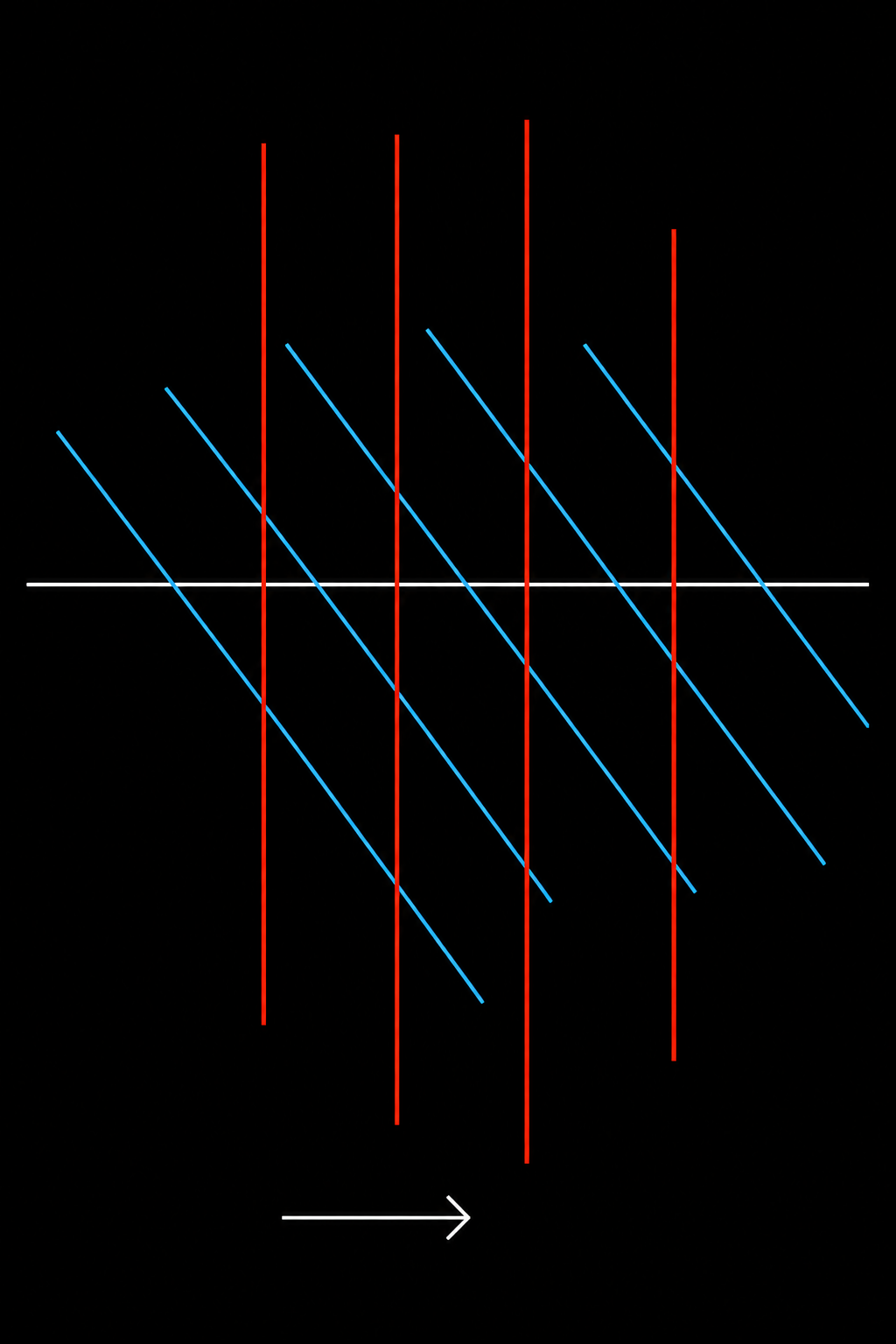
3. 如果说「时间意向性」是最根本的综合活动,那么这三个维度在「时间综合」里就应该已经呈现出来了。事实也是如此。在时间综合里,广度来自红轴,即「过去-当下-未来」在「当下」的呈现;深度来自蓝轴,即于「当下」所呈现的任意时间对于「过去」同样内容的活性的投射;高度来自白轴,即将「当下」呈现的所有时间重构为绝对活性的永恒之流,并将「过去」和「未来」视为「当下」把握。
补充3. 所谓广度即内容的综合,在时间综合中表现为对呈现内容「过去-当下-未来」的综合,也就是「当下之呈现」的超越性;所谓深度即意象性之朝向,“过去之所以是过去是因为它在「上一个意识」里是当下”,这就是时间意识最基本的朝向性,一直指向那无限延伸的「原初过去/当下/未来」,而这也构成了「物自体」的超越性,即那在某段时间背后作为支持的无限的时间,那一无限的「原初过去」或「原初未来」,任何一段时间的「呈现」都要求了这样的「原初遮蔽」的支撑,“在无限的过去,我曾认为这一时刻处于我无限的未来;同时,在无限的未来,这一时刻将回归我无限的过去”,在意识中,我的当下这一经验会站出,进入我下一个意识的过去,并在这个意义上获得了形式上的或者物自体意义上的超越性,也就是这个经验超越了内容,而获得了内容以外的自己的独立性;最后,那对一切「当下」的永恒重构构造出了「无时」的超越性,也就是理念的超越性,这一超越性不再像「物自体」那样显示为一种遮蔽,而是绝对的开显,是白轴的永恒对诸红轴的个体内容的统摄。
伯内特论无意识:
1. 无意识是意识之中的「别种意识」。而这一「别种意识」最具有代表性的现象便是幻象与记忆。这里尤其需要注意的是,幻象或记忆不能被理解为「图像-原型」的关系。这一种关系是胡赛尔最开始采用的范式,他遇到的问题是,他无法解释图像和原型之间的距离是如何生成的。图像仅仅作为感知内容无法揭示出根本的意向性结构。此外,在这一个范式里,幻象之所以为幻象,必须依赖对现实的感知;也就是说,主体是通过图像与现实的感知相比更加模糊这一事实才能断定脑海中的图像是幻象的;一旦缺失这一对照,那幻象之为幻象就消解了。可是幻象必须要有一个独立于感觉材料这一比照的肯定性的本质结构。因此,胡赛尔所遇到的问题无非是最开始的内时间意识问题;再详细一点,就是时间中的深度是如何得以构建出来的。
2. 在胡赛尔发现了「纵意向性」之后,他遇到的那两个问题便迎刃而解。记忆之为记忆是由于它是「这一个意识」对「上一个意识」的绵延与保留。因此,记忆并非是「从当下观测到的图像出发对重构出的过去的某一个对象的意向性」,而是「在当下的意识中留存的对一个对象的意向性的连续绵延」。「图像-原型」的距离因此不再是无法跨越的,而是连续生成的意识之流。与之相似,幻象并不是从某个图像出发所到达的对某个对象的意向性,而是当下的意识与对其可能性之视域的意识之间的连续。在这个意义下,无意识无非是对意识的更改。幻象之所以为幻象就是它的意向性所指示的是可能性,而非现实性。
3. 从胡赛尔出发,伯内特转向澄清弗洛伊德处的「无意识」概念。驱力就是纯粹意识流当中的绝对活性,表征就是被动性。而意识有两个流向,一个是以「当下」、或者说以广度为基准的呈现意识,另一个是以深度为基准的重复意识。前者将可能性视作是被笼罩于「当下」的向「非-当下」的投射,而后者将可能性视作是压抑物在当下的重复与回归。这两种意识互为表里,并在另一方的内部呈现为无意识。
4. 对呈现意识来说,重复意识将当下的表征与驱力的关系构造成深度结构,驱力的实在与表征之间因此具有距离,其具体的表现形式就是幻象的「洞」的结构,或者说「客体a」的形式。而对重复意识来说,呈现意识将当下的表征与驱力的关系构造成无深度的平面结构,其具体的表达就是破碎的驱力平面,或者说「原初焦虑」或者「原乐」的形式。这两种「意识/无意识」互相渗透;所以,在呈现意识中,当主体遭遇「焦虑」,它将进行符号的抵抗,并将这一焦虑转移给重复意识,构造出深度与距离的幻象;但如若在重复意识中,主体遭遇了「短路」,这一凝结的幻象就将侵入呈现,成为一个亟待满足的「症候/潜能/可能性」,而这一「症状」因此就从重复意识中被压抑出去,在现实中要求「修通」。这两种意识互渗,共同构成了「快乐原则」和「现实原则」的交互。
当下呈现出的无深度的焦虑被压抑入深度意向性,并指向对此焦虑的持续的否定(无之无化),而其终点要么是这一匮乏被满足的回忆或期盼,要么是这一匮乏尚未成型的无限的未来或者已经被遗忘的无限的过去;如果是前者,这回忆或期盼在深度意向性中朝向原初给予的对象,却因为作为这一原初给予的更改(从存在更改为非-存在),欲求着原初给予,因此必须在当下对原初给予进行表征再现;可这一表征无非是对压抑的压抑,或者是压抑物的回归;第一次压抑,是通过深度和距离取消或减轻焦虑在当下的活性,第二次压抑,则是通过当下的再现和表征满足驱力的欲求,而这一再现也由此再次构成了对非存在的当下的活的经验,并生成了焦虑。平面要求深度承重,而深度要求平面填充。两者的依靠和转换共同构成了意识-无意识的辩证运动。如果是后者,那也是一样的。
洛玛尔论类型(type):
1. 胡赛尔处的类型与康德处的图式(schema)有着相似的作用。其根本结构为:首先,类型将自己展现为一种索引或者视域,指示出感知的下一个步骤;此外,这一个视域直接地与有限的诸经验联系起来,并合成了半-普遍的图像(quasi-universal image)。实际上就是一个因为混杂太多不同经验而显得模糊的抽象的图像。尽管这些类型多种多样且可以被划分为无限多的不同层次,但它们都在活的经验中(作为潜在者)获得统一。
2. 但与其说胡赛尔的这一架构是康德式的,不如说是休谟式的,因为胡赛尔并不认为类型必然要求概念的约束,或者说类型是概念对想象力的规定。相反,对于胡赛尔来说,经验首先可以在最基底处建立起基础类型(basic types),也就是最开始的感知之间的联系,因此无需概念的帮助;然后,这些类型本身是流动的,可以扩张或缩减,因此可以从根本上完成自足的奠基,或者说,一种前概念的经验是完全可能的。
3. 洛玛尔这篇还算有意思的是对图式或者类型更具体的分析。一些在概念辨析中比较容易被忽略的地方是,当胡赛尔或者康德在讨论图像的时候,这并不只是一个视觉现象,甚至也不是一个“东西”的形象,而(至少在最开始)是一个有着自己时空秩序的事件。也就是说,图式或者类型不仅仅规定了什么东西看起来什么样,还规定了在哪里看(摸、闻、尝...)起来什么样,从什么角度看起来什么样,和周围其它物体的空间关系如何,以及这些图式会受主体心理动机的什么影响。在这个意义上确实非常休谟,而且也体现了“习惯”(habit)在胡赛尔伦理学中的基本位置。此外,关于「类型」的模糊性和有关其空间性的论述让我联想到,如果“模糊性”本身依赖于一种原初的对“遥远”的空间上的经验的话,那在类型中对空间关系的保留似乎是很复杂的问题。举个例子,在我凑近物体A之前,物体A表现为一个模糊的、朦朦胧胧的「什么」,其类型与空间上的切近直接有关;但当我看清这个物体是一个椅子后,那不管之后有离我多远,我都已经知道那是一个「离我很远的椅子」,其类型很大程度上就从空间关系中独立开来了(虽然并不绝对,比如有人偷偷在把椅子拖远的时候给它替换了)。这一点还需要更详尽的考量。
罗德梅耶论时间意识:
1. 重要的依然是对深度和广度意向性轴线的区分。任何一种「当下」都同时浸没在两种意向性带来的「前摄」与「后摄」中。在广度的轴线上,意识奠基于「后摄」并向前投射并构造出「前摄」之期待,而「前摄」同样在期待之目光中向意识的背后开显出那已沉淀者;在这个意义上,广度轴线上的意向性是「构造的意向性」。后者是「当下之过去」与「当下之未来」,前者则是「过去之未来」与「未来之过去」。
2. 在深度的轴线上,意识将「上一个意识」的前摄或后摄与「当下这个意识」的前摄或后摄比较,并由此张开了一个「讶异」的场所。上一秒我认为将要发生的事实际上却没有发生:也就是说,我过去的前摄落入当下的意向性中没有获得实现,这就是惊讶;或者,我过去的后摄落入当下的更遥远的后摄后发生了变更,这就是遗忘。我未来的后摄投射进入当下,就是印记(memorization/imprinting);而我未来的前摄投射入当下的前摄,就是期待。
3. 所以,无论是深度轴还是广度轴,前摄与后摄都是互相作用的统一意识的变更;这是因为两条轴线都是连续的,因此它们的每一个“位置”都要有共用的两个边界,也就是两次变更。当下同时是两个轴线上对前摄的后摄(the retention of protention),也得是对后摄的前摄。不仅如此,我们还要考虑这些关系是如何构成我对活的当下的经验的,甚至于我相对于「当下」那条横轴处在哪个位置。我从「当下」广度轴线上的任意一点回望「过去之未来」,那两个时间的关系就是「对过去预想之潜能或者起源的激活」;我从「当下」广度中任意一点沿着深度轴线向另一个方向遥望,那「未来之过去」就表现为「对当下之现实性进行变更的潜能」。从当下向其它方向延伸出去的意识是追寻潜能变更的意识。但是,如果考虑的是「过去之未来」朝向当下意识的涌现,那就是沉淀与现实化,这个与对现实性进行变更的潜能朝向一致;而如果是与「激活」方向一致的,「未来之过去」朝向当下意识的涌现,那这就表现为「当下的奠基性」(the founding nature of the present);这两者都表现为一种伦理学意义上的历史责任,前者是「传统的后继者的责任」,而后者是「为未来奠基的开端者的责任」。不从伦理学而单纯从意向性结构的分析上来说,前者是接受过往期待并试图满足的驱力,后者是将实现的内容保留而不至流失的驱力。
4. 对时间形式的讨论不能仅仅依赖于对时间性经验内容的举例。相反的,对时间形式的探究必须依赖于对意向性形式本身的探究,而这最终还是将聚焦于「一-多综合」的问题。
扎哈维论前反思自我意识:
1. 反思性的自我意识难以解决的问题是,作为对象“被认识”的我和作为主体“去认识”的我之间的距离无法解释作为主体作为认识者的我是如何意识到自己的。因此,在进行任何反思之前,都必须要对前反思的意识进行澄清。
2. 前反思的自我意识不能被仅仅视作是尚未被主题化的、作为潜能而沉淀的对对象进行构造的意向性行动以及这些行动共同构成的活的经验。这是因为,任何构造着对象的潜能都能被现实化、被主题化,可一旦主题化后,它就成为了反思对象。这样的反思对象不再具有前反思的「我性(mineness)」;但如果仅仅只是「非主题化」或者「潜能」本身,又不足以定义什么是「我性」,因为任何经验都摇摆于对象和主体之间,仅仅是潜能是无法划出主体之我的范围的,毕竟潜能仅仅是遗忘和沉淀,最多只是对范围的模糊。我们不可能说被忽略的周围的噪音作为潜能足以说明主体的我性。
3. 如果「我性」并不是指「非主题化的经验其潜在本身」,那它只能指涉某一个特殊的潜在经验,或者,某一个更基本且本质的经验的核。这一种经验永远无法被主题化,也就是一种原初被动性。这一原初被动性当然也就是时间综合的原初活动的绝对流。正是在内时间意识的「站出」当中,「后摄-前摄-原初印象」的统一带来了最根本的自我意识。这里也要注意,德里达和亨利的批评是无效的,即意识总是滞后的,因为原初印象不可能是无意识的,并且与后摄和前摄形成的是一个有机整体,不可以把一方从另一方完全抽象开来。此外,说绝对流内部有自我意识的结构,并在这个意义上奠基了自我意识,也并不是循环论证,或者说,至少不是恶性的循环论证。因为这里我们只是在寻找现象的源头(现象与源头本就早已事实上预先给定了一个无法还原的有机整体),而并非从单独孤立的点A出发去证明点B。
4. 扎哈维还认为,在日常生活中,我们基本的自我意识都是来自于内时间意识,而并不是潜在的、非主题化的意向性行动。他的理由是因为这单纯没有必要:因为假如内时间意识本身就是这些潜在之我性的本质,那不如直接表述本质;但假如内时间意识要区分于意向性行动,那只可能是意向性行动本身站出为已经被主题化的、占据了一部分时间的内在对象了,可这个时候,这些行动就不会是前反思的自我意识、也不会具有原初的「我性」了。事实上,「我性」必然是某种意义上「无时」的,因为任何经验所指涉的作为经验者的「我」都是统一的(康德处的「先验统觉」)。当然,这一个「无时(a-temporal)」并非是「乏时(time deprived)」,而是「出时(ex-temporal)」,也就是对绝对之流的绝对把握,这也是「活的当下(the living present)」相对于「活的经验(the lived experience)」的意义。
卡尔论先验与经验主体:
1. 所谓的「先验哲学」实际上就是相对于「形而上学」的「批判哲学」。海德格尔将「先验哲学」曲解成「形而上学」是忽略了康德以降的先验哲学的批判性。先验哲学并不是为了强调「自我」或「主体」的实在,而仅仅是为了解释实在之可能性。换句话说,先验哲学中的主体实际上与经验的、或者在世间的存在并不以同样的方式存在;主体是作为构造一切本体论区域的纯粹活性而在,而对象是作为被构造的超越性而在。这一点海德格尔自己也很清楚。在这种意义下,实际上先验哲学,或批判哲学,所代表的就是存在的多义性,或者说是一种经验与先验在各自态度和语境中各自具有有效性的视角主义,也并没有抹除本体论差异。
2. 在自然态度的意义上,先验主体“不存在”,因为它不在世界中;在先验态度的意义上,自然对象“不存在”,因为它只是先验主体的表征。但是先验哲学的关键不是两者的任何一个,而是这两个视角(世中的「整体-部分」与世外的「内在-超越」)的平等。这一多义性才是批判哲学的精髓。
3. 通过海德格尔和萨特的努力,自然态度和先验态度之间的转换不再是一个「奇迹」,或者说,不再是一个完全「无动机」的行动。相反,尽管这一转换必然是“前科学”甚至于“前理性”的,它可以被表述为一种情态;某种意义上,这种情态就意味着「自由」。海德格尔将其称作「烦」,而萨特将其称作「恶心」。在这个意义上,海德格尔和萨特依然是胡赛尔和康德的后继者,依然处在先验传统之内。
扎哈维论共主体性:
1. 「共主体性」的另一种说法是「共主观性」。正如滕格义和梅洛-庞蒂不断强调的,胡赛尔现象学的起点永远只能是先验自我的第一人称视角,哪怕是共主体也是主体所经验的共主体。共主体性的多与先验自我的一之间没有任何本质上的冲突。这一点可以通过莱布尼茨单子论理解。
2. 胡赛尔在手稿中提供了三个层次的共主体性分析。一个是具身层次,一个是内时间意识层次,还有一个则是语言层次。语言层次所关注的是「传统」与「常态」。但这里需要注意的是,这里胡赛尔的模型似乎依然还是古希腊式的「图像-对象」,也就是说,依然是「非常态-常态」之间的区分,而似乎无法有效回应现代的「符号性政治」。但这并不是说胡赛尔的政治伦理分析过时,而是说,他在古今之争中站在了古希腊人的阵营。对古今之争本身的问题化,这是施特劳斯和克莱因等人的贡献。
威尔顿和斯坦波克论现象学的方法论系统:
1. 现象学依照方法主要可以分成四个层次,静态的(static),构成(constitutive),生成的(genetic)和生息的(generative)现象学。每一个层次都隐含了其它层次,而任何彻底的分析都要求从每个层次上都完成现象学的要求。从前往后进行的是从简单到复杂的充实化(enrichment),而从后往前进行的是从具象到抽象的理念化(idealization)。只有完整的这几个阶段才能完全表达「永恒-历史」的辩证关系,或者绝对者的辩证法。
2. 静态的现象学关注点在于一个经验的基本结构是什么。但既然结构总是一个视域,那它总是预设了其它视域的其它结构。这同样也意味着,静态的现象学总是引向或者预设了构成的现象学。
3. 虽然构成的现象学可以展开视域与视域间的奠基关系,这一奠基关系依然是为了澄清现象学家所注视的对象所服务的。换句话说,这一种奠基仅仅描述了相对于构成对象来说其诸构成视域的奠基层次与其深度,却无力刻画这一奠基本身。第一,深度依然只是静态的描述,在这一静态视角下,诸层次之间的奠基关系是「本质可能性」的奠基而非「事实性」的奠基;第二,内时间意识的根本综合在此处是抽象的「形式」,每一个层次之间是「先……后……」的孤立静止的关系,而非「从……中生成」的内容上的辩证关系,而内时间意识根本意义上是内容的生成;第三,没有内容上的生成,就意味着主体没有对内容的「直面」,那么主体就仅仅是对对象进行了时间变更,而并没有任何的自由创造,历史性就失去了与无时性与永恒的内在关联;第四,我们所面对的就会是一个对时间和他者没有责任的主体。
4. 由此,构成的现象学必然引向生成的现象学。诸视域层次不再是构成奠基的元素,而是主体内在活性的成就。这自然将主体引向了一种内在的伦理学。而这一伦理学最终就被澄清为生息的现象学,也就是在世的主体如何与世界、传统和未来交互的。但是同样的,这一在世的主体与世界的交互最终是为了一个理想化的、绝对的理念在历史中的铭刻。在这个意义上,生息的现象学必须要处理内在于它的静态现象学的问题。在这个意义上,生活世界与科学世界之间的关系将再次在现象学中以绝对精神的两种面貌的形式重复(某种意义上,生活世界和科学世界正是这两种被抽象出来的面貌):静态的理念对主体的规定沉淀,与动态的生命对对象的历史激活。
AI translation from the Chinese original. The original is the authoritative text.
In this note / 篇目
- Held on the “Lifeworld”:
- Drummond on the Structure of Intentionality:
- Bernet on the Unconscious:
- Lohmar on the “Type”:
- Rodemeyer on Time-Consciousness:
- Zahavi on Prereflective Self-Consciousness:
- Carr on the Transcendental and Empirical Subject:
- Zahavi on Intersubjectivity:
- Welton and Steinbock on Phenomenology’s Methodological System:
Held on the “Lifeworld”:
1. The greatest misunderstanding of the “lifeworld” comes from sociologizing its theory. The “lifeworld” is directed not toward human social life but toward scientific objects. In other words, its theme is the relation between “timelessness and temporality,” rather than the relation between “object and subject.”
2. Of course, this does not mean the “lifeworld” is detached from the constitution of “object–subject.” The “lifeworld” cannot be understood unless we begin at the most basic level. First, we need “eidetic reduction,” a reduction comparable to “imaginative abstraction” in Aristotle or Descartes. Yet Husserl requires us ultimately to obtain not only the object’s eidos, but also the subjective structure “corresponding” to this eidos.
3. “Eidetic reduction” is only the first part of the phenomenological method. The second is “phenomenological reduction,” which reduces the “transcendent object” to “the inner constitution of the transcendental subject.” That is, “phenomenological reduction” transforms every object into a synthetic structure of “one–many”: how other “horizons” are concretely referred to and unified within a “horizon.” This “constitution” precisely originates in the subject’s “originary and passive synthesis” of “passivities.” We must note here that Husserl inherits the tradition of the “philosophy of reflection” since Kant: the interpenetration of “passivity” and “activity,” whereby immanent primordial synthesis is precisely the source of the object’s transcendence. Unlike neo-Kantianism, phenomenology accepts the thematization of the subject, and in a certain sense even of the absolute subject. For details, see Sebastian Luft’s Dialectic of the Absolute.
4. “Phenomenological reduction” thematizes the bundled “noesis–noema” structure sedimented and forgotten in the natural attitude. We should note that this reduction is “theoria” in the fundamental sense: its perspective makes no judgment about existence, but merely observes it. This is because a “horizon” is not an absolute being like the Cartesian subject, but the very openness of the activity of existence.
5. At this point, we finally have a basis for understanding the “lifeworld” correctly. Under “phenomenological reduction,” horizons acquire the structure of a “web of monads,” mutually grounding and connecting with one another. At the same time, these many horizons also connect to the “absolute,” or “absolute horizon.” Yet this “absolute horizon” can be understood in two ways: as absolute activity or passivity, or as the all of the structures in which activity and passivity interpenetrate. The former, whether complete activity or complete passivity, cancels the possibility of a “horizon,” since a horizon is precisely their synthesis. The absolute thus obtained is abstract: the source of the “absolute objectivity” pursued by modern science in Husserl’s time. The illusion of absolute objectivity comes from a twofold forgetting. First is the forgetting of the accomplishments of the transcendental subjects constituting this objectivity: a passive, gradually habitual forgetting, or “sedimentation.” Second, this absolute itself, as an idea, actively demands the abandonment of every finite horizon: the absolute subject’s devouring of every concrete existence, a thorough “concealment,” or “an oblivion caused by memory.” The consequence is science and technology’s transformation of the world into a picture, and the dangerous romanticism behind it. Husserl’s “lifeworld” seeks to recover the former “order,” reestablish the structure of horizons’ mutual grounding, and thereby accomplish the absolute’s self-realization. Most fundamental to this self-realization is the analysis of the synthesis between “timelessness” and “temporality.”
6. Klein’s criticism of Husserl therefore likewise concentrates on the “lifeworld.” For Klein, “temporality” and “timelessness” do not stand in a continuous relation of “experiment and idea,” or “content and form,” but in a discontinuous relation between “image”—concept–object—and “symbol”—subject–concept. The transcendental subject’s accomplishment is not “incremental,” but “rational.” The “lifeworld” is therefore not merely “the between connecting experience and the world of ideas”; as an open field, it must itself also be thematized as an “accomplishment of symbolic reason.”
7. To illustrate with an example: in Husserl, “bodily similarity” demonstrates the “variation of self,” while the diacritical difference of “here–there” demonstrates the “transcendence of the other.” Klein’s criticism is actually that, beyond these two steps, there is another accomplishment brought about by synthetic activity at the level of symbolic reason—for instance, “language” or “expression.” This is the immediate horizon facing the “lifeworld,” or its starting point. What this symbolic reason mediates is no longer “self” and “other,” but “the intersubjective community.”
Drummond on the Structure of Intentionality:
1. Intentionality has three dimensions: first, “longitudinal intentionality,” with depth; second, “transverse intentionality,” with breadth; third, “encompassing intentionality,” with height. The entanglement of these dimensions constitutes the bundle of intentionality. Depth distinguishes the object’s content from pure objectivity: the former is the meaning toward which intentionality is directed; the latter is this directedness itself. Its corresponding intentional act is “fulfillment.” Breadth distinguishes the collection of partial objects from the all of the object: the relation between parts and whole. Its corresponding intentional act is “determination.” Height distinguishes the actuality of intentional acts from intentionality’s structure: the relation between an eidos’ instantiation and the eidos. Its intentional act is “instantiation.” Together, these three dimensions constitute the subject’s lived experience.
2. These three dimensions determine different transcendences. Transcendence in depth is the thing in itself’s transcendence, manifested as an “unrepresentable x.” Transcendence in breadth is that of objective content, manifested as “infinitely supplemented content.” Transcendence in height is that of objective knowledge, manifested as the “encompassing genus.” These dimensions undoubtedly often become entangled and confused, yet subtle, irreducible distinctions remain between them.
3. If “temporal intentionality” is the most fundamental synthetic activity, these three dimensions should already appear within “temporal synthesis.” And they do. In temporal synthesis, breadth comes from the red axis: the presentation of “past–present–future” in the “present.” Depth comes from the blue axis: any time presented in the “present” projects activity onto the same content in the “past.” Height comes from the white axis: all times presented in the “present” are reconstructed as the eternal stream of absolute activity, and “past” and “future” are grasped as “present.”
Supplement to 3: Breadth is the synthesis of content. In temporal synthesis, it appears as the synthesis of the presented content “past–present–future”: the transcendence of “presentation in the present.” Depth is intentional directedness: “the past is past because it was present in the ‘previous consciousness.’” This is temporal consciousness’s most basic directedness, always pointing toward the infinitely extending “primordial past/present/future.” This also constitutes the “thing in itself’s” transcendence: infinite time supporting a particular stretch of time from behind, the infinite “primordial past” or “primordial future.” The “presentation” of any stretch of time requires the support of such “primordial concealment.” “In the infinite past, I once considered this moment to lie in my infinite future; likewise, in the infinite future, this moment will return to my infinite past.” In consciousness, my present experience stands out, enters the past of my next consciousness, and in this sense acquires formal transcendence, or transcendence in the sense of the thing in itself: this experience transcends its content and acquires an independence of its own beyond that content. Finally, the eternal reconstruction of every “present” constitutes “timeless” transcendence, the transcendence of the eidos. Unlike the “thing in itself,” this transcendence no longer appears as concealment, but as absolute disclosure: the white axis’ eternity encompassing the individual contents of the red axes.
Bernet on the Unconscious:
1. The unconscious is an “other kind of consciousness” within consciousness. The most representative phenomena of this “other consciousness” are phantasy and memory. Here we must especially note that phantasy and memory cannot be understood through the relation of “image–prototype.” This is the paradigm Husserl initially adopts, and the problem he encounters is his inability to explain how the distance between image and prototype arises. As merely perceptual content, the image cannot reveal the fundamental intentional structure. Moreover, in this paradigm, phantasy’s being phantasy must depend on the perception of reality. That is, the subject can judge a mental image to be phantasy only from the fact that it is more obscure than the perception of reality. Once this comparison is absent, phantasy’s being phantasy dissolves. Yet phantasy must possess a positive essential structure independent of this comparison of sensory materials. Husserl’s problem is therefore none other than the initial problem of internal time-consciousness; more specifically, how depth within time can be constituted.
2. Once Husserl discovers “longitudinal intentionality,” both problems are readily solved. Memory is memory because it is “this consciousness’s” continuation and retention of “the previous consciousness.” Memory is therefore not “an intentionality toward a reconstructed past object, starting from an image observed in the present,” but “the continuous duration of an intentionality toward an object, retained in present consciousness.” The distance of “image–prototype” is thus no longer an unbridgeable one, but a continuously generated stream of consciousness. Similarly, phantasy is not intentionality toward an object reached by starting from an image, but the continuity between present consciousness and consciousness of its horizon of possibilities. In this sense, the unconscious is nothing other than a modification of consciousness. Phantasy is phantasy because its intentionality points toward possibility rather than actuality.
3. Starting from Husserl, Bernet turns to clarifying Freud’s concept of the “unconscious.” Drive is the absolute activity within the pure stream of consciousness; representation is passivity. Consciousness has two directions of flow: presentational consciousness, oriented by the “present,” or breadth, and repetitive consciousness, oriented by depth. The former treats possibility as a projection toward the “nonpresent” encompassed by the “present”; the latter treats possibility as the repetition and return of the repressed in the present. These two consciousnesses are each other’s obverse and reverse, appearing within each other as the unconscious.
4. For presentational consciousness, repetitive consciousness constitutes the present relation between representation and drive as a structure of depth. The reality of drive and representation thus acquire distance, whose concrete manifestation is the “hole” structure of phantasy, or the form of “object a.” For repetitive consciousness, presentational consciousness constitutes the present relation between representation and drive as a depthless planar structure, concretely expressed as the fragmented plane of drives, or the form of “primal anxiety” or “primal enjoyment.” These two forms of “consciousness/unconsciousness” interpenetrate. Thus, when the subject encounters “anxiety” within presentational consciousness, it mounts symbolic resistance and transfers this anxiety to repetitive consciousness, constituting phantasy with depth and distance. But if the subject encounters a “short circuit” within repetitive consciousness, this congealed phantasy invades presentation, becoming a “symptom/potential/possibility” urgently demanding satisfaction. This “symptom” is thereby repressed out of repetitive consciousness and demands “working through” in reality. The two consciousnesses interpenetrate, jointly constituting the interaction of the “pleasure principle” and “reality principle.”
The depthless anxiety presented now is repressed into depth-intentionality, pointing toward the continued negation of this anxiety—the nihilation of nothing. Its endpoint is either the memory or anticipation of this lack’s satisfaction, or the infinite future in which this lack has not yet formed, or the infinite past in which it has already been forgotten. In the former case, this memory or anticipation is directed within depth-intentionality toward an originally given object. Yet because it is a modification of this original givenness—from being to nonbeing—it desires that original givenness and must therefore represent and reproduce it in the present. But this representation is nothing other than the repression of repression, or the return of the repressed. The first repression cancels or diminishes anxiety’s present activity through depth and distance; the second satisfies the drive’s desire through present reproduction and representation. This reproduction thereby again constitutes a present, living experience of nonbeing and generates anxiety. The plane requires depth to bear its weight, while depth requires the plane to fill it. Their mutual dependence and transformation jointly constitute the dialectical movement of consciousness–unconsciousness. The same applies in the latter case.
Lohmar on the “Type”:
1. The type in Husserl functions similarly to the schema in Kant. Its fundamental structure is this: first, the type presents itself as an index or horizon, indicating perception’s next step; additionally, this horizon connects directly to a finite set of experiences, synthesizing a “quasi-universal image.” In fact, it is an abstract image appearing obscure because it mixes too many different experiences. Although these types are diverse and can be divided into infinitely many levels, they all acquire unity within lived experience as potentialities.
2. Yet Husserl’s framework is more Humean than Kantian, since he does not think types necessarily require conceptual constraint, or that a type is a concept’s determination of imagination. On the contrary, for Husserl, experience can first establish “basic types” at the most fundamental level: initial connections between perceptions, requiring no conceptual assistance. These types are then themselves fluid, capable of expansion or contraction, and can thus accomplish a fundamentally self-sufficient grounding. In other words, preconceptual experience is entirely possible.
3. What is fairly interesting in Lohmar’s essay is its more concrete analysis of schemata or types. One point easily overlooked in conceptual distinctions is that, when Husserl or Kant discusses images, these are not merely visual phenomena, nor even images of a “thing.” Rather, at least initially, they are events with their own spatiotemporal order. That is, schemata or types determine not only what something looks like, but also where it looks—or feels, smells, tastes…—a certain way, how it appears from different angles, its spatial relations to surrounding objects, and how these schemata are affected by the subject’s psychological motivations. In this sense, the account is indeed very Humean, also showing “habit’s” fundamental place in Husserl’s ethics. Moreover, the discussions of types’ obscurity and spatiality suggest to me that, if “obscurity” itself depends on a primordial spatial experience of “distance,” the retention of spatial relations within types seems a very complex problem. For example, before I approach object A, it appears as an obscure, hazy “something,” its type directly related to spatial proximity. But once I clearly see that it is a chair, however far away it subsequently becomes, I already know it as “a chair far away from me.” Its type has largely become independent of spatial relations—although not absolutely: someone might secretly replace the chair while dragging it away, for instance. This point requires more detailed consideration.
Rodemeyer on Time-Consciousness:
1. What remains important is the distinction between the intentional axes of depth and breadth. Any “present” is simultaneously immersed in the “protention” and “retention” brought about by both intentionalities. Along the axis of breadth, consciousness grounds itself in “retention,” projects forward, and constitutes the expectation of “protention”; “protention” likewise discloses, behind consciousness and within expectation’s gaze, what has been sedimented. In this sense, intentionality along the axis of breadth is “constitutive intentionality.” The latter is the “past of the present” and the “future of the present”; the former is the “future of the past” and the “past of the future.”
2. Along the axis of depth, consciousness compares the protention or retention of “the previous consciousness” with that of “this present consciousness,” thereby opening a place for “surprise.” What I thought a second ago would happen does not actually happen: my past protention enters present intentionality without being fulfilled, and this is surprise. Or my past retention changes as it enters the present’s more distant retention: this is forgetting. My future retention projected into the present is memorization or imprinting; my future protention projected into present protention is expectation.
3. Thus, along either the depth or breadth axis, protention and retention are modifications of one unified, mutually interacting consciousness. This is because both axes are continuous, so each of their “positions” must have two shared boundaries: two modifications. The present is simultaneously, on both axes, “the retention of protention,” and must also be the protention of retention. Moreover, we must consider how these relations constitute my experience of the living present, and even where I stand relative to the transverse axis of the “present.” Looking back toward the “future of the past” from any point on the present’s breadth-axis, the relation between the two times is “the activation of the potential or origin of past anticipation.” Looking in the other direction along the depth-axis from any point within present breadth, the “past of the future” appears as “the potential to modify present actuality.” Consciousness extending from the present in other directions seeks potential modifications. But if we consider the “future of the past” emerging toward present consciousness, this is sedimentation and actualization, moving in the same direction as the potential to modify actuality. If the “past of the future” emerges toward present consciousness in the same direction as “activation,” this appears as “the founding nature of the present.” Both appear as historical responsibilities in an ethical sense: the former is “the responsibility of the successor to a tradition,” the latter “the responsibility of the initiator laying foundations for the future.” Considered purely through intentional structure rather than ethics, the former is the drive to receive and attempt to fulfill past expectations; the latter is the drive to retain fulfilled content and prevent its loss.
4. The discussion of temporal form cannot rely merely on examples of the content of temporal experience. Rather, investigating temporal form must depend on investigating intentional form itself, and this ultimately returns to the problem of the “one–many synthesis.”
Zahavi on Prereflective Self-Consciousness:
1. Reflective self-consciousness struggles with a problem: the distance between the I “known” as object and the I that “knows” as subject cannot explain how the subjective, knowing I is conscious of itself. Prereflective consciousness must therefore be clarified before any reflection takes place.
2. Prereflective self-consciousness cannot be regarded merely as object-constituting intentional acts not yet thematized and sedimented as potentialities, together with the lived experience they jointly constitute. This is because every potentiality constituting an object can be actualized and thematized, but once thematized, it becomes an object of reflection. Such an object no longer possesses prereflective “mineness.” Yet mere “nonthematization” or “potentiality” itself is insufficient to define “mineness,” since every experience oscillates between object and subject. Potentiality alone cannot delimit the subjective I’s domain: potentiality is, after all, merely forgetting and sedimentation, at most an obscuring of boundaries. We cannot say that ignored surrounding noise, as potentiality, suffices to explain the subject’s mineness.
3. If “mineness” does not refer to “the potentiality itself of nonthematized experience,” it can refer only to a particular potential experience, or to the core of a more fundamental and essential experience. Such experience can never be thematized: it is a primordial passivity. This primordial passivity is, of course, the absolute stream of temporal synthesis’s primordial activity. It is precisely in internal time-consciousness’s “standing out” that the unity of “retention–protention–primal impression” brings the most fundamental self-consciousness. We must also note that Derrida’s and Henry’s criticism—that consciousness always lags behind—is invalid, since primal impression cannot be unconscious and forms an organic whole with retention and protention; neither side can be wholly abstracted from the other. Moreover, saying that the absolute stream contains the structure of self-consciousness and in this sense grounds self-consciousness is not circular reasoning—or at least not viciously circular. Here we merely seek the phenomenon’s source: phenomenon and source are already factually pregiven as an irreducible organic whole. We are not starting from an isolated point A to prove point B.
4. Zahavi also holds that, in everyday life, our basic self-consciousness comes from internal time-consciousness, not from potential, nonthematized intentional acts. His reason is simply that the latter is unnecessary. If internal time-consciousness itself is the essence of these potential forms of mineness, we might as well state the essence directly. But if internal time-consciousness is to be distinguished from intentional acts, this can only mean that those acts themselves have stood out as already thematized immanent objects occupying a stretch of time. At that point, however, they are no longer prereflective self-consciousness and no longer possess primordial “mineness.” In fact, “mineness” must in some sense be “timeless,” since the experiencing “I” referred to by any experience is unified—Kant’s “transcendental apperception.” Of course, this “a-temporal” character is not “time-deprived,” but “ex-temporal”: the absolute grasp of the absolute stream. This is also the meaning of “the living present” relative to “lived experience.”
Carr on the Transcendental and Empirical Subject:
1. So-called “transcendental philosophy” is actually “critical philosophy” as opposed to “metaphysics.” Heidegger’s misinterpretation of “transcendental philosophy” as “metaphysics” overlooks the critical character of transcendental philosophy since Kant. Transcendental philosophy does not seek to emphasize the reality of the “self” or “subject,” but merely to explain reality’s possibility. In other words, the subject of transcendental philosophy does not actually exist in the same way as empirical or worldly beings: the subject is as pure activity constituting every ontological region, while the object is as constituted transcendence. Heidegger himself understands this clearly. In this sense, what transcendental or critical philosophy represents is actually the equivocity of being: a perspectivism in which the empirical and transcendental each possess validity within their respective attitudes and contexts. It does not erase the ontological difference.
2. In the natural attitude, the transcendental subject “does not exist,” since it is not within the world; in the transcendental attitude, the natural object “does not exist,” since it is merely the transcendental subject’s representation. Yet the key to transcendental philosophy is neither one alone, but the equality of these two perspectives: the intraworldly “whole–part” and the extraworldly “immanence–transcendence.” This equivocity is the essence of critical philosophy.
3. Through Heidegger’s and Sartre’s efforts, the transition between natural and transcendental attitudes is no longer a “miracle,” or a wholly “unmotivated” act. Rather, although this transition must be “prescientific,” even “prerational,” it can be expressed as an affective disposition. In a certain sense, this disposition means “freedom.” Heidegger calls it “care,” Sartre “nausea.” In this sense, Heidegger and Sartre remain successors to Husserl and Kant, still within the transcendental tradition.
Zahavi on Intersubjectivity:
1. Another way of saying “shared subjecthood” is “shared subjectivity.” As Tengelyi and Merleau-Ponty continually emphasize, Husserlian phenomenology’s starting point can only ever be the transcendental ego’s first-person perspective; even intersubjects are intersubjects experienced by the subject. There is no essential conflict between intersubjectivity’s many and the transcendental ego’s one. This can be understood through Leibniz’s monadology.
2. In his manuscripts, Husserl offers three levels of intersubjective analysis: embodiment, internal time-consciousness, and language. The linguistic level concerns “tradition” and “normality.” Here, however, we should note that Husserl’s model still seems to be the ancient Greek “image–object” model: the distinction between “abnormal” and “normal,” apparently unable to respond effectively to modern “symbolic politics.” This does not mean Husserl’s political and ethical analysis is outdated, but that he stands with the ancient Greeks in the quarrel between ancients and moderns. Problematizing this quarrel itself is the contribution of Strauss, Klein, and others.
Welton and Steinbock on Phenomenology’s Methodological System:
1. In terms of method, phenomenology can chiefly be divided into four levels: static, constitutive, genetic, and generative phenomenology. Each level implies the others, and any thorough analysis requires fulfilling phenomenology’s demands at every level. Moving forward through the sequence is an enrichment from simple to complex; moving backward is an idealization from concrete to abstract. Only all these stages together can fully express the dialectical relation of “eternity–history,” or the dialectic of the absolute.
2. Static phenomenology focuses on an experience’s basic structure. Yet since a structure is always a horizon, it always presupposes the other structures of other horizons. This likewise means that static phenomenology always leads toward or presupposes constitutive phenomenology.
3. Although constitutive phenomenology can unfold grounding relations between horizons, these relations still serve to clarify the object the phenomenologist attends to. In other words, such grounding merely describes the levels and depth of the constituting horizons’ grounding relative to the constituted object, but cannot characterize this grounding itself. First, depth remains merely a static description: from this static perspective, relations of grounding between levels concern “essential possibility,” not “facticity.” Second, internal time-consciousness’s fundamental synthesis is here an abstract “form.” Relations between levels are isolated, static relations of “first… then…,” rather than dialectical relations in content of “generated from…,” whereas internal time-consciousness fundamentally is the generation of content. Third, the absence of generation in content means the subject does not “confront” content: the subject merely temporally modifies the object without any free creation, and historicity loses its internal connection to timelessness and eternity. Fourth, we are left facing a subject without responsibility toward time or others.
4. Constitutive phenomenology thus necessarily leads toward genetic phenomenology. Horizons and their levels cease to be elements of constitutive grounding and become accomplishments of the subject’s immanent activity. This naturally directs the subject toward an immanent ethics. This ethics is finally clarified as generative phenomenology: how the worldly subject interacts with the world, tradition, and future. Yet this interaction between worldly subject and world ultimately serves the inscription of an idealized, absolute idea within history. In this sense, generative phenomenology must address the problems of static phenomenology immanent within it. In this sense, the relation between lifeworld and scientific world will repeat itself within phenomenology as two faces of absolute spirit—indeed, in a certain sense the lifeworld and scientific world are precisely these two abstracted faces: the static eidos’ determining sedimentation upon the subject, and dynamic life’s historical activation of the object.