William Stern · 威廉·施特恩
Temporality · 时间性
Undated 未注日期
时间性——散记
Reflections · Pages
Stern的时间理论图解
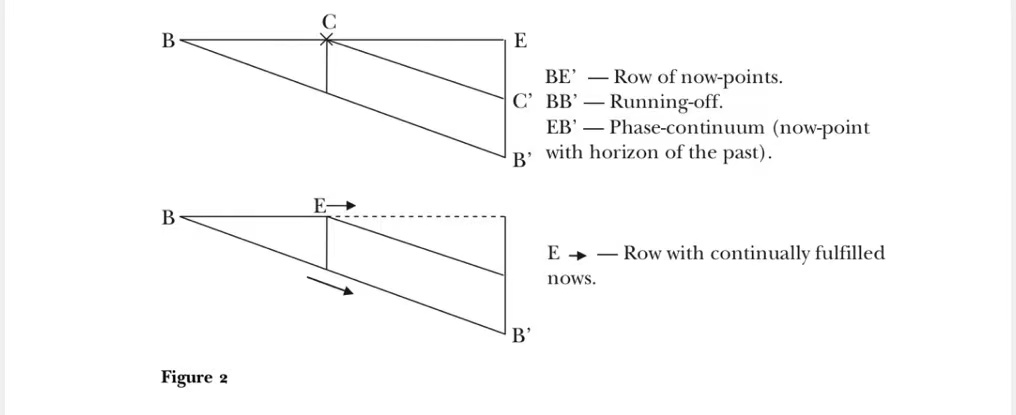
在布伦塔诺的时间理论基础上,Stern建构了自己的理论模型。这里主要是要解决共时-历时的协调问题;在布伦塔诺的原初综合处,仍然存在共时历时的悖论;历时性是如何在共时性中被展现出来的?如果意识恰恰是这样一种把各个时间共同展现出来的活动,时间的顺序又如何可能?Stern在此处的策略是将意识自身也描述为具有时间上的延拓的、而并非是一种瞬间行动而导致最后被还原为纯然共时性。
他具体是怎么达到这个目的的呢?以图为例,这里的时间被分成了两个层次,一条是横轴上的历时性对象时间,一条是纵轴上的共时性时间意识。在这里,时间与时间意识的关系展现为一种co-mapping运动。也就是,由B至C的历时顺序被拓印到纵轴上,却仍然保持其历时性为B’C';距离现在的时间点E来说,C'仍然距离较B'更近。而从时间点B(对象的直接给予)到意识中被保持着的时间B'要经历一个消散远去的过程;时间B并不仅仅是在横轴上被越过而消弭了,而是在意识中被保持为较远的“过去那个时间”。以这种方式,在意识的共时性中,历时性被保存了;但这同样意味着,意识的共时性只是形式上的,其质料仍然是处于历时状态的。那么,意识自身也必须是在时间中延拓而占据了一定时间的;换句话说,对时间的意识自己也要占据时间。而这可以看到图三,C时间点的纵轴线段被平移至EB'线段上并占据了其一部分;也就是说,在C时间的时间意识将在E时间的时间意识中占据同样的部分;C时间的时间意思将被E时间的时间意识所包含而划定相应的时间区域。在时间点E,我的意识中包含了由B至E的时间EB',而当中有C'B'属于在时间点C的时间意识,换句话说,在这里C处的时间意识占据了相应的C'B'的时间。
AI translation from the Chinese original. The original is the authoritative text.
A Diagrammatic Account of Stern’s Theory of Time
Stern constructs his theoretical model on the basis of Brentano’s theory of time. The main problem is to coordinate synchrony and diachrony. A paradox of synchrony and diachrony remains in Brentano’s originary synthesis: how is diachrony exhibited within synchrony? If consciousness is precisely an activity that presents different times together, how is temporal succession possible? Stern’s strategy is to describe consciousness itself as temporally extended, rather than as an instantaneous act ultimately reduced to pure synchrony.
How, specifically, does he achieve this? Taking the diagram as an example, time here is divided into two levels: diachronic object-time along the horizontal axis and synchronic time-consciousness along the vertical axis. The relation between time and time-consciousness appears as a movement of co-mapping. The diachronic sequence from B to C is imprinted onto the vertical axis, yet retains its diachrony as B′C′: relative to the present time-point E, C′ remains closer than B′. The passage from time-point B, the direct givenness of the object, to the time B′ retained in consciousness undergoes a process of fading and receding. Time B is not merely passed over and effaced along the horizontal axis, but retained in consciousness as “that time in the past,” now farther away. Diachrony is thus preserved within consciousness’s synchrony. Yet this also means that consciousness’s synchrony is merely formal: its matter remains diachronic. Consciousness itself must therefore be extended in time and occupy a certain duration. In other words, consciousness of time must itself take time. This can be seen in figure three: the vertical segment at time C is translated onto segment EB′ and occupies part of it. Time-consciousness at C thus occupies the same portion within time-consciousness at E; time-consciousness at C is included within time-consciousness at E and delimits a corresponding temporal region. At time-point E, my consciousness contains the time EB′, extending from B to E, within which C′B′ belongs to time-consciousness at C. In other words, time-consciousness at C here occupies the corresponding time C′B′.