Junior annual essay ·
Kant at Colonus
In this essay 篇目
If we say Kant’s philosophy comprises a system, we do not miss our mark. Naturally, we want to understand what a system is and how systemicity is conceived. But there is an even more profound difficulty: what motivates Kant, and what ought to motivate a philosopher, to construct a system?
This is a question regarding the ground of Kant’s philosophy, the ground which supports and continually activates a system. This ground can be interpreted in two ways. First, as the theoretical foundation, the center about which a system revolves. Second, as the fluid earth, the problematic undercurrents the foundation intends to repress; whose return, however, is inevitable.
A riddle to which the hero offers a grand solution, only to be taken by surprise later by his own answer. Like Oedipus who cracks the Sphinx’s riddle.
Oedipus knows what ‘man’ is, and he knows ‘man’ for a temporal being: he crawls, he walks, till he finally is dragged along by a cane. But Oedipus is ignorant of his own parents. He does not know the ‘origin of man’, and is for that finally devoured by the raging Furies1. In the jaws of the Sphinx, Kant declares the same answer to the riddle (‘the subject!’), and in a similar vein only adumbrates a more profound difficulty concerning the origin of subjectivity......
But let me dispense with these dissimulating metaphors for now and speak more straightforwardly. The Kantian revolution of metaphysics is but his solution to a problem he identifies in traditional metaphysics. My task is to trace out this development. I shall first delineate the problem as Kant sees it in traditional metaphysics, then his central strategy to get around this problem. After this initial elucidation, I shall provide an analysis of his system while interpreting systemicity in its light. In my conclusion, I shall broach again the question of the Kantian ground.
Part I
If Aristotle assigns the fundamental task of first philosophy to be an inquiry into being, he does not forget to add: being is in a way oneness2. Throughout the history of metaphysics, the question of being has constantly been raised under its arithmetical expression: if there is one that simply is, how come many share in this oneness of being? if there are many that are, how come they all point to one being? In simpler words: how is one many, and how are many one?
This needs further clarification. How being and oneness become synonymous is not necessarily transparent. Aristotle’s response to this problem is tautological. He claims that being and oneness mean the same since it is no different for one to say that ‘something is’ or ‘something is one’3. But here he is already taking this synonymity between being and oneness to be self-evident, which I am not convinced is the case. I shall therefore delve deeper to inquire into the origin of this synonymity.
For ‘traditional metaphysics’ (I use the term to loosely refer to pre-Kantian metaphysics), the question of being is largely equivalent to the question of the logical affirmation of being. This is because an equivalence between the order of thought and the order of things is presupposed. If Aristotle’s philosophy is teleological, it is because his method of transposing logical determinations to ontological ones presupposes the transparency of thought to being, which he shall substantiate only at the very end in the notion of a divine nous. We shall see later how Kant challenges precisely this equivalence between thought and being when he breaks away from the tradition. As for now, I restrict myself only to drawing out the consequences of this presupposition for traditional metaphysics.
The difference between being qua oneness as opposed to non-being qua manyness, therefore, amounts to a difference between affirmation and negation as functions of judgment. This suggests to us to excavate the original connection between being and oneness via interpreting our act of logical affirmation. Now, I am presented with a general set of things, whose members are A, B, C, D, X, etc., of which I am to either affirm or deny the existence. An asymmetry between affirmation and negation gradually emerges as I continue to pass judgments. An affirmation of the existence of X takes the form of ‘X is’, which is simple and exclusive, i.e. it does not involve in its content anything other than X. A simple presence of X is sufficient for its affirmation, independent of anything else. X is, and only is X. A negative judgment takes the form of ‘X is not’, which opens up an indeterminate realm of possibility. For something must be in lieu of X, in whose presence I am allowed to make the judgment at all. For instance, a round square is not, but its constituents, the circle and the square, must exist, so that something can be present for me to judge. X is not, but something yet unknown must take its place. And here we see the fundamental asymmetry. The affirmation of X is simple and determinate. The negation is indeterminate. Merely by stating ‘X is not’, I do not obtain the positive content that makes this negation possible. ‘X is not’ implies ‘there is something non-X’, yet ‘non-X’ can potentially contain A, B, C, D, etc., all these being contents of something I know nothing about.
I now turn to one single object. My task is to determine its being. I first say, this object is not a chair. But this only rules out one possibility among infinitely many others. In this case, the object remains indeterminate for me. But what if I try a different approach? I say an object is either a body or a non-body; if a body, either cold or not cold, and if not cold, either hot or lukewarm. Through such an eliminative procedure, hopefully I can discover all the hidden content of an object. But before I proceed in this way, I must have already made an affirmation. I must first exhaust the whole terrain of possibilities to be able to obtain only a finite number of options. Before the negation of ‘cold’ can yield a determinate result, namely, ‘hot’ or ‘lukewarm’, I must first know that the object is a ‘body’. But in the immediacy of a negation, nothing like this happens. By negation of ‘cold’ in its pure immediacy, I know nothing more about the object, if I have not already put it under the mediating genus of ‘body’, and without knowing beforehand the object in question is a body. For if the object is not a body, a mere negation of ‘cold’ does not eliminate and narrow down the scope of possibilities for me, as everything that is not a body is technically ‘not cold’. Kant warns us exactly on this point when he says: ‘if somebody were to say that every body has either a good or a bad smell, a third case is possible, namely, that it has no smell at all, in which case both conflicting propositions would be false’4. Therefore, in order to negate determinately, a prior affirmation is necessary. This equally applies to the highest kinds, for they are also known to be of a finite number, thus depend on a prior affirmation.
The fundamental asymmetry between affirmation and negation is thus clarified. Affirmation by itself is always simple and determinate, negation obscure and indeterminate, for one never determines anything through negation without a prior mediation of affirmation. We can explain on this account what is implied in the problem of one and many. Manyness in its original meaning precisely does not mean the arithmetical ‘many’, but rather ‘indeterminateness’ or ‘infinitude’. The obscurity here is, if manyness originally means ‘infinitude’, this has nonetheless been translated to the arithmetical concept of ‘many’. And it is not clear why the infinitude of non-being should be more than the finitude of being, for they might not be quantitatively comparable concepts. It seems that only two finite things can be compared by their quantities, for an infinite thing has no determinate amount at all. Can we say a body is more than a spirit? And if we think the latter absurd, why do we not think that of the former? How does the qualitative difference between finitude and infinitude come to be taken as a quantitative one?
If we look at oneness and manyness only in abstraction as independent principles, this translation of the metaphysical to the arithmetical, or the qualitative to the quantitative, remains unintelligible. For the true thrust of the metaphysical question is to be elucidated only in a concrete problem. That is, the fundamental problem of metaphysics is formulated in an arithmetical way precisely because its most original concern is directed to the foundation of arithmetics: the questions ‘how is one many?’ and ‘how are many one?’ are only ramifications of the question, ‘How is number possible? What is the essence of number’? Again, the telos of the inquiry directs the inquiry itself; the task of metaphysics to ground arithmetics predetermines its arithmetical nature:
“By Zeus!” he said, “I seem to be far from thinking, I suppose, that I know the cause concerning any of these things, I who don’t even allow myself to assert that whenever anyone adds a one to a one, the one added to or the one that was added has become two, or that the one that was added and the one to which it was added became two by the addition of the one to the other. Here’s what I wonder about: When each of the two was separate from the other, then each was one and the pair were not two, but when they came close to each other, this then became the cause of their becoming two –– the concourse that comes from their being placed close to each other. Nor again can I yet be persuaded that if somebody splits a one apart, this –– the splitting –– has in turn become the cause of their having become two. For then this cause comes to be the contrary of the former cause of their becoming two. Then it was because they were led close to one another and were added, one to the other, but now it’s because they’re led away and separated one from the other. Nor do I any longer even persuade myself that I know why a one comes to be nor why, in a word, anything else comes to be or perishes or is by this way of proceeding. Instead, I’ve randomly smushed together another way myself, and that former one I don’t tolerate at all.”5
In the passage cited above, Socrates is asking none other than the question, ‘how are manyness (the principle of “the splitting”) and oneness (the principle of “bringing close”) combined to make a number’? The two causes, the ‘splitting’ and ‘bringing close’, seem contrary, only because it is not mentioned that the number ‘two’ is a combined product of these ‘two’ causes. Regarding this combination of causes, many likely stories are contrived. One common narrative goes like the following. First, ‘one’ is a simple affirmation. Yet the determination of ‘one’ soon reverts to its own un-determination, for its simplicity is without content6. With the bounds of oneness thus breached, the one nonetheless coheres with that which it is not, and what it is not is nevertheless itself, thus the one that is not and the not-one that is one is maintained in a ‘twofold-ness’. This ‘twofold-ness’ is unified in the one through the one, and is held together in the one, which, distinct from the twofold it encompasses, is then added to the twofold-ness as a third. Within the twofold-ness, however, the indeterminate remains, and continues to generate new pairs... This is a generative account of number qua evens and odds, and this same narrative runs through traditional metaphysics: the ‘one’ in its self-sameness generates a power of manyness, with which the unity of one combines to make ‘number’, thus making arithmetics possible. Therefore, from the very start, we see metaphysics tasked with the grounding of arithmetics, and this has remained one of its most lasting motives, as is obvious in the case of Leibniz, who strives to construct the mathesis universalis.
Since the end-goal predetermines the procedure, it is no wonder traditional metaphysics follows an arithmetical paradigm. We can briefly recall two samples of traditional metaphysics to convince ourselves that this is the case. For this purpose I choose to interpret Aristotle and Plotinus, since they represent, in relatively systematic ways, two major schools of traditional metaphysics. My interpretation is by necessity incomprehensive and cannot do justice to the interpreted, but I believe the arithmetical nature of traditional metaphysics, through my delineation, can be brought clearly to the eye.
The pinnacle of Aristotle’s metaphysics is the active nous. However, in order for nous to be active, it must in itself embrace a passive side to be acted upon. The pure activity of nous thus introduces in itself its own opposite. Nous in this sense cannot be a highest genus, since it is self-generative. It acts upon itself and self-differentiates, i.e. it is its own differentia. Below the divine nous are the highest sources (categories), which are the first products of the activity of nous. These highest sources, driven by the same divine activity, combine with each other in pairs, and are genera or differentiae to each other. These combinations bring forth many intellectual products. These new products in turn combine as genera or differentiae to each other and generate more complex products. As this process of generation proceeds unrelentingly, eventually some products are composite of so many antecedents that our finite intelligence loses sight of those ‘combinations’ completely, even as we cannot intuit a chiliagon or a thousand grains7. It is in this way our sensible world composite of form and material is generated and placed at the lower rung of the ontological ladder, with aether on the outermost sphere as the encompassing form and earth at the center as the encompassed material8, form being a power of unification that more closely indicates the original unity, material a passivity farther removed from that unity. Yet both form and material are far enough from the original unity to look obscured (hence un-intellectual) to us, for they each contain too great a number of antecedents, only more or less so.
It is true that Aristotle vehemently criticizes Pythagoreans’ doctrine of eidetic number, especially Plato’s supposedly ‘unwritten doctrine’ that grounds arithmetics through metaphysical speculations. Yet we must not fail to see that that criticism is only directed at the unreflective method the Pythagoreans have employed in such grounding. For Aristotle, the grounding of arithmetics through metaphysics cannot be a direct one, as if whenever two objects are present, ‘two-ness’ is itself present9. Rather, there is a fundamental gap between the mathematical operations of human beings and the ontological progression of real beings, for when we count, we are only abstracting mathematical units from the concrete determinations of all antecedents involved in the objects presented to us10. Our counting only reduces things to homogeneous units and does not see things in concreto. The grounding in question for Aristotle cannot therefore be as direct as how some specific eidetic number grounds its corresponding mathematical number, like ‘two-ness’ for two, but how the metaphysical account in general of the progression of beings should ground arithmetics in general. The Aristotelian grounding of arithmetics therefore proceeds as follows.
Since everything is involved in the original unity of nous, everything shares the same ‘oneness’ of being, so that all individuals can be reduced to homogeneity, though they remain mathematically distinct. In other words, each being is itself ‘one being’ as any other being. The possibility of number hence still hinges on the combination of the two metaphysical principles of oneness and manyness, so that things are distinct as many, yet limited by one common measure. But it is only in a realm where the hierarchy of beings is indiscernible that we are able to treat things as homogeneous. This realm is not inherent in the order of things, but only relative to our finite intelligence. For each thing in itself has its own unique composition of antecedents that is irreducible to any other, not even to its own immediate antecedent, as a particular cat is not the universal cat. It is only due to our abstraction that unique beings are reduced to the same. Now, abstraction is rooted in the sensible, for as generation proceeds to infinity, everything becomes equally obscured to us; only then can we indiscriminately treat all things as sharing in the same ‘form’ (the same ‘oneness’) and as homogeneous units. From there we even apply this abstraction derived from the sensible back onto the intelligible. Number for Aristotle therefore originates from an abstract measuring of a magnitude. As Aristotle himself says, ‘for a thing to be in number is for there to be some number of the thing’11. Yet even if arithmetics can only be thus indirectly grounded through metaphysics, as the order of things and the order of number do not completely coincide, (for instance, since there are ten highest kinds12, the twofold nous in its generative activity would make a jump from 2 to 12 by our human reckoning), the grounding still strongly entails a hierarchical order proceeding from finitude to infinitude.
Plotinus’ doctrine is no different on this front. Starting from the bottom of the ontological ladder, matter is relatively many. It is then unified through the unity of form, and thus unified with form, constitutes natural things. This unifying power of form, however, stems from a higher principle. Form is but an image of what Plotinus calls ‘The Highest Reason’, which then unifies, and is unified with, all natural things to constitute Nature. The Highest Reason in turn is a reflection of a higher principle, i.e. the higher part of The Soul. The higher part of The Soul unifies Nature and is unified with it to constitute The Soul proper. The higher part of The Soul again only reflects an activeness of The Intelligence, which similarly unifies The Soul to make The Intelligence. But the activeness of The Intelligence is no different from The One, which encompasses The Intelligence13.
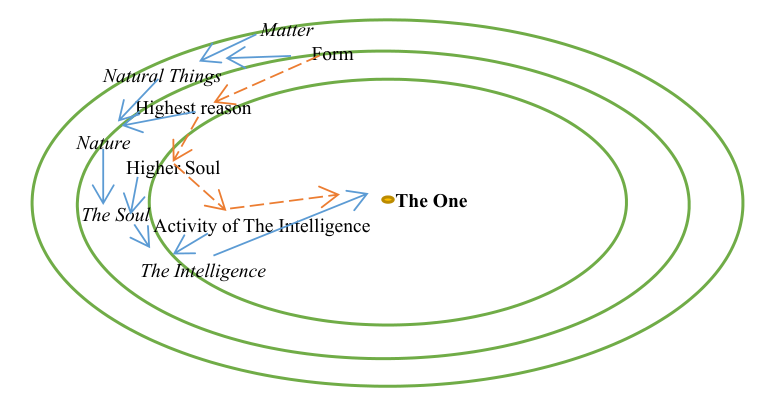
Again, we see the same arithmetical paradigm at work. The One is the original unity which splits into a twofold-ness, i.e. the activity and passivity of The Intelligence. The Passive Intelligence, qua The Soul, is then divided into a higher and a lower part. The lower part of The Soul, qua Nature, further divides. This progression proceeds until finally the power of manyness is fully manifest through the lowest rung, i.e. matter. It is to be noted, however, that all beings, not just matter, generated in this progression are infinite, since they all contain the principle of manyness. The only difference here is how contained and suppressed the power of this principle is. The closer to The One, the more unified and concentrated is the infinitude inherent in the being; that is, the more is the infinitude ‘limited’.
If I seem to digress much from a simple exposition of Kantian philosophy, I hope this digression is not taken to be irrelevant to my task. Kant is born into a tradition, and his originality cannot be appropriately appreciated without first understanding what that tradition entails. Through this section, it is clear that traditional metaphysics operates in an arithmetical paradigm. This is not without consequence for metaphysics: first, it presumes the question of being and non-being to be equivalent to the question of oneness and manyness; next, it constructs an ontological hierarchy that roughly follows the progression of numbers, if not precisely coinciding with it, so that the higher on this ladder a being is placed, the simpler and the more unified this being is; thirdly, since all beings are involved in the arithmetical progression and encompassed by the same original unity, beings are primarily different by ‘degree’, and most of the distinctions are reducible to quantitative differences, namely, how ‘much’ a being partakes of the original unity; finally, since every being is conceived in the original unity as a ‘quantity’, and quantities are related to each other through ratio and proportion, logos becomes the predominant force in our understanding of being. The power of reason gathers what is many into what is one in a ratio, and many such ratios into one proportion (analogia), and in so doing places manyness under the command of a superior unity, judging and comparing beings according to ‘how much closer’ to the origin each of them is. Reason becomes not only the unifying and commanding power, but the ultimate judge. In the next section I shall argue that Kant’s Critique of Pure Reason is nothing less than a critique of precisely this arithmetical paradigm and the traditional metaphysics that follows it.
Part II
Kant’s opposition to the arithmetical paradigm is motivated by a difficulty he sees in traditional metaphysics. This difficulty comes with the theory of participation. On the one hand, this theory dictates a group of particulars to partake of a universal. On the other, these universals themselves must be particulars that partake of higher universals. This series is potentially infinite, and the difficulty here is how to move along this infinite progression. This difficulty is twofold.
First, starting from our sensible world, all perceived beings are presented as obscured. In order to ascend to the ground, I need to discover the antecedent contained in the composition of the thing. To ensure my success, I need a method. This method is usually termed ‘abstraction’, as commenced by Aristotle and inherited by Descartes, which consists in varying in imagination the modes a certain being can possess, thus sieving out the essence of that being from all its accidents. But this incurs the problem of infinite regress. Since a variation in our imagination can proceed in infinite ways, it is impossible to conclude the process without a leap of faith. When Descartes is meditating on that wax, he abstracts its essence from its color, its texture, its circumstance, its position, etc. Yet before he abstracts it from its color, he must first abstract its color from a particular red, blue, green... Before he abstracts its color from a particular red, he... Abstraction is interminable as a procedure dependent on the variations in imagination, and we are constantly stuck in the process. This induces Descartes to conclude that there must be some act more than simple variation ad infinitum that provides us with rational knowledge: viz., intellectual intuition14.
Then, suppose through intellectual intuition, I successfully sieve out the ultimate substance from everything else, this does not help my knowledge. For whatever can be abstracted away from a being is accidental to that being. And for the original unity, i.e. the substance, thus retained through abstraction, everything that is derivative of it would only be accidental to it. I then encounter a second problem, namely, the production of the world is now purely accidental and thus inexplicable.
These two problems, i.e. infinite regress from bottom to top and mysterious production from top to bottom, are problems because they fail to satisfy the principle of sufficient reason. With infinite regress, the ultimate ground for everything becomes unreachable, while with mysterious production, it is only due to God’s will, instead of necessity, that the world which is inferior to him is created.
Kant’s genius is that he sees the present difficulty not as accidental to traditional metaphysics, but rather inherent in its very beginning. Because traditional metaphysics follows an arithmetical paradigm, it blindly presumes that ‘oneness’ and ‘manyness’ are only quantitatively different, rather than qualitatively distinct. In truth, what Kant does is simply to supplement the arithmetical paradigm with a geometrical paradigm; ‘oneness’ and ‘manyness’ are not different amounts, but different kinds, as rectilinear and curvilinear figures are different.
It is likely that Kant owes this discovery of the geometrical approach to metaphysics to Spinoza, for Spinoza, prior to Kant, had already challenged the traditional arithmetical paradigm, which constantly subjects body to thought for its supposed inferiority and passivity. Contrary to this tradition, Spinoza claims that nobody as yet knows what bodies can do15, thus releasing body from the yoke of thought, and places the corporeal (Extension) on equal footing with the intellectual (Thought), each an attribute amongst the infinitely many attributes of God.
This is not to say Kant is secretly a Spinozist. Quite the opposite. As we shall see later, Kant has a different agenda in employing the geometrical approach. But even before that, we should understand Kant’s philosophy is only geometrical to an extent. The apparent geometricism of his philosophy is merely a supplement to an overall arithmetical structure.
Let us now delve deeper into the concrete of his new approach, so as to understand his solution to the present difficulty. As said above, geometricism in this context means Kant discerns between ‘oneness’ and ‘manyness’ not a quantitative difference but a qualitative distinction. Yet, why is this the solution? The Kantian solution cannot be properly understood without determining more precisely how the difficulty first comes about in traditional metaphysics.
For traditional metaphysics, ‘oneness’ and ‘manyness’ are only quantitatively different. Each being as a combination of both principles therefore stands more or less proximate to one or the other end, i.e. being or its privation, on a continuous spectrum. The closer a being is to ‘oneness’, the simpler, the more unified and the more perfect it is. As truth has to do with clarity and distinctness, which is proper only to unity, the pursuit of knowledge is to minimize the expression of ‘manyness’ and maximize that of ‘oneness’, so as to ascend from particulars to universals, from the sensible to the intellectual. And since all beings are only different by degrees, the knowledge one presumes to have of each being is not in principle different. The knowledge one has of the ultimate unity is the same kind of knowledge one has of any other being and is comparable to any other knowledge, only more eminent and perfect. This first allows the knowledge of the ultimate unity to be a ground for all knowledge, then necessitates it. For without the ground provided by the ultimate unity, all knowledge becomes indeterminable and void. One does not know where one is located in the infinite chain without knowing where the chain starts, even as one does not know the number without knowing the unit. Yet, since the chain is infinite, one can never traverse the chain step by step. And if, on the contrary, one starts from an intellectual intuition of the origin, it is difficult to see why the unity should place beings in an order of proximity as numbers are placed from less to more, when everything is equally encompassed by it. The former amounts to the problem of infinite regress, the latter the problem of mysterious production.
The geometrical approach enables Kant to achieve one simple thing: the redefinition of knowledge. If oneness is not ‘more perfect’ than manyness but is of a different kind, knowledge should not be a reduction of what is less perfect to what is more perfect, but a correspondence between two qualitatively distinct principles. For Kant, every being consists of a unity and its corresponding manifold, both of which contribute equally to the full knowledge of this being. This is Kant’s famous maxim: ‘thoughts without content are empty, intuitions without concepts are blind’16. The concept of an object, as Kant describes it, is the manifestation of a principle of unity: ‘knowledge consists in a determinate relation of given representations to an object; and an object is that in the concept of which the manifold of a given intuition is united’17. Concepts provide the unity that organizes the manifold of intuitions, not to reduce or abstract away from the manifold, but only to relate the unity to the manifold. Knowledge of the pure unity, which according to traditional metaphysics is the grounding of all knowledge, is thereby expelled from the foundation. For Kant now declares: if knowledge is only a composite of unity and manifold, the ‘knowledge’ of the pure unity, which is of a different kind from the composite, is no knowledge at all. The ground that traditional metaphysics seeks is thus illusory.
This redefinition of knowledge, achieved through the introduction of geometricism, solves the twofold difficulty Kant sees in traditional metaphysics. First, since knowledge is the correspondence between two qualitatively distinct principles, the true ground lies in this very correspondence, in lieu of the original unity. Therefore, one does not need to ascend from the sensible all the way up to the intellectual in order to ground knowledge, for knowledge occurs ‘here and now’, in a manner of speaking. This is the force of the Transcendental Analytic, for it establishes precisely this correspondence between concept and intuition. For instance, in order to know a causal relation, we need not go through everything in the causal chain to trace back to a first cause. Rather, what is required is only an irreversible succession of two representations:
When, therefore, I perceive that something happens, this representation contains that something precedes, because by reference to what precedes the appearance receives its relation of time, that is, to exist after a time in which it did not exist. Its determinate position in time within this relation can only be assigned to it, if in the antecedent state something is presupposed on which it follows always, that is, follows according to a rule. It thus follows, first of all, that I cannot reverse the series, and place that which happens before that upon which it follows; secondly, that if the preceding state is posited, the other event follows inevitably and necessarily.18
All other elements besides The Second Analogy in the Analytic should be interpreted in the same vein, for all these categories are what Kant calls formal conditions, i.e. rules applied by the subject only to singular and immediate representations. An analogy might help elucidate this notion. ‘Each’ and ‘all’, though both expressive of a universality, have different grammatical functions, for ‘each’ is followed by a singular noun, while ‘all’ by a plural. Following this distinction, formal conditions are rules applied to ‘each and every’ representation, since knowledge for Kant is always an immediate and singular application of the universal rule, whereas for traditional metaphysics, knowledge only resides in the ‘totality of all beings’ grounded in and through an original unity.
If the original unity is no longer the ground, there is no need to traverse the infinite chain in search of that unity, and no infinite regress can thus be incurred. This has both an ontological and an epistemological implication. First, universals are neither more real nor more perfect than particulars, as is established. Second, a knowledge no longer requires a higher knowledge to be the guarantee of its validity. This addresses a criticism constantly raised against Kant, i.e. in order for me to know my faculty of knowledge, do I not put myself in a vicious circle? In order to know, I have to know that I know, and have to know that I know I know, etc. In this view, the Critique of Pure Reason would be an impossible project, since Kant presupposes he knows what knowledge is. In traditional metaphysics, the solution to this problem is to divide knowledge into more or less universal categories. The highest knowledge is infinitely reflective and self-grounding, e.g. the absolute transparency of divine nous or the unity between Being and Thought in The Active Intelligence, so as to be a stoppage to the infinite regress of reflections. This solution, as we can deduce, is defective. Kant departs from the tradition and provides his own solution. The knowledge of knowledge, or the reflective knowledge, is not a higher knowledge, but only an elucidation or an analysis of a synthesis that has already been carried out:
This act we shall call by the general name of synthesis, in order to show that we cannot represent to ourselves anything as combined in the object without having previously combined it ourselves, and that of all representations combination is the only one which cannot be given through objects, but, as it is an act of the subject’s self-activity, can only be carried out by the subject itself. It can easily be perceived that this act of synthesis must originally be a single act and must be equally valid for all combination, and that its dissolution, that is analysis, which seems to be its opposite, always presupposes it. For where the understanding has not previously combined, there is nothing for it to dissolve, because only as having been combined through the understanding could it have been given to the faculty of representation.19
The Kantian epistemological project is therefore not a grounding of knowledge through a higher reflective knowledge, but an analysis of the latent syntheses, i.e. a transcendental analytic. The ‘knowledge of knowledge’ is nothing but a tool that clarifies what is by itself already knowledge, a ‘reflection in the mirror’ that shows what already is in its full right, i.e. the synthetic activity.
The problem of mysterious production is similarly resolved. This problem stems from the apparent arbitrariness of an arithmetical order. Why must all things be placed on an ontological ladder, some more perfect than others? Are these not all equally encompassed by ‘the one’? This incongruence in thought comes about only because the arithmetical paradigm of traditional metaphysics is itself arbitrary. Metaphysics is addressed to the opposition of ‘one’ and ‘many’ only because it concerns itself with the foundation of arithmetics. Now, Kant has not gone so far as to claim that the question of being and non-being has nothing to do with the question of one and many, which would be an equally nonsensical position. But he does see that arithmetical progression is not the only model via which one can conceive of one and many, and the ontological ladder is not the only possible order of things.
Since ‘one’ and ‘many’ have a qualitative distinction, they can be mixed not only in varying proportions, but also in varying relations. A concept is a mixture of ‘one’ and ‘many’ in a way qualitatively different from the way an intuition is a mixture of them. In the next section, I shall analyze in detail what these qualitatively distinct structures are and how they are interrelated. For now, it is sufficient for us to see that the problem of mysterious production is solved when the arithmetical order becomes just one structure in a larger system of corresponding structures. Its arbitrariness disappears as soon as it is grounded in relation to other structures in a harmonious totality.
Part III
A system is a harmonious whole that has all its parts so closely related to the totality, that each part is less of a constituent than a certain perspective on the totality. Each element of a system is reflective of the whole. This is what Kant understands a system to be:
When one is concerned to determine a particular power of the human soul in terms of its sources, contents, and bounds, then indeed, by the nature of human cognition, one cannot start except from the soul’s parts, their exact and (as far as is possible according to the current situation of what elements of the soul we have already acquired) complete exhibition. But there is also a second attentiveness that is more philosophical and architectonic: viz., to grasp correctly the idea of the whole and, on the basis of this idea in a pure power of reason, to fix one’s eyes upon all those parts in their reciprocal reference to one another by means of their derivation from the concept of that whole. This examination and warrant is possible only through the most intimate acquaintance with the system. Those who were irked by the first investigation and hence did not consider acquiring that acquaintance worth the trouble do not reach the second level, viz., that of the overview, which is a synthetic return to what had previously been given analytically; and it is no wonder if they find inconsistencies everywhere even though the gaps that suggest these inconsistencies are to be encountered not in the system itself but merely in their own incoherent progression of thought.20
It is in this way the Transcendental Aesthetic cannot be understood without the Transcendental Logic, which in turn remains unintelligible without us grasping the mutual dependence between the Analytic and the Dialectic. When I call Kant’s philosophy systematic, I understand its every part to be reflective of the whole, as a perspective on the whole.
I shall follow Kant’s suggestion and analyze the elements of his system with the whole in my view. As established in last section, ‘one’ and ‘many’ are mixed for Kant in qualitatively different ways that generate different structures. These structures are then elements that constitute the totality of Kant’s system. The analyses of each structure roughly correspond to the division of the book, viz., the Aesthetic, the Analytic, and the Dialectic.
Right off the bat Kant has made the distinction between intuitions and concepts clear. In the Metaphysical Expositions in the Aesthetic, Kant says of space, that
Space is not a discursive or, as we say, general concept of the relations of things in general, but a pure intuition. For, first of all, we can represent one space only; and when we speak of many spaces, we mean only parts of one and the same unique space. Nor, secondly, can these parts precede the one and all embracing space, as its constituents, out of which it can be assembled; rather, they are thought only as in it. Space is essentially one; the manifold in it, and therefore the general concept of spaces in general, arises entirely from limitations. Hence it follows that, with respect to space, an a priori intuition of it (one that is not empirical) must underlie all concepts of it. In the same manner, all geometrical principles, e.g. that in a triangle two sides together are greater than the third, are never derived from the general concepts of line and triangle, but from intuition, and derived moreover a priori with apodictic certainty.21
He says the same about time: ‘different times are only parts of one and the same time; and that representation which can be given only through a single object is an intuition’22. In other words, one and many in intuition has the structure of inherence. Many parts of an intuition inhere in one singular intuition, whereas the particular intuitions as limited parts of the whole inhere among many other parts, all homogeneous with each other. This structure is distinct from an arithmetical one, where an ontological hierarchy is the natural consequence. Concepts, on the contrary, do follow the arithmetical paradigm: ‘now it is quite true that every concept must be thought as a representation which is contained in an infinite number of different possible representations (as their common characteristic), and therefore the concept contains these under itself; but no concept, as such, can be thought as containing an infinite number of representations within itself’23. Through understanding, concepts are organized in a hierarchy, the particular subjected to the universal.
It is not difficult to see that both intuitions and concepts are mixtures of ‘one’ and ‘many’, as both require the unification of a manifold. Yet the structures by which ‘one’ and ‘many’ are mixed are distinct for them. For intuitions, each particular inheres in a larger one, and there is no distinction of rank between the particular and the universal; everything is organized on a homogeneous plane. This structure can be understood succinctly as one-among-many, as opposed to the structure of understanding, which is one-above-many. However, if knowledge requires the correspondence between the two structures, how is it possible that these two orders of things should ever work together?
Now, we can see how Kant has transformed metaphysics and relocated the ground. The ground is no longer ‘at the foundation’ of things, but rather ‘in between’ orders of things. The ground is no longer the immobile center, but becomes a transitive relation: this is the true significance of the Copernican Revolution. In order to address this ‘grounding’, we now move to the Analytic.
Knowledge for Kant ‘consists in a determinate relation of given representations to an object; and an object is that in the concept of which the manifold of a given intuition is united’24. This already answers the question for us: the two orders work together because these two orders constitute each other and are originally interdependent, so that one cannot be itself without the other.
The unity of space and time in intuitions is not possible without a higher unity in concepts. The concept, in its most originary determination, is not a ‘thing’, but an activity of combination that unifies the manifold of intuitions into a whole, and is the source of this unity of intuitions. As Kant makes explicit in his footnote to B161:
Space, represented as object (as required in geometry), contains more than mere form of intuition, namely, also the comprehension of the manifold given according to the form of sensibility into an intuitive representation, so that the form of intuition gives only a manifold, while the formal intuition give unity of representation. In the Aesthetic I had simply ascribed this unity to sensibility, in order to show that it precedes any concept, though it presupposes a synthesis not belonging to the senses, and through which all concepts of space and time become first of all possible. For as by this synthesis (the understanding determining sensibility) space and time are first given as intuitions, the unity of this a priori intuition belongs to space and time, and not to the concept of the understanding.25
In other words, the unity that constitutes space and time as such originates in our understanding, yet the unity per se is not separate from our plane of intuitions. The activity of unification proceeds from concepts and is projected onto the plane, thus generating an unified intuition as one-among-many. Though its source is a ‘higher unity’ in the understanding, the unity of intuitions remains on the plane of sensibility. The initial manifold that concepts subject and organize into a hierarchy is received as a unity through sensibility, yet it is a unity without any distinction of rank.
It is obvious that the concept of ‘right’ can never be sensible while the appearance of ‘body’ is not by itself a concept. Yet at the limit case, where the unity of intuitions (one-among-many) originates in the unity of concepts (one-above-many), the difficulty of keeping things apart is accentuated. This is where schematism and the faculty of imagination comes in. The role schematism plays is twofold: it unites sensibility and understanding in mutual affinity, yet also separates them, so as to rescue Kant’s philosophy from becoming yet another unfortunate example of traditional metaphysics.
Kant is clearly aware of the danger. After speaking of the mediating role of schemata, he does not forget to stress that ‘appearances must therefore be subsumed not directly under the categories, but only under their schemata’26. Schematism must be a bridge that separates two banks.
Kant lays out the structure of schematism in B180. He determines that
the image is a product of the empirical faculty of productive imagination; the schema of sensible concepts (such as of figures in space) is a product and, as it were, a monogram of the pure a priori imagination, through which and according to which images first become possible. These images, however, must always be connected with the concept only by means of the schema which they designate; in themselves they are never fully congruent with the concept.27
Two things are to be noticed here. First, schemata are not particular sensible images. They are rules ‘for the determination of our intuition, in accordance with a certain general concept’28. Yet, a schema is not in itself general. It only refers to a general concept, for it is a figure following the rule ‘according to which my imagination can generally register’29. Imagination is thus placed at a strange terrain of incipience, where a general figure is about to be raised above the particulars, yet without becoming a concept proper. The best way to understand this, I believe, is to think of the structure of schematism as an enfolding of many into one. Schemata are figural horizons that enfold appearances, without being above particulars. This is already implied in the Aesthetic, for space and time are there determined to be intuitions both singular and formal, as unities of intuition that encompass all possible intuitions. Opposed to either one-among-many or one-above-many, the faculty of imagination embraces an intermediate position, that of many-in-one.
Even without completing our full analysis of Kant’s system, it is not difficult to see that on the whole Kant has preserved the arithmetical paradigm. Concepts are still the higher unities to which intuitions are subjected. Compared to concepts, intuitions are ‘many’, for the structure of sensibility, i.e. one-among-many, entails that the unities of intuitions are those of flocks and folds, which unities must originate from a purer unity. Yet if the paradigm of traditional metaphysics is salvaged, it is not without sacrifice. First, intuitions are ‘many’ not in a quantitative sense. In his criticism of Leibniz, Kant points out that ‘the concept of “right”, as used by common sense, contains all that the subtlest speculation can draw out of it, except that in its ordinary and practical use we are not conscious of the manifold representations contained in these thoughts’30. Concepts therefore contain just as many representations as intuitions. The only difference is, a concept contains the manifold under itself, while an intuition contains the manifold within. Understanding is not inherently simpler or more perfect than sensibility. Rather, regarding clarity and distinctness, each should be judged by its own measure. Hence, even if understanding is the dominant faculty in our disposition for knowledge, this is not due to its superiority, but because sensibility and understanding can only work in this manner for knowledge to be possible. Concepts do not wield tyranny over intuitions, but only reign in harmony and freedom to which sensibility willingly submits. The horizon of our imagination is where this freedom is actualized.
Sensibility, imagination and understanding comprise the disposition of knowledge. Yet we still lack one last piece of the puzzle. In order to explain the unity of a concept, it is necessary that an ultimate unity be sought, for it is only from this unity that the power of unification originates.
On the face of it, it seems at this point traditional metaphysics has been fully resuscitated in Kant’s system, and his whole endeavor has miscarried. For is not this original unity rediscovered precisely the ultimate ground traditional metaphysics seeks? Does not this original unity, when posited, reclaim the problem of ground to itself? This is, however, not the case. It is true that the unity of a concept must have originated in a highest unity, but it is not necessary that the concept is ‘grounded’ in that unity. Rather, the ultimate unity is only projected to our understanding, while the ground is in the middle, even as imagination is the ground between sensibility and understanding.
Similar to the triad of sensibility-imagination-understanding, a mediating principle is to be found between the faculty of understanding and the faculty of reason. Just as traces of schematism are already present in the Aesthetic, we should expect the same with the Analytic.
The unity of reason is determined as the unconditional totality31. Its structure is one-for-many. It is crucial to note that this structure does not primarily entail a quantitative maximum of oneness, but rather an identification of the two principles, so that infinitude is grasped ‘all at once’ in the ultimate unity. We can recall the previous distinction between ‘each’ and ‘all’. In all other structures, there remains a distance between one and many, so that the infinitude is not given all at once, but always incompletely. For intuitions, I traverse them one by one in the plane; for schemata, I enfold each given intuition into the horizon; for concepts, I ascend step by step on the ladder. It is only with the unity of reason that the complete identity between one and many is reached.
Now, what could mediate the unity of understanding with that of reason? It has to be a principle that is unconditional, yet still works with ‘each’ singular representation. This principle is given in the Analytic as ‘the original synthetic unity of apperception’32. The unity of apperception is ‘that self-consciousness which, by producing the representation, I think (which must be capable of accompanying all other representations, and which is one and the same in all consciousness), cannot itself be accompanied by any further representations’33. Moreover, it refers directly to the act of understanding, for understanding is ‘nothing but the faculty of combining a priori and of bringing the manifold of given representations under the unity of apperception; and the principle of this unity is, in fact, the supreme principle of all human knowledge’34. That is to say, the unity of apperception has an absolute and unconditional representation, yet it is not separate from the act of understanding. This supreme principle only posits the unity in order to regulate our activity of understanding. In the Dialectic, we become aware that this unity is nothing but the transcendental idea par excellence.
A transcendental idea is transcendental on this account: it guides our faculty of knowledge, and in this sense is a ground for knowledge. As a ground, however, it is only remote, for knowledge occurs primarily in the correspondence between sensibility and understanding. In our disposition for knowledge, the correspondence between reason and understanding through self-consciousness only serves the other correspondence. The unconditional totality of reason is projected onto understanding in the cast of apperception, through which I retain the ideals of reason as the regulative grounds for my acts of understanding, as these ideas direct the rational subject only through a self-consciousness: the world is presented to me only as how far I am from knowing it; God is to me how I should serve him; soul is to me why I exist. This regulative use of reason therefore marks the birth of a moral subject.
Though this subject remains in his theoretical disposition, a turn to the practical disposition is already prepared for him. If the disposition for knowledge implies a subjection of the unity of reason to the unity of understanding, the disposition for morality is its reverse. This reversal would be impossible if Kant has not completely revised metaphysics and the meaning of ground. Only when ground comes to move and communicates one structure to the other in a harmonious correspondence can each structure be released from the arbitrary yoke of the ultimate oneness. Ground for Kant is never a ground of blind necessity, but of free possibility. It is only because each faculty is in free harmony with the other, a reversal such as from the theoretical to the practical can occur.
With this complete analysis of Kant’s system, we can finally understand the systemicity of his philosophy as such. In a system, each part is reflective of the whole. That is, each part is but a perspective on the whole. The faculty of sensibility is structured in the following way: each particular intuition is posited among many intuitions, while these many intuitions are encompassed by general projected figures according to rules dictated by the higher unities of concepts, and all these figures are encompassed by the totality of an ultimate singular horizon, the limitation of which constitutes each particular intuition. Thus in his analysis of sensibility, Kant has already introduced the functions of imagination (general figures), understanding (higher unities), and even reason (the ultimate totality), all of them projected onto the same plane of one-among-many. When we move to the perspective of understanding, we find all the intuitions enfolded by imagination into one unified manifold are organized in a hierarchical order directed by the supreme unity of apperception, in which all the ideas of reason stay regulative. Finally, we move to the perspective of reason, and see how everything we have come to know so far is organized according to a plan and unified into an architectonic system by our own doing, which makes us morally responsible for our knowledge.
Again, this systemicity where everything reflects the whole in harmonious correspondences is not possible without the rethinking of ground. It is no coincidence that both Leibniz and Kant, the two most penetrating thinkers on the question of ground against traditional metaphysics, have constructed systems. If Kant has borrowed from Spinoza geometricism as a method, he borrows from Leibniz the moving ground as a principle. Leibniz’s God is a God in transit who coordinates the totality of perspectives from each monad to make a perfect world, while the Kantian subject is a subject in transit who relates all his faculties into a harmonious whole. For Kant, as for Leibniz, there is ultimately no disorder in our world. Between the skeptics and the dogmatists there exists only a disagreement of dispositions. This disagreement is no real contradiction, but a realization of human freedom. When the skeptics and dogmatists each present their case in court, the judge is no longer reason, as it is itself on trial. The judge can be none but the whole of humanity, even as to mitigate the conflict between sensibility and reason, we need the whole disposition of man.
Conclusion
The main argument so far consists of three parts. First, I identified the paradigm of traditional metaphysics to be arithmetical and its main motivation to be providing a foundation for arithmetics. The consequences are, first, that every being is understood to be a ratio between oneness and manyness; secondly, that the ground is conceived to be of maximum oneness, below which everything is organized in a hierarchy; thirdly, logos becomes a predominant force as it relates beings qua quantities.
I then argued that Kant revolutionizes metaphysics by introducing a geometrical paradigm in which ‘one’ and ‘many’ are qualitatively distinct. This helps him redefine knowledge as a correspondence between one and many, instead of a reduction of many to one, thus relocating the ground of knowledge from the original unity to in-between two faculties, so as to avoid the paradoxes of infinite regress and mysterious production constantly incurred by traditional metaphysics.
Finally, I analyzed Kant’s philosophic system into corresponding structures. The system is divided into two triads. The first triad consists of sensibility, understanding and the mediating imagination. The second triad consists of understanding, reason and the mediating apperception. The first triad, i.e. the unity of understanding, subjects the second one, i.e. the unity of reason, since knowledge is primarily a product of the correspondence between intuitions and concepts. The second triad, however, regulates and directs the first in dictating to it the moral significance of our knowledge. Kant thus achieves a twofold grounding of knowledge: first substantially as a correspondence between the unity of concepts and the manifold of intuitions, then morally as motivated by a command from our reason. This answers the two questions Kant raises for himself in the Introduction, first, how is metaphysics as a science possible?, second, how is metaphysics as a natural disposition possible?35 Metaphysics is scientific as it is grounded in the correspondence between sensibility and understanding. It is natural as it obeys the command of reason.
In revolutionizing metaphysics, Kant has thoroughly reconceived the ground. First, he relocates the ground from center of the system to the in-between. Second, if the ground is now in the middle, it becomes likewise transitive and movable. Kant’s philosophy is a map, which registers and delineates the smallest vibrations between different structures as if they are tectonic plates. But if the ground is moving under our feet, an abyss threatens to open up any time. The ground becomes just as obscure as it is fluid: the common root whence our knowledge springs remains unknown to us36.
To the maw of the Sphinx, Kant throws out his solution: ‘the subject’. It is clearer now where the subject springs from. The subject comes to be through the ruins of traditional metaphysics, for as the ground relocates, Thought and Being come out of joint, and we move from the ultimate unity of Being to the immediate ‘here and now’ of Understanding. The ground is not remote, but near to us. It is in us.
But this only brings the crisis closer. Despite, or precisely because of this new grounding, the dark abyss of absolute freedom underlying harmony and order is finally exposed to the eye. Oedipus recognizes man from all his phases of life, and Kant reassembles man from all his faculties. Yet they cannot determine the obscure origin of man, the true ground he stands upon. Because of this, they soon vanish into the dark night of subjectivity, as the underworld, the earth’s unlit foundation, gapes open37.
Notes
- The Theban Plays: Oidipous At Colonus, by Sophocles, translated by Ruby Blondell. 40–45. ↩
- Aristotle’s Metaphysics, by Aristotle, translated by Joe Sachs. Book IV, Chapter 2, 1003b 30. ↩
- Ibid. ↩
- Critique Of Pure Reason, by Immanuel Kant, translated by Marcus Weigelt. Transcendental Doctrine of Elements, Transcendental Logic: Transcendental Dialectic, The Antinomy of Pure Reason, Section VII, B531. ↩
- Phaedo, by Plato, translated by Eva Brann, Peter Kalkavage and Eric Salem. 97A. ↩
- Parmenides, by Plato, translated by Mary Louise Gill and Paul Ryan. 137C–142A. ↩
- Aristotle’s Metaphysics. Book XII. ↩
- De Caelo, by Aristotle, translated by C. D. C. Reeve. Book IV, Chapter 3, 310b 10. ↩
- Aristotle’s Metaphysics. Book XIII, Chapter 6–10, 1080a 10–1087a 20. ↩
- Greek Mathematical Thought And The Origin Of Algebra, by Jacob Klein, translated by Eva Brann. Part I, Chapter 8. ↩
- Physics, by Aristotle, translated by C. D. C. Reeve. Book IV, Chapter 12, 221b 14. ↩
- Aristotle’s Categories And Propositions, by Aristotle, translated by Hippocrates G. Apostle. Chapter 4, 1b 25. ↩
- The Essential Plotinus, by Plotinus, translated by Elmer O’Brien. The Three Primal Hypostases (V, 1 [10]). Contemplation (III, 8 [30]). ↩
- Discourse On Method And Meditations On First Philosophy: Meditations On First Philosophy, by René Descartes, translated by Donald A. Cress. Meditation Two, 31. ↩
- Ethics, by Baruch Spinoza, translated by Samuel Shirley. Part III, Proposition 2, Scholium. ↩
- Critique Of Pure Reason. Transcendental Doctrine of Elements, Transcendental Logic: The Idea of a Transcendental Logic, I, B75. ↩
- Ibid. Transcendental Logic: Transcendental Analytic, 17, B137. ↩
- Ibid. Second Analogy, B243. ↩
- Ibid. 15, B130. ↩
- Critique Of Practical Reason, by Immanuel Kant, translated by Werner S. Pluhar. Preface, 10. ↩
- Critique Of Pure Reason. Transcendental Doctrine of Elements, Transcendental Aesthetic, 2, B39. ↩
- Ibid. 4, B47. ↩
- Ibid. 2, B39. ↩
- Ibid. Transcendental Logic: Transcendental Analytic, 17, B137. ↩
- Ibid. 26, B161, footnote. ↩
- Ibid. Analogies of Experience, B223. ↩
- Ibid. Transcendental Doctrine of the Power of Judgement, Chapter I, B181. ↩
- Ibid. B180. ↩
- Ibid. ↩
- Ibid. Transcendental Aesthetic, 8, B61. ↩
- Ibid. Transcendental Logic: Transcendental Dialectic, Book I, Section II, B379. ↩
- Ibid. Transcendental Analytic, 16, B132. ↩
- Ibid. ↩
- Ibid. B135 ↩
- Ibid. Introduction, VI, B22. ↩
- Ibid. VII, B29. ↩
- Oidipous At Colonus. 1660–1665. ↩