Senior preceptorial essay ·
The Roadmap to Transcendental Phenomenology
In this essay 篇目
This paper attempts to sketch Husserl’s complete picture of the ideal science and its ramifications as put forward in the Crisis in order to locate preliminarily, but as accurately as possible, where transcendental phenomenology fits in his schema. I shall begin the task, no matter how imperfectly, and to begin it all parts of the Crisis are to be mobilized.
We start off, historically and necessarily, at the grounding lifeworld presented to us in our natural attitude. In this naturally present world we have “sciences” only in a rudimentary sense, i.e. “sciences” as practical and subjective know-hows. But as the first philosopher (Thales, or Solon, or who preceded them) ushered in the first interest in the totality of the world (θαυμάζειν), the theoretical attitude in the pregnant sense was introduced and habitualized.1 We now become spectators of the world and take interest in the “structures” of it in itself. Different structures become objects idealized for science, and form thematic regions, such as the study of shapes (geometry), the study of locomotion (mechanics), the study of change (chemistry), etc. Among all these regions, the mathematical ones are the most brilliant and privileged. Historically, mathematics holds three achievements crucial for the later development of sciences: 1. The idealization of all physical shapes through geometry; 2. The idealization of all surrounding “beings” through arithmetic; 3. The formalization of all “beings” that reduces them with all their particularities into a universal “anything whatsoever” through algebra. Galilean mathematical physics further exploits a hypothesis that the change in an infinity of, if not the totality of, properties of natural bodies corresponds to the change in their shapes, or to the same effect, there are infinitely many properties of bodies that are mathematizable. In order to determine the indirectly mathematical relations between these infinitely many properties of bodies in our surrounding lifeworld, Galileo devised the first clarified project of experimental science. A circuit is thus established by Galileo between the mathematical world of idealized objects and the subjectively relative lifeworld of practices, i.e. the verificatory circuit between theories and experiments.
It is worth distinguishing more carefully the second and the third achievements of mathematics. Through idealization, objects or beings we experience in our lifeworld are reduced to abstract monads, mathematical units, or “ones.” These units are idealized objects, no matter if they are considered “measures” such as “meters” “centimeters” “seconds” or simply “the pure notions of oneness.” They are considered higher “sources” or “origins” of our subjectively relative appearances and things we encounter in the lifeworld. Then through formalization, or in Husserl’s own words, through “arithmetization,” a further universalization is accomplished, such that the theoretical objects are leveled with the empirical things. An algebraic symbol can stand for any magnitude and is indifferent to what is being represented. It can represent either something ideal, such as a multitude of pure ones, or something empirical and imperfect, such as the volume of this very table without idealizing anything. The exact nature of this arithmetization requires further determination, which cannot be effected here, but three consequences of it are of great importance: 1. This arithmetization allows a “complete” resumption (we see later that this “completeness” here is only provisional) of the lifeworld into the mathematically scientific world, since this scientific world is no longer ontologically different from our lifeworld as the “source” is ontologically different from its “copy.” That is, the lifeworld is mathematically determinable as lifeworld, and nothing in our lifeworld is not in principle subject to mathematical determination. 2. This, however, also means the scientific world has to now incorporate the “Heraclitean flux” of subjectivity. Positive sciences with their mathematical formalism must now take in the absolute and unlimited horizonality as such of our lifeworld and unify everything under one science of “horizons.” Thus is born formal ontology, i.e. “the theory of manifolds,”2 which is more traditionally called mathesis universalis. This is the science that studies how “anything whatsoever” is to be related to any other “anything whatsoever.” In this notion of “anything whatsoever” is implicated “any possible object,” so that instead of singular “things” or real “objects,” what is investigated is each “an infinite horizon of possible objects,” as each is indeterminate and represented only by a symbol. Finally, only under this pure study of horizons as such can the absolute horizon be thematized in mathematical science. In other words, through incorporating the subjectively relative lifeworld, mathematics has become a science of “any possible world as such,” a science of pure “worldliness.” 3. Yet this achievement of mathematical science that in a way “reactivates” the lifeworld is also a forgetting. It is even the most dangerous kind of forgetting. But before we investigate this aspect thoroughly, we need a recapitulation of our roadmap so far.
We start from empirical practical “pseudosciences” in the lifeworld and move to mathematics. Mathematics and the Galilean impulse of the mathematization of nature then initiates the elevation of “pseudosciences” into exact positive sciences. But the achievement of arithmetization in mathematics also brings about a reintegration of the lifeworld inside the mathematically scientific world, so that the lifeworld is now thoroughly mathematical, and all the positive sciences studying regions belonging to the lifeworld are thus unified under the theory of manifolds. This picture seems complete in principle. Yet we notice something is amiss in this sketch: where in this roadmap is “first philosophy” or “metaphysics,” the science of Being and beings as such? Metaphysics as the science of Being is the science of the sources of all things or the science of the most actual things. I shall not get into the weeds of giving a precise definition for metaphysics, for this is beyond the scope of this paper. Yet two things at least are clear: 1. Formal ontology cannot be metaphysics, since it is the science of “any possible thing” and as such it is indifferent to actuality or potentiality. What is actual is but an instance of the most general “anything whatsoever.” 2. No empirical positive science can ever be metaphysics either, since each science of this kind is concerned only with a particular region of being, but not with the universal region of the highest things where all other regions are implicated.
Yet metaphysics must be somewhere on this map. Indeed, it is precisely in the mediating position between formal ontology and empirical sciences. For if formal ontology is concerned with “universality” and empirical sciences with “actuality,” then metaphysics must be a synthesis of both as it is the science of the “universal actuality.”
Now we are in a position to see more clearly the danger latent in arithmetization. Though arithmetization “reactivates” the lifeworld inside the mathematically scientific world, it reactivates it in such a way that is prone to mislead. Within formal ontology, horizons are not presented as horizons, but rather as sedimented “objects” or “symbols,” since they when arithmetized lack the fundamental characteristic of an “unfoldability.” Any horizon is revealed to us little by little in a determinate order as if it were an unfolding scroll. We first perceive, for instance, the front side of a body, then co-perceive other sides implied through the front side. We can then move to the other side to reactivate the co-perceptions sedimented or implied in our first perception. This is an example of the network of self-evidences, in which one intuition is transmitted to other implied potential intuitions that, when activated, harmonize with it. Through this network of corroborating and harmonizing potential and activated self-evidences (“ontic validities”), our objective reality is constituted. This objective reality is just the actuality we are inquiring into.
Then we must say that formal ontology is necessary but insufficient for instituting a metaphysics. Without it, the absolute horizon of the world remains stubbornly unthematic, and any philosophical interpretation of the totality tends to be a particular “worldview,” e.g. the idiosyncrasies of the Pre-Socratics. Though someone like Plato or Aristotle might have successfully broached a genuine metaphysics, this achievement seems more accidental than methodologically justified. Without a formal ontology through which we can construct any possible thing whatsoever, how are we able to tell if our “abstraction” from all regions of empirical sciences and practical interests is thorough enough? One should not miss here the similarity between the formal ontologist’s attitude and the transcendental phenomenologist’s attitude. Just as the phenomenologist is neutral toward any ontic validity, the formalistic-logician-algebraist-ontologist is neutral toward any pre-given object. The key distinction here is that though the phenomenologist is neutral toward all ontic validities, he is not oblivious of them. He holds before him the totalizing universal horizon expanded through formal ontology, but also at the same time traces the actuality constituted in a network of harmonizing validities.
Imagine this network to be like a nighttime map that displays manmade illumination, which illumination in this case represents self-evidence. Depending on how they define metaphysics, metaphysicians either look to where this network tends to be the most illuminated (the central region of the most certain Being), or where this network has the densest nexus of possible illumination (the region of the most concrete and substantial Being), or where it is bounded by drastic diminishment in illumination (the minimal requirement for any possible thing to be meaningfully and stably considered “actual”), or this network itself (anything logically possible is here considered somehow “actual”), etc. Metaphysicians, however, take this network as given, and inquire only into the structures of the region they confine metaphysics to. That is, they investigate the general laws under which things in this region behave and sometimes even how this region relies on some of its sub-regions and is constituted by them, without necessarily looking into the infinite totality of this network and every constitution implied therein, nor the activity of constitution itself. An exact tracing out of this network of constitutive activities, i.e. transcendental phenomenology, begins with the most originary self-evidence: the apodicticity of the primal ego, and investigates how this primary self-evidence constitutes all other self-evidences into a harmonious totality. Therefore, only a most genuine “first philosophy” qua the inquiry of “the roots of all things (ῥιζώματα πάντων)” can coincide with transcendental phenomenology.
One must be extremely careful as one compares transcendental phenomenology with first philosophy or metaphysics. Transcendental phenomenology is the study of the constituting activity that constitutes regions, not the study of any region itself. It is only metaphysical insofar as it relies on an apodictic self-evidence, yet this self-evidence for the phenomenologist is only a marker that helps the tracing out of the whole harmonious network of activity, but not the subject matter itself. That is why Descartes, according to Husserl, did not fully carry out the transcendental task. The fundamental problem of transcendental phenomenology is the problem of constitution, not of the region of primary and original self-evidence. A philosophy that stops at the problem of primary region necessarily involves mythical constructs. This is why Husserl calls the world revealed by transcendental phenomenology “the world of depth,” since it is “interested” in nothing other than the progressive tracing out or the working through of each constituting activity, whereas sciences, including metaphysics in the usual sense, are interested merely in the structures of constituted regions and their mutual dependencies. If ever transcendental phenomenology is to be considered metaphysical, it is only because in tracing out its transcendental problem of constitution, it has necessarily made the network of all meanings and validities intelligible and grounded in the most originary self-evidence of the primal ego, though this grounding in the absolute self-evidence per se is only a part of the infinite task of transcendental phenomenology to analyze all constitutions. In other words, though imbued with the metaphysical impulse of grounding, a phenomenologist also takes “interest” in the work itself, hence attaining a teleology of the infinite task that is forever at work and stays itself, and the metaphysical impulse, taken in the most general sense of an impulse to attain true grounding, is by no means incompatible with the phenomenologist’s attitude. Yet metaphysics in the narrow sense of the study of Being is interested only in what is “properly Being,” thus what region is “properly” or “normally” the most real or the most actual, and is not necessarily interested in the totality of the network constituted through the common root of transcendental subjectivity. In other words, the metaphysician remains in the particular interest in certain regions, while the phenomenologist has transcendentally reduced all regions, and is only the neutral spectator of this totality.
Let us see where we are on the roadmap now. Between formal ontology and empirical sciences, we locate metaphysics. Yet this metaphysics attains its genuine meaning only if it is transformed by transcendental phenomenology, i.e. when transcendental phenomenology “flows into” it. Transcendental phenomenology is the hidden depth that constitutes all these regions, i.e. empirical sciences, metaphysics (what Husserl calls “material ontology”) and formal ontology, in their mutual relations. Metaphysics is transformed insofar as the primary region it ought to work on is clarified, namely, the universal and pre-given lifeworld that is the ultimate ground of actuality. Metaphysics is then transformed into an “ontology of the lifeworld.” Yet we cannot help but notice that here metaphysics is only one exemplary science transformed through phenomenology. Indeed, after one has taken up and habitualized the phenomenologist’s attitude, one’s whole life is transformed, so is one’s scientific praxis in any discipline. One is always ready to take up the phenomenologist’s attitude again and again conducting any particular science. But this means that this science has become “indexical” of phenomenology: it has established in itself a habituality to conduct one back to the same phenomenology again and again. In Part III B of the Crisis, psychology is one such indexical science.
Indeed, psychology is privileged among empirical sciences, since despite the rather toilsome roadmap I sketched above, psychology hints at a “shortcut,” a “hidden path in the woods,” so that it by its own domain of problems points to transcendental phenomenology without being necessarily transformed by it beforehand. Yet if this road has fewer steps, it by no means suggests that it is easy. The difficulty is readily apparent as one reads from Appendix X, the supposed outline for the continuation of the Crisis, that “transcendental phenomenology has, as opposed to the limited horizon of psychology that is bound to the scope of self-objectification (after the reduction), the truly absolute horizon.”3 In a manner not entirely clear to us, psychology, even after it is fully transformed through phenomenology, remains distinct from it. Despite the obscurity of the state of destination, the steps of this other approach to arrive at transcendental phenomenology are nonetheless clear.
The movement is initiated by an impulse of the psychologist to attain the proper subject matter of his science. That is, like the natural scientist who attains the abstract region of bodies, the psychologist attempts to achieve a parallel task to attain a complementary abstraction of spiritual things. This is a necessary first step. But then the psychologist is involved in a difficulty: though he attempts to reduce every external object through an abstraction, he nonetheless of necessity must retain an intentional object that hovers in the soul. No such obstacle impedes the natural scientist’s abstraction, as he always only talks about objective truths without involving any subjective relativity. Without attaining transcendental phenomenology this strange fact of asymmetry between the two complementary abstractions should remain the greatest puzzle. Yet for the achieved phenomenologist, this puzzle is resolved as he comprehends the fundamental structure of intentionality: for the natural scientist, his theme is a definite constituted objectivity, and it as such has a relatively stabilized and self-enclosed horizon; whereas for the aspiring psychologist, he takes on the subject as his theme, which simply cannot be a constituted and self-enclosed object (such as “soul” or “psyche”), but must be thematized and “caught” precisely in its subjective act of constitution. The object is a unity of sedimented validities that can either be reactivated or remain latent, and this object can be simply identified with this unity where all latent validities remain enfolded. In this sense an object is already abstract. As a product that only hints at the source, it can be studied purely on its own. Yet the subject proper is this very activity of synthesis that must be carried out concretely. No complementary abstraction, therefore, can yield for psychology a subject deprived of its activity of self-objectification and self-constitution, but must always posit the intentional object as its derivative accoutrement.
This strange inclusion, at first not phenomenologically clarified to the aspiring psychologist, of the intentional object in the abstract region of subjectivity implodes this region. For now the soul proper, or the pure subject, though supposedly an abstraction, is nonetheless self-sufficient and concrete, since it can constitute any objectivity for itself. The soul, qua the abstract thing, is now seen to be the absolute “source” of everything.4 Through this abstraction, therefore, psychology has by necessity led to the complete transcendental reduction and the first establishment of transcendental phenomenology. Yet, as psychology remains a region grounded in the pre-given world, it is nonetheless a positive science only indexical of the “pure psychology,” i.e. transcendental phenomenology. It stays positive psychology when the psychologist studies the ego as he studies a region that has its own empirical laws regulating the entities belonging to this region, but it becomes transcendental phenomenology when the psychologist starts to look into only the constitutive problems of all regions. In this sense, psychology is analogous to metaphysics, since it also becomes genuine only through the transformation effected by transcendental reduction, while remaining distinct from phenomenology par excellence for being a region among many, no matter how privileged it is as a region.
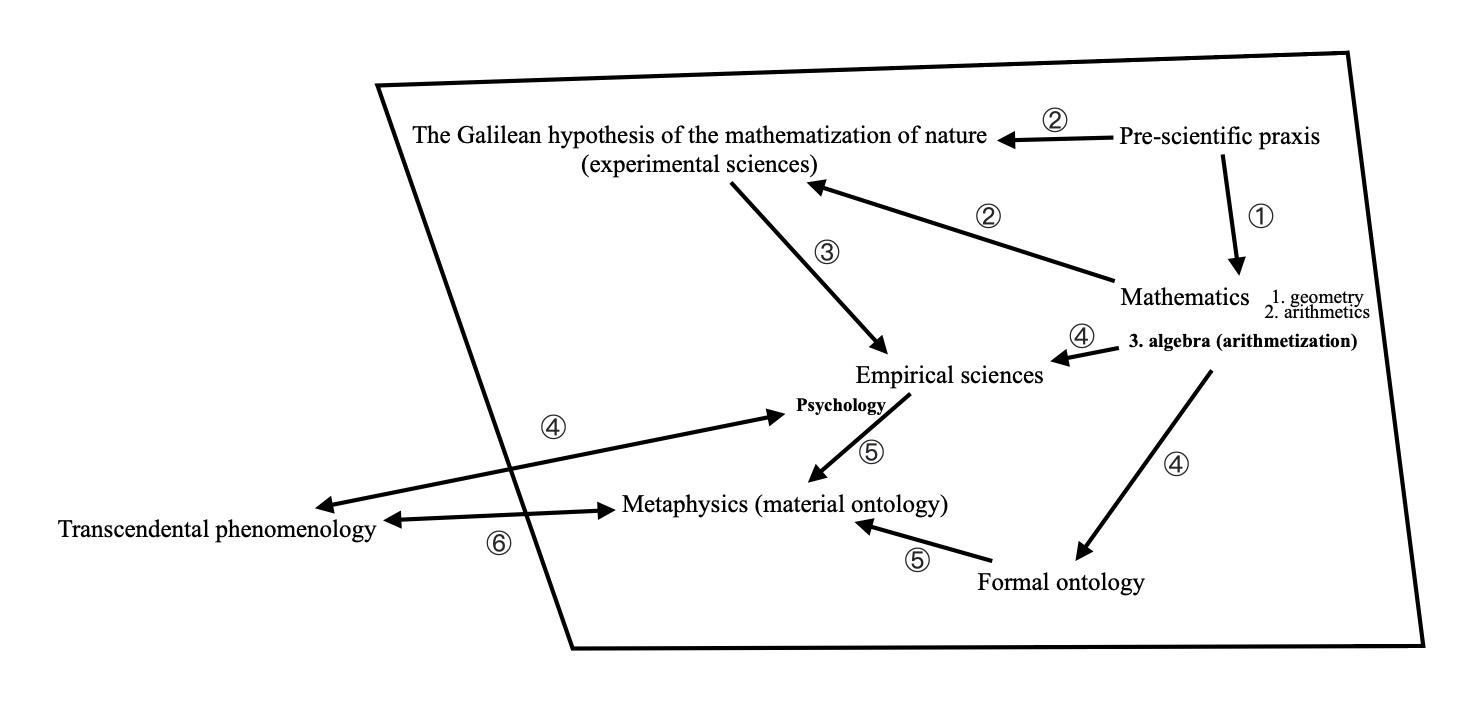
Now I have provided a general sketch of a roadmap to transcendental phenomenology as traced out by Husserl in the Crisis. Let us trace the beaten tracks again so as to recollect. First, we have quasi-scientific praxis in the lifeworld. Through idealization we move to mathematics. Mathematics combined with the Galilean hypothesis then elevates all those pseudosciences to exact empirical sciences. At this stage, we have the bifurcation of our approaches. One could either go the direction indicated in Part II, so as to inquire into an ontology of the lifeworld (an ontology of the paramount reality or actuality), or go the other direction indicated in Part III B, so as to inquire into a pure psychology. The first route is longer and has to go through the detour of arithmetization and formal ontology to arrive at metaphysics, which then indicates transcendental phenomenology. The second route is a shortcut that takes up psychology among the plurality of empirical sciences. It expands the resistance psychology poses against mathematization and sees in this resistance an impulse to abstract a region proper to itself that directly points to transcendental phenomenology. Though this roadmap is imperfect in many ways, I hope it is helpful in guiding readers through the complexities involved in one of the profoundest works of philosophy, understood here as a science and not as a mystical charlatanry.