Sophomore annual essay ·
Relentless Jokes And Long Daydreams
On Plotinus, The Comedian
In this essay 篇目
The Divine Comedy: Are You Serious?
Plotinus opens his treatise on contemplation1 (III, 8 [30]) in a rather surprising way. What is surprising, however, is not that he opens it with an attempt at humor, but how bad the joke actually is. His clumsiness at poking fun looks almost miserable, and one cannot say if that per se is not funnier than the content of the joke. Yet one is missing the truly profound mystery here if one should judge the philosopher solely based on his bad taste for humor. Perhaps Plotinus being funny or not is the wrong question to ask. Instead, one should wonder: why does he even try to be funny at all, if he is bad at it? why should a philosopher jest? what is that irresistible impulse that drives him onward despite failure? A most extreme example of one thus urged is Chrysippus, the Stoic philosopher who anecdotally died of unconstrained laughter over a bad joke he himself made2.
Yet, are we sure the jesting merely stems from a compelling impulse? One might argue the Plotinean joke reflects nothing like an impulse at all. For while telling a joke, one could be genuine or half-hearted. That is, one could be jesting purely for the fun of it, or could use it as a means for deliberate education, provided the uncultured youths whom a philosopher aims to educate are susceptible to amusement of this kind, and can thus effectively be led on to true philosophy through it. Therefore, one could hypothesize that it is for the benefit of the youths that the philosopher deliberates jesting to be the best course. In the ongoing discussion, I will be basing most of my speculations off this hypothesis, for I disbelieve the Plotinean joke to be only a recondite inside joke, or at least that was not how I first read it. This hypothesis, however, gives rise to a problem: how are we sure that jesting can be at all conducive to the pedagogical purpose? is jesting perhaps not antagonistic to the serious stance required of any teaching?
The means has to be analogical to the end, as is sufficiently expounded by Thomas Aquinas3. Via being directed toward the higher purpose, the means itself must harmonize with its end and not intrinsically fall short of it. The higher purpose in this context, according to Plotinus, seems to be nothing but contemplation, for he says ‘children and adults, jesting or serious, seem to have no other purpose except contemplation’4. This statement raises multiple questions. But now, I should stick to my initial task and ask, first, how is jesting conducive to the pedagogical purpose in general? and second, how is jesting conducive in this particular instance?
In general, jesting is conducive to contemplation for it tends toward it. But this is not sufficient, for as Plotinus says, ‘to contemplation all actions tend’. Jesting is no more superior in this aspect. The following clause in the text is helpful here, for we read, ‘compulsive actions drawing it somewhat towards external objects, voluntary actions less so’5. From Plotinus’ treatise on the three primal hypostases (V, 1 [10]) we also read ‘ignorance of origin is caused by excessive valuation of sense objects and disdain of self’, of which the effect is ‘souls forget the divinity that begot them’6. If these separate statements be combined, one could aver: for Plotinus, jesting has to contain something free and voluntary in itself, and this freedom is a freedom of thought and self-reflection, for it must needs lead one away from the excesses of sense objects and educate one’s soul towards a divine kind of contemplation that reminds it of its origin.
What in our general experience of jesting vindicates this conjecture? Is our example of Chrysippus not contradictory to this view? Somehow, it seems that a burst of laughter is always involuntary and compulsive. And can we really laugh at things internal in lieu of external, or laugh only internally? Perhaps the question is better formulated this way: what is the ultimate object for our laughter?
Allow me to take a bold step here. Even as Socrates needs a whole city in order to inquire into the nature of justice in the soul7, I need a bigger image than one single joke for my inquiry into jesting. What would be helpful here is a constellation of jokes, follies, witticisms, puns, double-entendres and cracks: in short, I need a comedy as my free terrain to roam and foray. I will use The Miller’s Tale from Chaucer’s Canterbury Tales as an example of such.
The Miller’s Tale tells a story about adultery. The adulterer and adulteress in this tale hoaxed the cuckolded husband into believing that an apocalyptic flood was coming, and he, being ridiculously gullible, hid away in a boat afloat in air, while his wife was sleeping with her lover. The climax of this tale, however, occurs when another admirer of the wife came, tricked by her into kissing her ass, for vengeance came back with a red-hot iron staff and poked at the adulterer’s anus. This tale is excessively vulgar. Yet, the sheer vulgarity of this comedy alone does not suffice as an explanation for its humor. In spite of the shock proffered by the obscenity, the humorous aspect of this tale is also achieved on two other levels. First, the intricate design of the drama is quite amusing. The happenstance at the end where hearing the adulterer’s cry for water since his anus was burned, the husband mistook that cry for a signal of the coming flood and cut away the tethers, is especially clever, as it gathers two originally separate narrative threads into one unexpected denouement. Second, the respective stupidities and excesses of the characters also contribute immensely to the humor. The futile wiliness of the adulterer (for he fulfills his desire at a high price), the vulgar mischief of the young wife, the irregularity of the admirer’s obsession, and the utmost simplicity of the husband, all display how far a comedy would go in its multifarious depictions of the human folly. Here, from these two aspects of the tale’s humor, something deeply intellectual about the comedic enterprise has already emerged.
The vulgarity and obscenity of things alone when presented can only be repulsive. The shock from something vulgar becomes funny only when it is intellected in a context. Thus one can say the comedy is comedic only because it is understood. This can also apply to a joke. A joke induces laughter only when the teller tells it in a clear and intelligible way, and when the hearer understands the content and context of it. It can therefore be inferred that the act of jesting is in fact prompted by an intellectual desire. A joke is always intellectually demanding, for one has to be capable of making associations that are otherwise not made between different terms, and to make such associations needs both a prior familiarity with these terms and an acute wit for mastering the new significance created by the joke. For instance, to grasp the joke ‘what do you call a fake noodle? an impasta’ both the semantic linkage between the terms ‘fake’ and ‘impostor’ and the phonological linkage between ‘-postor’ and ‘pasta’ need already be familiar, to allow for a comprehension of the subversion of these relationships. Even in the telling of a joke, a desire at mastering the art of delivery preponderates, and it necessarily compels the teller to fully understand the joke and the circumstances to find the opportune moment and tell it the right way. Also, a joke-teller is sometimes motivated simply by a desire to recollect that clever artifice which makes the joke beautiful, or to invent it if he makes his own material, and thus what he desires in this case is primarily to dwell in an intellectual appreciation for the joke itself. By sharing the joke, he not only entertains his listeners, but promulgates what he considers to be artful and well-designed, not just what is vulgar. Therefore, it is clear that the desire at jesting is, no matter if it pertains to the teller or the listener, an intellectual desire, and this desire is most apparent in our daily experiences when one sees everyone at the table laughing tacitly, him alone being left out of the joke, and feels it almost irresistible to ask others to explain the joke to him. In that scenario, one might even feel ashamed about not ‘getting the joke’. One also notices this aspect of jesting when one fails to remember a joke and feels the strong frustration of not knowing it anymore. Therefore, it is without a doubt that jesting is an intellectual, hence contemplative, practice. Moreover, since the desire is an intellectual desire, the satisfaction one gets is also intellectual: on the one hand, one takes pride in succeeding to grasp or comprehendingly deliver the joke, while on the other hand, the very activity of recognition and comprehension brings fulfillment. Hence, one may argue that there is always a contemplative element contained in our act of jesting, and this contemplation is directed at nothing other than a certain kind of ‘knowledge’ prescribed by our thinking and reasoning capacity.
But this conclusion cannot yet be final. For we know jesting is, after all, distinct from rational knowing, if simply because jesting is always about something unreasonable and ridiculous. A joke always makes terms that are supposed to be unequal equal, thus signifying a failure of reason. This failure is also evident in the fact that as soon as a joke is rationally expounded, it loses its charm. The externality to reason, however, only contributes to humor through the lens of a rational understanding: only a rational soul can understand the failure at rationality and is thereby able to obtain meaningful satisfaction from observing such failure. This satisfaction is synonymous to the satisfaction felt by those who are amused by the stupidities and excesses from characters in a comedy. On this point, Aristotle observes ‘comedy, as we said, is an imitation of people of a lower sort, though not in respect to every vice; rather, what is ridiculous is part of what is ugly. For the ridiculous is a certain sort of missing the mark and a deformity that is painless and not destructive’8. To turn his definition around, one might say that only a person who does not feel pained by the stupidity presented is able to laugh at it. The people who find amusement in comedy, hence, are supposedly superior people who can either comprehend the ugliness without finding themselves ugly, or are able to distance themselves from the ugliness presented. Either case, they are looking down upon the comedic characters from a higher level. Therefore, it is reasonable to conclude that one main satisfaction one might obtain from seeing a comedy is the self-felt superiority over the ridiculous and the absurd, which comes from a triumph of the rational over the irrational, the wise over the stupid.
It is indeed possible for a spectator of comedy to be amused and pained by it at the same time. Yet my conclusion is not contradicted. For when one relates to the character and sees in the character one’s own vice, one feels the mockery directed at oneself, and pain is thus felt; but if we suppose the soul is ‘divisible’ into an order of hierarchy, the higher and more virtuous ‘part’ of the soul can still feel superior and be amused by its own vice and stupidity as if they belong only to the lower ‘part’. From this posited ‘divisibility’ of oneself ensues the activity of joke-telling (for in telling the joke one temporarily puts on a mask and appears irrational), self-mockery and self-irony, and this activity can be inherent in the affectation in comedy seeing, too. Thus so far we can firmly establish that in general jesting is contemplative, for it cultivates both an intellectual desire to acquire, recollect or originate ‘knowledge’ and a feeling of superiority of ‘wisdom’, and both relate directly to φιλοσοφία.
Now, as the general aspect of jesting is dealt with, it remains to be determined how humor works in this particular Plotinean joke and how this joke should be ‘contemplated’. There are some preliminary observations to be gleaned from it that can be helpful.
First, in this joke, a philosophical doctrine of contemplation is proposed in a jesting way, before it is to be put under ‘serious investigation’9. Second, if this doctrine were proposed jestingly without qualification on the recipients, no person would ‘listen to such nonsense’10. Third, the risk of proposing this doctrine in a jesting way is eliminated by the knowledge that ‘we are here by ourselves’11. Two questions that naturally arise are, therefore, what is the risk involved here? and why should this joke in particular precede the ‘serious investigation’?
The most obvious risk for a joke is of course that of it being either misunderstood or not understood at all. The so-called ‘uninitiated’ lack the context and knowledge to actually see the joke, thus they would not ‘listen to such nonsense’, whereas only among ‘ourselves’ is the joke understood and therefore amusing. But with Plotinus, another likely risk can be that of the joke being treated merely as a joke. If the joke is not seen as an ingress into something more serious, the joke might lose its proper purpose of directing the hearers to ascend. Thus, it is not enough for the ‘initiates’ to merely get the joke, but they also need to transcend the joke and see the touch of divine inherent in the jesting.
Those who never truly devote themselves to contemplation do not get the joke. In order to get the joke, one has to be capable of making sense of this ‘nonsense’, and has to be familiarized already with the activity of contemplation. Only those who have a prior understanding of what contemplation should be, viz a serious mental activity of having grasped, can be shocked by this joke. The joke is (now I am ‘explaining the joke’) that contemplation is described by this doctrine to be the most universal, but it seems absurd to say that all things should contemplate, and all their actions be contemplation. The risk, however, is that even those who actually contemplate and get the joke might persist in their self-ignorance in seeing this doctrine only as an absurdity, hence failing to ascend. Only those who both get the joke and somehow feel intrigued by this seemingly unreasonable position to further inquire into its truth will be able to enjoy this joke fully in transcending themselves through the eventual reception of the doctrine. For them, a second joke is prepared.
In the paragraph that follows immediately afterwards, the transition from jesting to serious investigation is played out: ‘Could it be true that in jesting we are contemplating? Yes. As do all who jest, in jesting we contemplate. One jests because one wants to contemplate’12. The transition effected here is crucial and difficult; but above all, comical. In claiming that the former activity of jesting the reader is engaged in is itself a kind of contemplation, Plotinus effectively shifts to a more serious stance without losing his playfulness of language. By broaching such a surprising claim and following it up with a strong affirmation, he shows how radical his doctrine really is, that even you, who were just now reading the joke and jesting with him, are included in the ‘absurd’ universal contemplation. The once passive observer now is involved as part of the comedy itself, the indifferent superiority being thus challenged: in short, the message is, if this is indeed a comedy, by treating the doctrine as mere jesting, you are exactly the one being jested for jesting along without realizing that what you are now doing is contemplation all the same, which identification has seemed to be precisely what is ridiculous; that the reader has just thoughtlessly participated in a jest which is nonetheless ‘contemplation’ and which he probably feels absurd to call ‘contemplation’, is the second joke.
But this really is a comedy, for the initiation into this doctrine of universal contemplation cannot be effected here through rational persuasion. Moreover, it seems that Plotinus does not even intend to do so. By simply claiming jesting to be also contemplation, he essentially evades the real difficulty of convincing the unconvinced. If we interpret the introductory passage of this treatise to be argumentative, the argument seems to run as follows: 1. the objector does not treat the doctrine of universal contemplation seriously; 2. ‘not treating something seriously’, viz jesting, seems to be a least contemplative activity; 3. but even jesting is a kind of contemplation; 4. therefore, the objector should reconsider his position. To effect the third step, one must already be willing to accept, to some extent, the doctrine itself. For those unconvinced of the equation between jesting and contemplation, this ‘argument’ can only be spurious. And even if the objector concedes that jesting is contemplative, it does not necessitate any wholesale acceptance of the full doctrine: after all, jesting seems to be exclusively a human activity; plants and animals seem to not jest, and likewise not contemplate.
That is why this passage is exactly not meant to be taken as argumentative. Rather, it is a show that Plotinus has put on only to display his good spirit. What else is presented here about his doctrine other than its inherent weaknesses and absurdities? If jesting really is a kind of contemplation, and the doctrine of universal contemplation is put into a jest, is his presentation here not dangerously self-referential? It seems possible to reduce the relationship just outlined to the following: universal contemplation is itself something contemplated. This self-referentiality portends great ‘metaphysical’ trouble: since universal contemplation (taken in the absolute sense) can be encompassed by a particular act of contemplation, should this particular belong to the universal, the same thing would be smaller than itself, thus breaching the principle of self-identity; should this particular not belong to the universal, the universal would stop being universal in the absolute sense; lastly, should this particular not belong to this universal but belong to a higher and more absolute (this is already nonsensical) universal, that more absolute universal in turn can be encompassed by a particular act of contemplation, ad infinitum. Therefore, even before seriously expounding his doctrine, Plotinus has already exposed it as something quite absurd.
Moreover, the very universality claimed by his doctrine (that ‘everything’ contemplates) inevitably entangles all reality to the one absurdity established above, for just as universal contemplation is to be particularly contemplated, every contemplation encompassed by the universal is contemplated likewise, and we are eventually confronted with either a paradox or an infinite regress, so that, via this doctrine, all things become participants in an infinite comedic parade. One should nevertheless not fail to see that the consequence of this installment of an absolute and universal comedy is very serious: are we supposed to live in a world where everything can ultimately be treated as absurd laughing matter? One finally makes the leap from jesting to serious investigation, as soon as one realizes the serious and uncanny consequence possibly entailed by a wholehearted acceptance of the Plotinean doctrine. The thought, however, that he should expose this absurdity even before the doctrine itself gets formally introduced, creates a certain sense of awe in us, which is no less than what one feels upon seeing a warrior who voluntarily exposes his mortal wound; and awe, according to Aristotle, makes men ‘both now begin and at first began to philosophise’13. What Plotinus has put on behind the jesting, therefore, is essentially a challenge, an invitation, a show of his hospitality, instead of an attempt at argumentation, for only through this interpretation are we able to construe his saying ‘we are here by ourselves’, which are his welcoming words of intimacy for us to take on the honorable task of joining the divine comedy to reason with the unreasonable, and to think the unthinkable: that is, to feel awe and philosophise. And is not his bad humor exactly that awesome thing which has initially spurred me on to this task of investigation? It is fortunate that after the initial wonder I should discover other even more wondrous things to extend my pursuit, and thereby overcome myself.
There are different kinds of spirits who read this same passage, and they react in various ways. Some of them fail to get the jokes. Some only get one of the pair. Some get both, but pause before that imminent transition to a more serious attitude, for they are stopped by their stagnant ‘superiority’ from wondering: what if the absurdity has some truth? what if the joke reflects some reality? if truth he really has not, how can he be yet so self-assured that he is willing to expose so many apparent weaknesses? Only those more powerful and adventurous spirits, who are always bored of their unchanged stations and try to overcome themselves, will enjoy the joke to the fullest extent, so that they not only get it, but also decide to learn it by heart.
It will come in handy if I now give a brief summary. To start with, I base the first section of my essay on the hypothesis that the jesting which opens this treatise on contemplation has some pedagogical function. Then I determine that jesting generally can be conducive to philosophical education because it contains something voluntary and free, which here consists in its satisfying an intellectual desire of the soul and nurturing a feeling of superiority of reason and wisdom. But this feeling of superiority, if it becomes stagnant and lethargic, can hamper the soul’s ascent. Therefore, the Plotinean joke in particular has something more to offer: first, it stings that indifferent superiority held by the reader and shakes it up via making him part of the ‘play’; next, by implicating a very serious consequence of everything merging into an absolute comedy, it becomes something uncanny and hence worthy of serious investigation; third, it functions as a highly selective invitation addressed to a certain kind of spirit. This endeavor of serious investigation belongs only to those who are so willing to reason with the unreasonable and to understand the absurd, that they not only see the absurd, but also in their freedom decide to commit themselves to the absurd, at least temporarily. For these spirits are no less enticed by the stance and posture that a thinker exudes than by the actual content of his thought. And one who thus belongs to this tribe of spirits is sometimes called, in short, a free thinker.
Yet, is my hypothesis that the Plotinean joke is nothing but a pre-figurative accessory in the help for the philosophical spirit to its own education not perhaps a too questionable self-delusion? Am I not perhaps too rash and also foolish if I just conclude in a thoughtless rejection of any impulse for laughter and entertainment the philosopher might have had? If I on the one hand stress the voluntary and free aspect of jesting, why do I on the other still subject it to its serviceability to a master, and thereby in a sense disparage its freedom? The issue that I initially undertake to investigate is therefore still not resolved, and shall be taken up in the next section under a different perspective.
Infinite Jest: The Eidological Play
Is it possible for a philosopher to be playful on its own accord, to take up the act of jesting and the attitude of unseriousness simply for the fun of it? This possibility seems, at a first glance, counterintuitive, and when investigated appears even the more unreasonable: is not philosophy the serious profession par excellence, when it concerns itself solely with the gravest matters of life, nature and being? It seems as if philosophy in its very essence is antagonistic to the lightheartedness of play. Yet, by simply reading any Platonic dialogue a conviction such as this would immediately be thrown into doubts and suspicions. What is the significance of the fact that the only writings this most exemplary philosopher bequeathed (either accidentally or intentionally) to later generations consist nearly of nothing other than plays? While it remains true that Plato’s Socrates in Phaedrus apparently dismisses writing as, ironically, ‘mere play’ and thus ‘devalues’ the activity of writing as a whole14, the very paradox of the written-ness of this dismissal has to make us pause. I am not convinced by the claim that Platonic plays are not serious even in their own way, and I believe no one will solemnly conclude from reading Phaedrus that these written plays lack some intrinsic value. The tension between play and philosophy, therefore, is never resolved matter. On the contrary, to even perceive and be able to characterize this tension despite all the presuppositions and prevalent opinions that tend to conceal it is a task strenuous and serious enough to suggest high rewards.
In the first section, I have determined the qualities that play has in service to a subsequent serious investigation. Yet I have scarcely spent ink on explicating the phenomenon itself. This negligence will persist if I, instead of extolling play as the guide to philosophy, start to emphasize its restorative value. For play itself can so easily be glossed over and slide into being a supplement to the ‘solemn’ task of actualizing life, i.e. a mere respite that one uses only to recover the strength necessary for next day’s labor, if one pays no attention. Therefore, one cannot be too careful in hunting down the essence of playfulness, since it is a wily animal: but is ‘hunting’ not already a most exemplary form of play?
For primordial men, hunting figures as a means to provide the household with sustenance, clothing, and livestock. Primarily, hunting aims at the procurement of necessities. But even there it already implicates something more. It first is an exploratory venture, for in pursuing one leaves home. Next, it provides a space for the display of honor, so that those who acquire the biggest game are considered better warriors. Hunting hence always projects beyond itself an excess that surpasses mere survival: one seems capable of ‘surviving’ by feeding solely on the produce from earth. Moreover, this excessiveness becomes ever more amplified as the necessity of hunting gradually recedes, so that in times more recent to ours, hunting eventually became the royal game. And since then a third aspect of hunting has become the most acute: the pure rapture in pursuing the game now is the main motivation. See what Montaigne has to say about this: ‘I think the example of the chase would be more appropriate. Even as there is less pleasure in it, so there is more transport and surprise, whereby our reason, stunned, loses the leisure to prepare and brace itself against it, when after a long quest the beast starts up suddenly and appears in a place where perhaps we were least expecting it. This shock, and the ardor of the hue and cry, strike us so that it would be hard for those who love this sort of hunt to withdraw their thought elsewhere at that point. And the poets make Diana victorious over the torch and arrows of Cupid: Who amid these does not forget the stings and all the cares love brings? [Horace]’15.
Nevertheless, it is exactly on hunting, the activity which, according to Montaigne, extinguishes reason and effaces love, that Plato paradoxically models his most well-known philosophical quest: the hunt for the sophist. To show what is broached there is not merely a superficial parallelism but a thorough fusion of the two pursuits, I shall quote profusely from the text:
STRANGER: [...] Now, then, Theaetetus, this is my own advice to the pair of us, inasmuch as we believe the genus of the sophist to be difficult and hard to hunt down, to make a practice run of his pursuit in something else that’s easier––unless of course you can from somewhere or other speak of a different and easier way.16
STRANGER: Well, if that’s the decision, let’s dismiss you and me, and until we meet with someone who is able to do it, let’s say until then that it’s as certain as anything can be that the sophist is a criminal in the way he has of stopping at nothing, and he has slipped into a trackless region.17
STRANGER: We’ll find, then, if we seek, both now and later, the philosopher in some sort of region like this, and though he too is difficult to see vividly, it’s in another way than his that the sophist’s difficulty is.
THEAETETUS: How’s that?
STRANGER: One’s a fugitive into the darkling of ‘that which is not’, to which he attaches himself by a knack, and on account of the darkness of the region, he’s hard to get an understanding of. Isn’t that so?
THEAETETUS: It seems likely.
STRANGER: Yes, but the philosopher, devoted to the look (idea) of that which is always through calculations, it’s on account of the brilliance of the place that he’s in no way easy to be seen, for the eyes of the soul of the many are incapable of keeping up a steady gaze on the divine.18
THEAETETUS: Yes, but it seems, stranger, to be utterly true––it’s what was said at the beginning about the sophist––that the genus is hard to hunt down. He really does appear to be full of defenses, and whenever he sets up one of them in front of himself, it’s necessary to fight through it first, before arriving at him himself. For now with difficulty we pierced through the defense that ‘that which is not’ is not, and he has to set up another, and we must now prove that there is falsehood of both speech and opinion, and after this perhaps there’s another, and still a different one after that, and, it seems, that no limit will ever appear.19
Unfortunately, I would not be able to undertake a thorough explication of these passages in the space of this treatise. However, one should not fail to perceive that for Plato, the playfulness of philosophy is not an utter impossibility. The rapturous chase which seems most oppositional to a love of reason can nonetheless be used as the paradigm on which a philosophical pursuit is modeled: but in what way? is the paradigm of hunting simply applicable to philosophy without any internal tension? After all, the sophist is not just any beast of game, but a hunted ‘criminal’!
But back to Plotinus. In his treatise on virtues (I, 2 [19]), Plotinus explains: ‘wisdom and prudence [...] are of two kinds, one in The Intelligence and another in The Soul. In The Intelligence they are not virtues. In The Soul they are virtues. What are they then in The Intelligence? Its act and its essence. But in coming from The Intelligence and taking up residence in a being different from them, they are virtues’20. In what follows, he implies that corresponding to each virtue, there is in The Intelligence an original paradigm, an Idea of virtue. Now playfulness, even according to Aristotle, is a virtue21. Should we not then conclude that, even for playfulness, there possibly is an original paradigm in The Intelligence? And is the philosopher, who aspires to the loftiest contemplation, not evincing such transformed ‘virtue’ of the intelligible being when he jests ‘contemplatively’? What could be the nature of such ‘eidological playfulness’ (as that which belongs to the gathering of εἰδη)?
Plato’s Sophist again gives us a lead for addressing these questions. Around 234B, the Eleatic Stranger asks Theaetetus: ‘do you know of any more artful or maybe more charming species of child’s play than the imitative?’22 Playfulness is here determined in its most crucial aspect as imitativeness, that it shows its essence most in relation to the act of imitation. How should one interpret this most decisive claim with respect to our guiding question?
Imitation occurs when something is produced in the likeness of something else. Our human play imitates. Hunting imitates war. Flirting imitates love. In video-games, most digital figures imitate real things. Toy cars imitate vehicles. Yet imitation is of various sorts. To a natural kind of imitation belong quasi-entities such as shadows and mirror-images. Paintings and photographs can be categorized as artificial imitations. Play seems to most appropriately belong to the artificial category. Though sometimes children play with just sticks and rocks, the imitation is still achieved only through an artificially fabricated and jointly shared ‘fantasy’. But a further specification is required since play is not exactly the same as a painting or, for that matter, a video. For play, in its broadest sense, is always ‘acted out’ and immersive. Even a play on stage presents itself as something more than a spectacle: it grips and interacts with the audience in a self-conscious and active way. It stretches itself and extends its scope to those who step in by lighting up a jovial space of fantastical hospitality. Yet an immersion of this kind is never total, for one thus immersed is no less able to recognize this play-space as an imitation: one knows those ‘corpses’ that lie on the ground at the end of a tragedy do not tend to remain there next morning, and one almost always freely enters or exits a play, just like when one daydreams.
This is not so with life. Life seems to not be something over which one has a free mastery. No one is willingly born, and if one ever willingly exits life (instead of merely accepting death as an inevitability), the suicide is always described as a sacrifice, a sin or a most consequential liberation, e.g. what laymen conceive of as ‘nirvana’. The seriousness of life also consists in the fact that life is always determined to some extent by its past history and is therefore unable to always freely rebuild its whole trajectory. Every choice or happening has some irremediable consequence that constitutes our destiny. One labors under such destiny, constantly attacked by chance, either to actualize or to maintain a most vulnerable happiness. This manacle of drudgery, however, is not worn by a player. A player is never serious, for his actions implicate no consequence such as an ultimate triumph or a most sorry debacle. This freedom over life and fate thus characterizes a most essential aspect of a player.
By this criterion, The Intelligence in its activity is most necessarily a player. As it is next to what is the most superior, i.e. The One, and participates in its eternity, it is not entangled in the attacks by what is inferior to it: neither bodily passions, nor the weal and woe of life, nor time disturbs its leisure. Those who contemplate, when contemplating, are likewise free from worldly cares. But how does this eidological freedom relate to imitation? For it seems unlikely that upon the heights of The Intelligence, the contemplator should be imitating human life. Even the playfulness of The Soul does not intend to imitate it, since Plotinus has already determined virtues of the soul to be likenesses of divinity, not of finite existence. Then much less should playfulness of The Intelligence be an imitation of it. And above all, is even human play in its essence an imitation of human life? Only in a sense, for there what the imitation essentially achieves is a feeling of mastery and freedom. What the play imitates, therefore, is ultimately nothing less than the most superior freedom, which amounts to a contemplation of The One. And insofar as highest contemplation is the τέλος of our human life, play is an imitation of it. But play also exceeds life, insofar as it much more directly comports to this happiness our life aims at.––Thus equipped with these preliminary determinations, I am finally able to venture a more definite (hence more definitely wrong) exposition of playfulness in context of the Plotinean doctrine.
The Plotinean philosophy is predominantly a philosophy of signs. This feature of his thought can be discerned most clearly through an understanding of his multifarious delineations of the ascent to The One. These delineations usually conform to a process of him finding on each level of the hierarchy a special index that dialectically points beyond itself to what is higher that unifies and gathers the lower level as a whole. One such delineation can be found in his treatise on contemplation23. My synopsis of it runs as follows.
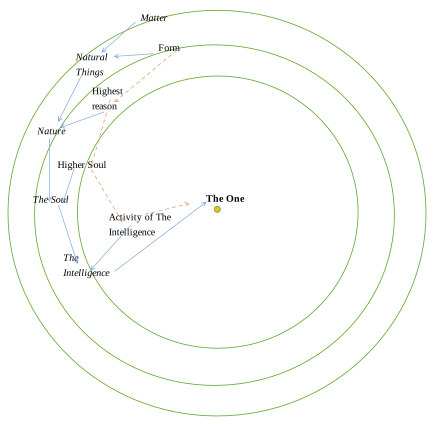
On the lowest level there is material. But material is a passive multiplicity unified by form; form and material constitute the totality of natural things24. This totality becomes an object for contemplation when it, being ‘the lowest reason’ according to Plotinus25, is unified by The Highest Reason. The Highest Reason, the intermediary reason of actions and the lowest reason of visible shapes then constitute the totality of Nature as Reason26. This totality of Nature, being a lower soul, is again a passive multiplicity to be unified by ‘the higher part’ of The Soul27. The lower and higher parts then constitute The Soul as a totality. This totality abiding with time is in turn gathered by an atemporal activity of thinking into an object for contemplation28. The thinking activity is then unified with its object, i.e. The Soul, into a new totality. Plotinus calls it The Intelligence29. The Intelligence, still split in a sense between the active thinker and the passive thought30, turns to the ultimate unifying principle: The One. This ascent delineated by Plotinus is a dialectical process that unifies, on each level, the oppositional parts of a totality. But what is more significant of this process is the ‘signitive’ nature of it: on each level, there is an active principle of unification, a superior instance from the totality, that in turn represents an activity higher than itself. Form points to The Highest Reason as its producer31, The Highest Reason to the higher part of The Soul32, it to activity and life of The Intelligence33, which ultimately points to The One34. These indexes also relate the totalities to one another in a likewise manner, e.g. The Soul to The Intelligence, so that one totality is said to reproduce an antecedent totality. Therefore, one can say that the Plotinean philosophy is not simply dialectical, but a dialectic of indexical signs that each preserve, sequentially, traces from an antecedent. It is to be noted that being indexes, these signs are not simply landmarks separately distributed on a linear path; rather, they are like inner parts of concentric circles35, each coinciding with a smaller circle that in turn contains a more condensed part. The ascent, once presented this way, is also a process of concentration and contraction.
In no way is this delineation the most precise. In his treatise on souls36, Plotinus further specifies all the sub-levels that characterize the path leading to The Soul. Though the steps are more detailed, the very same pattern still governs his thinking: upon each level of the hierarchy, there is always one superior instance from the totality that would make an index to indicate a higher principle. Thus I say that the Plotinean doctrine can be thoroughly determined as a philosophy of indexical signs.
Yet signs are of different sorts. Some signs are like reflections, photographs and realistic paintings, while others are like words, national flags, and coats of arms. Those belong to the former category are ‘images (εἰκόνες)’ that directly and immediately refer to the objects they represent, whereas those belong to the latter are ‘symbols (συμβόλαια)’ that only indirectly and mediately refer to the objects. Both are imitative so long as both depict ‘things’ and what they are ‘like’, but an image always indicates something in its particularity as a determinate object, while a symbol, that which is ‘thrown together’, only indicates an object that is indeterminate and general. Upon seeing a national flag one does not see the nation itself, yet one interprets from it a general mood that is ‘like’ the national spirit in a very loose sense, symbolized by the color and design of the flag. Upon hearing a word, one does not have before oneself an unproblematic ‘likeness’, for most words do not sound ‘like’ the things they denote, yet through etymological connections a relational similarity between the word to other words and its object to other objects can be established. That is probably why in Cratylus Socrates, not without difficulty, could tentatively treat words as likenesses37. A likeness between an algebraic symbol and the magnitude it signifies might be the most difficult to reckon with, yet insofar as the symbol is as random and coincidental as the magnitude itself can be before it becomes known, the symbol is said to liken what it represents.
So in what sense do those indexical signs in the Plotinean ascent refer to their respective higher realities? And how can their statuses be determined? If falsity, which allows for imitations, really is a mixture of Being and Non-Being as maintained by the Eleatic Stranger38, different kinds of imitations would suggest different ways of mixing the two genera. With what ratio are images mixed and produced? Images are produced when Being and its truth are locked in the eye in the production process, and they are interpreted as images only when their originals are thereby determined. Symbols, on the other hand, are ‘thrown together’ with their referents, as the word συμβόλον originally signifies the two halves of a split coin that help to identify contracting parties. Symbols represent only incidentally, for the person who currently wears this other half of a coin might have robbed it from someone else; while a shadow can never be stolen. The incidence of a symbol, however, comes precisely from its being broken off from its original oneness. Its fragmentary nature makes it something that ‘desires’ its other half and its own completion, but being excluded from its most originary unity, it no longer truly belongs anywhere and is thereby made readily detachable, hence incidental. The symbol is therefore a residue, and its being residual gives it a power to represent something other than its most primordial origin, to represent ‘anything at all’: jettisoned from the transactional configuration of a coin, it can now be carried around as a mark that represents something, precisely because it has been denied its most proper function as currency. Thus, in the process of symbolization, the original has to be irremediably fractured: the two halves of the coin can probably still be fit together, yet the split remains in the middle, and neither of the two halves is still functionally serviceable for the market. The production of images, on the other hand, does not in any way diminish the originals, since images always point to the originals directly: this indexical immediacy would not be possible if with the production of images the originals themselves somehow become confused or less illuminated.
Images, then, are signs produced with prior determinations of originals. Symbols, on the contrary, are fragments that strive to become whole despite remaining incomplete. These, however, are only characterizations of signs as ‘things’. To connect these determinations with playfulness, the differentiation between signitive things have to correspond to a differentiation between practices that ‘act things out’. In the Plotinean doctrine, this correspondence between the imitative thing and the imitative practice can ultimately be discerned in a differentiation between the upward and downward directions of contemplation. As one climbs the ladder leading up to The One from down below studiously, one constantly encounters fragmented things that long to be unified. They are symbols on the road that testify to the indeterminateness of life and of happiness. Yet as one reaches the highest contemplation and thereby contemplates with The Intelligence, one has attained the knowledge of originals upon the eidological terrain, and when one looks down from there, how else can those derivative things be seen but as images and shades? Why else would images be produced when originals are within grasp, if not to play with? At the level of The Intelligence, one is ‘oned’ with The One, eternally blessed in the ultimate happiness: what else remains to be ‘done’ but to play blissfully in this eternal leisure? Sooner or later, a philosopher who has thus left the cave will start to treat his own life as a play of images and shadows, and dwells with it as if a game. And in such playing he achieves a most superior kind of imitation, for through it one imitates The One which ‘descends’ from its self-contentedness to produce its own images. Such a descent is completely free and voluntary: The One has no reason to ‘descend’ and does not ‘really’ descend, and in imitating it the philosopher likewise produces derivative images as freely and playfully. Unlike symbols that always are ‘meaningful’ in pointing toward general ideas that wait to be further examined and determined, images are produced ‘meaningless’, ‘apparent’ and ‘superficial’ in their immediacy, since they are excesses despite the originals: they persist alongside the ultimate fulfillment, as meaningless and nonsensical, hence as playful, as the ‘descent’ of The One. The eidological playfulness, therefore, consists in both an imitation of the playfulness of The One and an unseriousness that most properly belongs to the divine which sees and plays with its own images. However, this eidological play needs be differentiated from the human play in its character of actuality and fulfillment. The human play remains vulnerable to the seriousness of human life and is demarcated by it, so that the human player is still constantly disturbed by the thought of ‘wasting time’ on games and sports instead of investing those chunks of time ‘more efficiently’: to the actualization of ‘real happiness’. But with the eidological playfulness, as the highest contemplation is already achieved, no care of finite human beings should genuinely remain attached to the philosopher. Human play, even if it comports to happiness more directly than the struggle of life does, remains in the earthly realm and is thus often utilized only as an instrument for realizing and habituating one to the ultimate happiness. In other words, unlike the eidological play, the unpurposiveness of play in the human realm is only temporary and is often subsumed under the service of a more general project with the ultimate happiness in scope.
Now I shall recapitulate my exposition. First, I have determined that the Plotinean philosophy is a philosophy of signs. Then I differentiate two categories of signs, that of images and that of symbols. Images refer to determinate objects directly, while symbols refer to indeterminate objects indirectly. The playfulness of the highest contemplator is of an eidological sort, so that he freely participates in a production and play of images that is unserious in two aspects: first, images are produced without any reason other than the superabundance of power, hence a production of images playfully imitates the senseless descent of The One; second, this divine playfulness is utterly unperturbed by the struggle of human existence, and compared to the initial labor it takes to achieve such highest contemplation, this ‘descent’ is most effortless and lighthearted. One could say that here Plotinus has anticipated a reversal of The Divine Comedy: for Dante, it is the descent to inferno that is the most torturous, but as soon as he starts to ascend, his path becomes ever more serene. For Plotinus, however, the comedy consists not so much in seeing heaven in its true face as in striking a fall that is like a somersault, upon the clouds.
Everything That Rises Must Converge: Plotinus contra Augustine
In the second part of this treatise, I have treated generally what it means for a philosopher who contemplates the highest to be playful. Yet play covers a variety of activities: games, sports, theatrical plays, etc. Among them, one particular species of play especially presents a difficulty: how is tragedy considered play? Is tragedy not perhaps exactly about what is serious? In assigning the playfulness of philosophy exclusively to the comic, am I not perhaps overlooking a significant possibility?
Tragedy is playful insofar as it is imitative. But it is imitative in a mode different from a comedy. In a comedy, neither the characters in the play nor the audience are ‘pained’. The audience retain their superiority, whilst the comic characters exude a unique kind of immortality. Every buffoon in a play seems to be somehow put under a strange aegis that protects him against any worldly attack. Jacques the melancholic in As You Like It goes so far as to say: ‘I must have liberty withal, as large a charter as the wind, to blow on whom I please; for so fools and they that are most galled with my folly, they most must laugh’39. A comedy is determined thoroughly as that which is not serious. The comic playfulness plays with shallow images, and is in that sense imagistic. But tragedies always depict a pitiable downfall of the ‘superior people’, and thereby exhibit the indeterminateness of human fate, so as to show how the τέλος of life is forever out of reach for any finite being. This abysmal indeterminateness unconcealed by tragedy makes tragic playfulness a symbolic imitativeness. Tragedy is hence bordering on our human struggle of life and death with fundamental meanings and symbols. Despite this shared border, tragedies can still be counted as play as opposed to serious life only because they in some way break from the normal self-forgetfulness of our quotidian existence and become the ultimate condensation of symbols: they gather the human suffering into an enchanting, maddening and intoxicating totality. In doing this, they transform our daily struggle into a war on the cosmic level and elevate us from our ordinary life-trajectory. Immersed in the hustle and bustle of our lives, we tend to forget about those critical questions such as on mortality, happiness, and truth. In tragedies, these most essential questions concerning mortal existence are raised and addressed. Comedies, on the other hand, tend to suppress such questioning: human existence when put into the comic perspective becomes unserious. Let us reflect how often we try to determine the right and wrong in a tragedy. Is Antigone perhaps too headstrong? Is Creon too austere? These questions are much less often raised by a comedy: as soon as one gets this serious about it, one detaches it from its most primordial sphere of lightheartedness. The tragic playfulness, therefore, does not consist in a jocundity that most properly belongs to comedy, but shows a different sort of transcendence; or rather, it puts the transcendence into a different perspective: in beholding the most sublime possibility of life it struggles to ascend so much that it forcefully ‘breaks free’ from a normal course of time, whereas the imagistic playfulness of the divine jester signifies a freedom that has long been attained and secured. The festivity and eventfulness of tragedy thus hinge on a break from the ordinary self-forgetfulness of human existence, in conjuring up transcendence through the ultimate presentation of a struggle.
Is it possible for the playfulness of The Intelligence to be tragic? This seems to me to be a dubious possibility. Augustine is the most prominent thinker that seems to have approached this question. For being a habituated tragedy lover, even when he later renounces it in words, he still keeps in his thinking his tragic consciousness intact. He exposes this side of himself when he confesses: ‘hence came my love for sufferings, but not of a kind that pierced me very deeply; for my longing was not to experience myself miseries such as I saw on stage. I wanted only to hear stories and imaginary legends of sufferings which, as it were, scratched me on the surface’40. And of his comment on Dido and himself: ‘what is more pitiable than a wretch without pity for himself who weeps over the death of Dido dying for love of Aeneas, but not weeping over himself dying for his lack of love for you, my God [...] ’41. Despite his apparent abstinence from it, is it possible that his love for tragedy only grows subtler as he becomes more mature? Instead of wanting to see the tragedy, has he not perhaps surreptitiously transformed his life into one, thus imbuing his personal experience with a symbolic significance?
Now, a philosopher’s eidological playfulness seems to have become an impossibility under the Augustinian perspective. This is because the eidological terrain is time-less in the strict sense: time is only a ‘possession’ of The Soul, being an imagistic product of The Intelligence. Yet for Augustine in particular and for human existence as he views it in general to be, it is a mere hope to transcend the fragmenting time: ‘You are my eternal Father, but I am scattered in times whose order I do not understand. The storms of incoherent events tear to pieces my thoughts, the inmost entrails of my soul, until that day when, purified and molten by the fire of your love, I flow together to merge into you’42. Augustine, by his belief in the human sin, has to deny any possibility for the earthbound to achieve ultimate freedom without the messianic savior liberating him through grace. Having thus transformed his life-history into a tragic play and his contemplation to a symbol that cries for the advent of God, he demonstrates how the tragic playfulness can be present at a lower level of The Soul, where the human soul remains fragmented. But throughout his contemplation, especially with that vision at Ostia43, an absence of the tragically playful or the playfully tragic from the ordered-ness of The Intelligence is strongly suggested. On this point he therefore seems to converge with the philosopher, since The Intelligence, as described by Plotinus, immediately relates to its own fulfillment and ultimate happiness, and stays one with The One. No tragic split of time separates The Intelligence from its τέλος. But since philosophy, being the highest human attempt at contemplation, aspires to participate in such eidological play, which is nothing other than the inexhaustible activity of the divine νοῦς, the Plotinean comedy is, in its final analysis, marked off against the Augustinian tragedy of faith as a competing interpretation on what is essentially possible for men: are men mortal sinners, or are men players above all? In play, Augustine sees primarily the danger of a sinful pride. This is why he praises child’s play in opposition to the ‘play’ of adults, which consists of all vain customs and proceedings from human society: not because children play better, but because they play less pretentiously so that they do not mistake games for something serious44. Yet with adults, ‘play’ is something always to be guarded against, for it either brings pleasure to the senses and distracts soul, or takes itself too seriously. But is Augustine not blind to himself on this? Does he perhaps not see that he also plays himself too seriously? I leave it at that.
Earlier, I have determined that one aspect of the eidological playfulness stems from an imitation of the playfulness of The One. Yet what is this playfulness? Does The One exhibit a kind of playfulness different from any of those previous determinations? Is The One playful at all? I do not have a definitive answer to these questions. But one does perceive a fundamental difference that separates The One from all its descendants. The One does not imitate, if it imitates at all, in either an imagistic or a symbolic way. Though The Intelligence is said to be an image of The One45, the metaphor employed by Plotinus actually exceeds image and is light itself: all the descendants of The One are, in a manner of speaking, emanations of the same light from the same source46. What is emphasized by this metaphor is an all-encompassing continuity of The One. The One produces neither a stand-alone reflection nor an excluded virtuality. Rather, it embraces and seeps into all entities; and if The One is ever playful, its play is none other than a play of light. This is certainly a very different sort of playfulness that requires further exploration which cannot be taken up here. But it points out a way to further our serious investigation up to this point: it jests towards it.
Now I shall present a final review before concluding this essay. In the first section, I work with the hypothesis that the Plotinean joke is serviceable to a philosophical education. But this hypothesis greatly overlooks the freedom intrinsic to the act of jesting. Therefore, in the second section I shift to a discussion of playfulness itself. I expose the Plotinean philosophy to be a philosophy of signs and thereby determine the philosopher’s playfulness is to be interpreted as a painless descent from the eidological terrain of The Intelligence to an imitative production of images. In the third section, I antagonize Augustine to Plotinus to show that a tragic playfulness can be a competing interpretative possibility as to what men are capable of and where the limit lies. Finally, I raise the question about the kind of playfulness that belongs to The One, which requires further inquiry.
I shall conclude this treatise with a lay snippet from Nietzsche47, who had recovered the tension between play and philosophy before most did, and to whose inspiration this essay is deeply indebted. This snippet delineates a most interesting inter-play between play and the world it is situated in, and is hence fitting as our conclusion:
[...]
World-wheel, spinning by,
Skims goals on its way:
Calamity! is rancor’s cry;
The jester calls it Play!
World-play, the ruling,
Mixes ‘Seems’ with ‘To Be’:
Eternally, such fooling
Mixes us in––the melee!
Notes
- The Essential Plotinus, translated by Elmer O’Brien. III, 8 [30], chapter 1, page 163. ↩
- Lives of the Eminent Philosophers, by Diogenes Laertius. Book VII, chapter 7, line 186. ↩
- The Summa Theologica, by St. Thomas Aquinas. First Part, question 12, article 1, objection 4 and the reply to it. ↩
- The Essential Plotinus. III, 8 [30], chapter 1, page 163. ↩
- Ibid. ↩
- Ibid. V, 1 [10], chapter 1, page 91. ↩
- Republic, by Plato. Line 368E. ↩
- Poetics, by Aristotle. Chapter V, line 1449a 30. ↩
- The Essential Plotinus. III, 8 [30], chapter 1, page 163. ↩
- Ibid. ↩
- Ibid. ↩
- Ibid. ↩
- Metaphysics, by Aristotle. Book I, line 982b 10. ↩
- Phaedrus, by Plato. Line 276D. ↩
- The Complete Essays of Montaigne, translated by Donald M. Frame. Book II, essay 11, Of Cruelty, page 313–314. One might argue that Montaigne’s conception of hunting as a game is anachronistic to the subject I have here, namely, hunting as was conceived in antiquity. But regardless of anthropological and historical circumstances, the excessive nature and a potential playfulness of hunting in all times are evident. ↩
- Sophist, by Plato. Line 218D. In Sophist, hunting is literally determined as an art of the acquisitive sort (see line 219D–219E). The playfulness of hunting is therefore consciously suppressed, probably as a joke, by Plato. Yet it is significant that as the coercive art to acquire resources, hunting is an imitation (concealment) of war, hence a play of war. And a war against the sophists is mentioned in later text (see line 261B–261C). This is evidence enough that Plato is conscious of the playful nature of hunting. ↩
- Ibid. Line 239C. ↩
- Ibid. Line 253E–254B. ↩
- Ibid. Line 261A–261B. ↩
- The Essential Plotinus. I, 2 [19], chapter 6, page 116. ↩
- Nicomachean Ethics, by Aristotle. Book IV, chapter 8, line 1127b 30. ↩
- Sophist. Line 234B. ↩
- The Essential Plotinus. III, 8 [30], chapter 1–11, page 163–175. ↩
- Ibid. Chapter 2, page 163–164. ‘Only matter is movable. The efficacy that forms it is not.’ ‘But if one means here the totality of natural things, then Reason will move, too. If, however, one means that a part of Nature is unmoved, this part will be Reason.’ What the second quote essentially means is that, since Reason is identified with Nature, if Nature were then merely taken as a totality of natural things, Reason, qua Nature, will move. But since Nature is not a totality of natural things but a totality of the lowest, the intermediary and the highest reason, Reason will be the unmoving part of Nature. ↩
- Ibid. Chapter 2–3, page 164. ‘Reason that manifests itself in visible shapes is the lowest of its kind, inert, unproductive of another rational form.’ ‘The lowest reason proceeds from contemplation. It is contemplation in the sense that it is the object of contemplation.’ ↩
- Ibid. Chapter 3, page 164–165. ‘Higher reason is of two kinds: one that changes with beings and is not Nature but soul, and another that is in Nature and is Nature.’ ‘Nature does not lack for anything; it produces by the mere fact that it possesses; for it to be is for it to be productive. Because it is Reason, it is contemplation and object contemplated. Being all three––contemplation, object contemplated, and reason––it produces through the mere fact that it is all three.’ The multiplicity of disparate reasons is gathered by the Highest Reason into a totality of Nature, the internal tension of which waits to be further unified under a higher and more potent principle. ↩
- Ibid. Chapter 4–5, page 165–167. ‘What is the meaning here? That what we call “Nature” is a soul; that it was begotten by a higher soul of more powerful life [...].’ ‘The higher part of The Soul, inhabitant of the supreme and, by its sharing in the supreme, filled and enlightened, stays there. The lower part shares in what the higher part has received and proceeds everlastingly from what is above it, life from life, an activity extending to everything and in everything present. Proceeding, The Soul’s higher part stays in the supreme, which the lower part leaves. Detached from its higher part, The Soul would no longer be present everywhere but only where its procession ceased. The part of The Soul that leaves is not the equal of the part that remains.’ From the perspective of The Soul, the individuated souls are not separate from the whole, but only belong to a lower part. However, the individuated souls might view themselves as separated from their origin and thus mistake themselves for independent beings. Nature ‘is’ an independent soul only in this sense. ↩
- Ibid. V, 1 [10], chapter 4, page 95. ‘Since it is in a state of bliss, why should The Intelligence seek change? [...] It is eternally all things in that eternity of which time, which abandons one moment for the next, is only a fleeting image upon the level of The Soul. The Soul’s action is successive, divided by the various objects that draw its attention––now Socrates, now a horse, always some particular.’ This temporality of The Soul, however, is an abiding image of eternity, and is itself eternal. The Soul with Time was, is and always will be. This eternal time of The Soul is hence indexical for the eternal activity of The Intelligence. ↩
- Ibid. ‘Singly they are both intelligence and being. Together they form the totality of intelligence and the totality of being. The Intelligence gives existence to Being in thinking it. Being, by being object of thought, gives to The intelligence its thinking and its existence.’ Ibid. III 8 [30], chapter 6–7, page 168–169. ‘Thus it is that the wise man is penetrated by reason and has wholly within himself what he manifests to others. He contemplates himself. He achieves unity and immobility not only in regard to external objects but also in regard to the things within himself. He finds all things within himself.’ ‘Begetting originates in contemplation and ends in the production of a form, that is, a new object of contemplation. All things, as images of their generating principles, universally produce forms and objects of contemplation. Begotten existences, being imitations of truly real beings, show that the purpose of generation is neither generation nor action but the production of works that are to be contemplated.’ The Soul is begotten by The Intelligence as its image, i.e. an object for its contemplation. The Soul is thus coextensive to the totality of Being, and when further unified by The Intelligence is elevated fully to that status. Just like the wise man finds all things within himself, The Soul contains in its ‘memory’ all beings from past to future, and is an object of contemplation for The Intelligence. ↩
- Ibid. Chapter 9, page 171–172. ‘This multiplicity is The Intelligence and the intelligibles taken together, both at the same time. They are two. Therefore must we find the principle prior to this duality.’ ‘First off, The Intelligence must, so to speak, turn back and, in spite of its duality, give itself over to the reality there; it must, if it wishes to look upon the first principle, cease to be entirely intelligence.’ ↩
- Ibid. Chapter 2, page 164. ‘Nature is a rational principle that produces the Reason that accords something of itself to the substratum while itself remaining unmoved.’ The rational principle qua Nature is The Highest Reason. The Reason that is in direct contact to the material substratum is the lowest reason. See Note 25, 26. ↩
- See Note 27. ↩
- Ibid. Chapter 8, page 170. ‘All life is thought, thought of greater or less obscurity as is life itself. But the life of which it is question now is a life of complete clarity. It is the highest life and the highest intellection identified.’ ‘The highest life is the highest thought; the lowest of lives, the lowest of thoughts. Every life is of this sort and is thought.’ Ibid. V 1 [10], chapter 5, page 96. ‘The Intelligence, manifold and divine, is in The Soul, since The Soul is joined to it, provided The Soul does not will to overstep its bounds and “secede” from it. So close to The Intelligence that it is almost one with it, The Soul is everlastingly vivified.’ Souls, as principles of life, are hence ranked by a hierarchy of degrees up to The Highest Life, which eventually exceeds the totality of The Soul and is identified with The Highest Thought. The Highest Soul qua The Highest Life is one with The Highest Thought, i.e. The Intelligence, which is a totality of abiding intelligences further unified by its own activity and life. Hence in the schema I align The Higher Soul with The Intelligence on the same circumference. ↩
- Ibid. III 8 [30], chapter 9, page 172. ‘Necessarily, therefore, it must proceed from a higher principle that, instead of being within the motion by which The Intelligence runs through all things, is the origin of this motion, of life, of The Intelligence, and of all things.’ ‘The originating principle is not the totality of things, but from it all things proceed.’ Life and activity of The Intelligence are indexical for the origin of this activity, and point to the ultimate principle of unification, i.e. The One. ↩
- Ibid. Chapter 8, page 171. ‘[The Intelligence] deploys itself like a circle which in its deployment becomes figure and surface, circumference, center, radii, higher and lower points––the higher, whence come the radii being the better, and the lower, whither the radii extend being the less good. The originating center is not equivalent to both center and circumference, nor the two to center alone.’ Ibid. VI 9 [9], chapter 10, page 87. ‘The man who obtains the vision becomes, as it were, another being. He ceases to be himself, retains nothing of himself. Absorbed in the beyond he is one with it, like a center coincident with another center. While the centers coincide, they are one. They become two only when they separate. It is in this sense that we can speak of The One as something separate.’ The signs are indexical insofar as they each lead to a higher and more condensed circle. See the schema in Appendix. ↩
- Ibid. IV 3 [27], chapter 1–32, page 126–160. ↩
- Cratylus, by Plato. Line 397C–421C. This part of the dialogue works with the premise that the fitness of a name to its referent can be determined solely based off a determination of the etymological relationships this name has to other names. ↩
- Sophist. Line 260C. ↩
- As You Like It, by William Shakespeare. II, vii 47–51. ↩
- Confessions, by St. Augustine. Book III, chapter ii (4). ↩
- Ibid. Book I, chapter xiii (21). ↩
- Ibid. Book XI, chapter xxix (39). ↩
- Ibid. Book IX, chapter x (24). ‘We moved up beyond them so as to attain to the region of inexhaustible abundance where you feed Israel eternally with truth for food.’ This region of abundance seems synonymous to The Intelligence in the Plotinean doctrine. ↩
- Ibid. Book I, chapter ix (15). ‘But we loved to play, and punishments are imposed on us by those who were engaged in adult games. For “the amusement of adults is called business”.’ Ibid. Chapter x (16). ‘Yet I was at fault, Lord God, orderer and creator of all things in nature, but of sinners only the orderer. Lord my God, I sinned by not doing as I was told by my parents and teachers.’ Ibid. Chapter xix (30). ‘For in those endeavors I was the lowest of the low, shocking even the worldly set by the innumerable lies with which I deceived the slave who took me to school and my teachers and parents because of my love of games, my passion for frivolous spectacles, and my restless urge to imitate comic scenes. [...] Even in this game I was overcome by a vain desire to win and was often guilty of cheating.’ Child’s play is not superior to the play of adults for its ‘innocence’, but for its less degree of vanity. ↩
- The Essential Plotinus. V, 1 [10], chapter 7, page 98. ‘We call The Intelligence image of The One.’ ↩
- Ibid. VI, 9 [9], chapter 9, page 84–85. ‘All these entities emanate from The One without any lessening for it is not a material mass. If it were, the emanants would be perishable. But they are eternal because their originating principle always stays the same; not fragmenting itself in producing them, it remains entire. So they persist as well, just as light persists as long as sun shins.’ Ibid. V, 1 [10], chapter 6, page 97. ‘How are we to conceive this sort of generation and its relation to its immovable cause? We are to conceive it as a radiation that, though it proceeds from The One, leaves its selfsameness undisturbed, much in the way the brilliance that encircles and is ceaselessly generated by the sun does not affect its selfsame and unchanging existence.’ ↩
- The Gay Science, by Friedrich Nietzsche. Appendix. To Goethe. ↩
Appendix
Below is an explanatory schema for the concentric coincidence of levels. The solid arrows represent dialectical unification which results in a totality, the dashed arrows represent the indexical signification that leads from one unifying principle to its antecedent. The italicized names represent the totalities that are each images of the other, whilst the roman names represent the corresponding unifying principles. The unifying principles are aligned with those totalities that respectively contain these as average instances, i.e. Nature contains forms, The Soul contains neither-visual-nor-practical Reasons, The Intelligence contains abiding intelligences. This schema is, of course, tentative and is only a convenient summary of my own interpretations. Eventually, the interpenetration of levels and the problematic status of The One in Plotinus’ writings shall unsettle all such schematization.